On this page
Chemical Coordination and Integration is Chapter 19 of Class 11 NCERT Biology. Here are the 2026-27 syllabus, every gland in one list, and our practice questions.
What does the 2026-27 syllabus include for this chapter?
The CBSE Biology curriculum for 2026-27 places it in Unit V, Human Physiology, which carries 18 marks of the 70-mark Class XI theory paper. Chapters 14 to 19 share those 18 marks; CBSE gives no per-chapter figure.
Its Chapter 19 line covers the endocrine glands, an elementary idea of hormone action, and seven disorders: dwarfism, acromegaly, cretinism, goitre, exophthalmic goitre, diabetes and Addison's disease. Its formative-only list names only Digestion and Absorption, so this whole chapter counts.
We followed the current NCERT chapter (Reprint 2026-27), which has four sections, 19.1 to 19.4.
That list is the NCERT rationalised content booklet for Class XI.
What is a hormone, and how is it different from a nerve signal?
The NCERT chapter sets up three ideas:
Endocrine glands have no ducts, so they are called ductless glands; their secretions are hormones.
Hormones are non-nutrient chemicals that act as intercellular messengers and are made in trace amounts.
Neural coordination is fast but short-lived; hormones regulate cells that nerves do not reach.
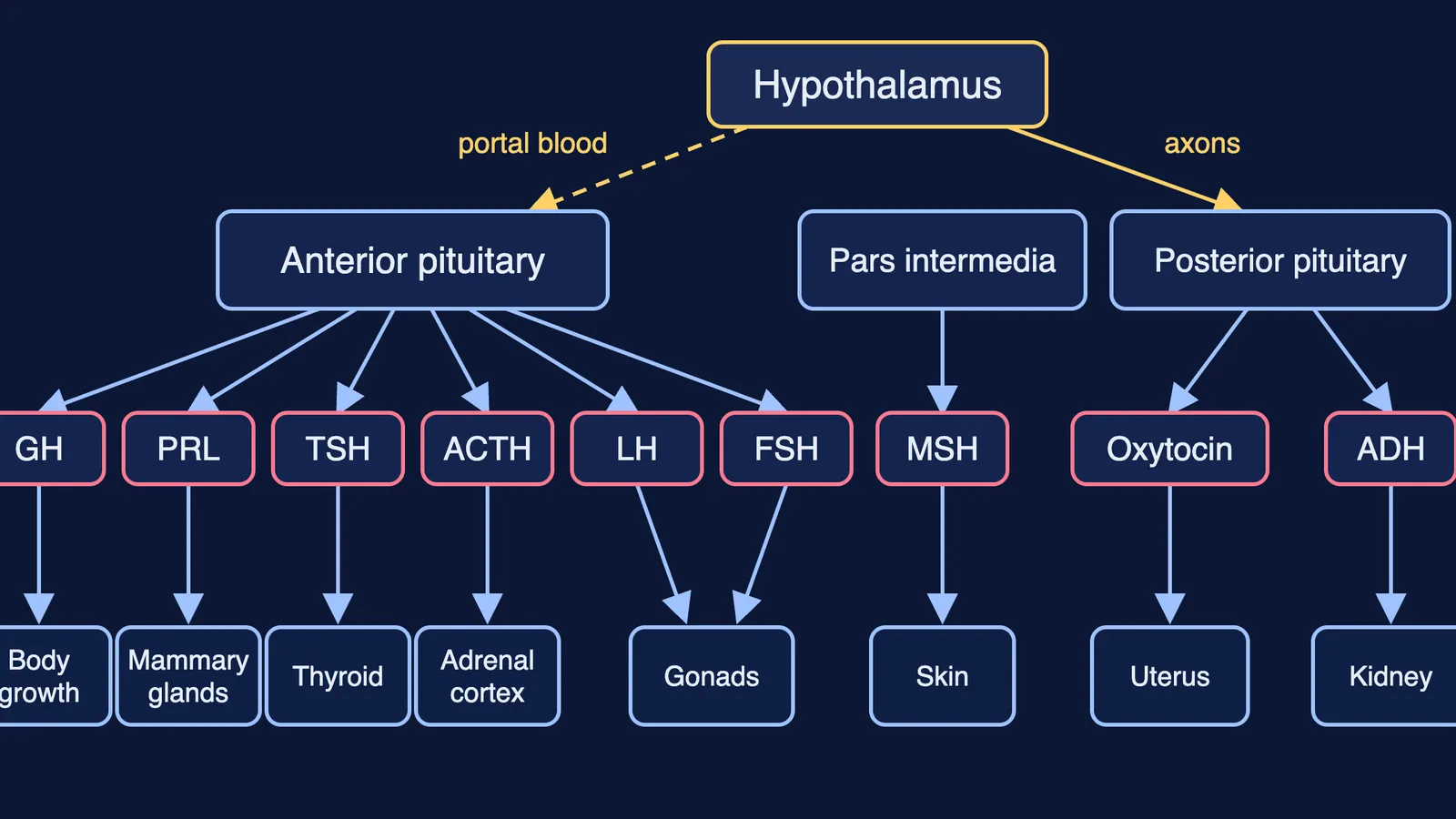
The diagram above shows the control line: hypothalamic hormones reach the anterior pituitary through portal blood, while the posterior pituitary is under direct neural control. The pars intermedia adds a ninth pituitary hormone, MSH.
Which gland makes which hormone? (gland, hormone, function, disorder)
Learn each line as one unit, from the NCERT chapter.
Hypothalamus: releasing hormones such as GnRH and inhibiting hormones such as somatostatin control the pituitary.
Anterior pituitary (pars distalis): GH, PRL, TSH, ACTH, LH and FSH. Excess GH causes gigantism, or acromegaly in adults; too little causes pituitary dwarfism.
Pars intermedia: MSH, which regulates skin pigmentation.
Posterior pituitary: stores and releases oxytocin (uterine contraction, milk ejection) and vasopressin, or ADH (water reabsorption in the distal tubules). Impaired ADH causes diabetes insipidus.
Pineal: melatonin sets the 24-hour (diurnal) rhythm, such as the sleep-wake cycle.
Thyroid: T4 and T3 regulate the basal metabolic rate; thyrocalcitonin (TCT) regulates blood calcium. Iodine deficiency causes goitre; hypothyroidism in pregnancy causes cretinism; exophthalmic goitre (Graves' disease) is a form of hyperthyroidism.
Parathyroid (four glands): PTH raises blood Ca2+, so it is hypercalcemic.
Thymus: thymosins help T-lymphocytes differentiate.
Adrenal medulla: adrenaline and noradrenaline, the fight-or-flight hormones.
Adrenal cortex: cortisol (main glucocorticoid) and aldosterone (main mineralocorticoid). Underproduction causes Addison's disease.
Pancreas (Islets of Langerhans): α-cells make glucagon (raises blood glucose); β-cells make insulin (lowers it). Prolonged hyperglycemia leads to diabetes mellitus.
Testis: Leydig cells make androgens, mainly testosterone.
Ovary: estrogen from growing follicles; progesterone from the corpus luteum.
Heart, kidney, gut: ANF lowers blood pressure; erythropoietin stimulates RBC formation; gastrin, secretin, CCK and GIP regulate digestion.
How do hormones act on target cells?
Each hormone binds its own specific receptor. Protein and peptide hormones bind membrane receptors and work through second messengers such as cyclic AMP, IP3 and Ca++. Steroids and iodothyronines bind intracellular receptors and mostly regulate gene expression. Revise membranes and the nucleus in Cell: The Unit of Life for Class 11.
What practice questions should you try?
Mark labels are our suggestion; formats follow the Class XII Biology sample paper for 2026-27, as no Class XI paper is published.
(1 mark) Name the kidney cells that secrete erythropoietin.
(1 mark) Which gut hormone acts on both the pancreas and the gall bladder?
(2 marks) A classmate draws nerve fibres from the hypothalamus to the anterior pituitary. Correct this.
(2 marks) A hormone acts through a receptor in the nucleus and changes gene expression. Is it cortisol or glucagon? Give one reason.
(3 marks) Which pancreatic hormone raises a low blood glucose level, and which lowers a high one? Give the cell type and one liver action of each.
(3 marks) For acromegaly, Addison's disease and exophthalmic goitre, name the gland and say whether it is over- or under-active.
(5 marks) Describe the adrenal gland's two regions with their hormones and two actions of each.
Answers: 1. Juxtaglomerular cells. 2. CCK. 3. Hypothalamic hormones reach it through portal circulation; the nerve route serves the posterior pituitary. 4. Cortisol; steroids bind intracellular receptors. 5. Low: glucagon, α-cells, glycogenolysis; high: insulin, β-cells, glycogenesis. 6. Pituitary, over (GH in adults); adrenal cortex, under; thyroid, over. 7. Medulla: adrenaline, noradrenaline, which raise heart rate and break down glycogen; cortex: cortisol (gluconeogenesis, anti-inflammatory) and aldosterone (Na+ and water reabsorption, K+ excretion).
How should you revise this chapter?
Redraw the diagram above from memory, then recite the gland list. For a labelled body sketch, see the location of endocrine glands. Preparing for NEET too? Read Human Physiology for NEET.
Stuck? Fermi's AI tutor works out what you already know and builds a plan for the session, so you start from the gap.