On this page
These three original cases practise Chapter 2 of the new NCERT Class 9 Science book, Exploration: "Cell: The Building Block of Life". Each passage uses only ideas the NCERT chapter teaches: microscopes and cell size, osmosis and the cell wall, and cell division. Try each part before reading the answers. New to the chapter? Start with our Cell Class 9 chapter guide.
Case 1: How big is a garlic peel cell?
Ishita, a Class 9 student in Nagpur, peels the thin inner skin from a garlic clove, stains it and puts it under her school microscope. First she places a transparent ruler on the stage and finds that the circular field of view is 4 mm across. She replaces the ruler with the garlic slide and counts 16 cells lying in one straight line across the field. The microscope has a 15X eyepiece and a 10X objective. Her lab partner Kabir then switches to the 40X objective and measures the new field of view as 1 mm across.
(i) What is 4 mm in micrometres? (a) 40 µm (b) 400 µm (c) 4,000 µm (d) 40,000 µm
(ii) Estimate the size of one garlic peel cell.
(iii) Find the total magnification Ishita used and how large one cell appears through the eyepiece.
(iv) How many cells should Kabir see across the field at 40X? Why will neither of them see ribosomes?
Answers.
(i) (c). 1 mm = 1,000 µm, so 4 mm = 4 × 1,000 = 4,000 µm.
(ii) Cell size = field diameter ÷ number of cells = 4,000 µm ÷ 16 = 250 µm.
(iii) Total magnification = eyepiece × objective = 15 × 10 = 150X. The cell appears 250 µm × 150 = 37,500 µm, or 37.5 mm across.
(iv) 1,000 µm ÷ 250 µm = 4 cells. Ribosomes are far smaller than the finest detail a light microscope can resolve; NCERT places them in the electron-microscope range, which uses a beam of electrons instead of light.
Case 2: Why does salted cucumber go limp?
A cook in a Chennai canteen slices 200 g of cucumber for a salad and sprinkles salt over it. Twenty minutes later a pool of water has collected in the bowl, and the drained slices weigh 174 g. The slices feel soft, yet under a microscope each cucumber cell keeps its outline. Next to her, a vegetable seller has a bunch of wilted coriander weighing 40 g. He stands the stems in a jug of plain water, and an hour later the bunch is crisp again and weighs 46 g.
(i) Compared with the cucumber cells, the salty film on the slices is: (a) isotonic (b) hypotonic (c) hypertonic (d) neutral
(ii) What percentage of its mass did the cucumber lose?
(iii) The cells lost water but kept their outline. Which structure explains this, and what happens inside the cell?
(iv) Explain, using the vacuole, why the coriander became firm again, and find its percentage gain in mass.
Answers.
(i) (c). The solution outside has more solute than the cell contents, so it is hypertonic and water leaves the cells by osmosis.
(ii) Loss = 200 − 174 = 26 g. Percentage = 26 ÷ 200 × 100 = 13%.
(iii) The rigid cell wall. It is permeable, so water leaves, but it holds its shape while the cell membrane and its contents pull away from it and shrink inward.
(iv) Plain water is hypotonic to the cells, so water enters by osmosis and fills the large central vacuole. The full vacuole builds pressure that makes the cells firm. Gain = 46 − 40 = 6 g, and 6 ÷ 40 × 100 = 15%.
Case 3: How fast does a cell culture fill a dish?
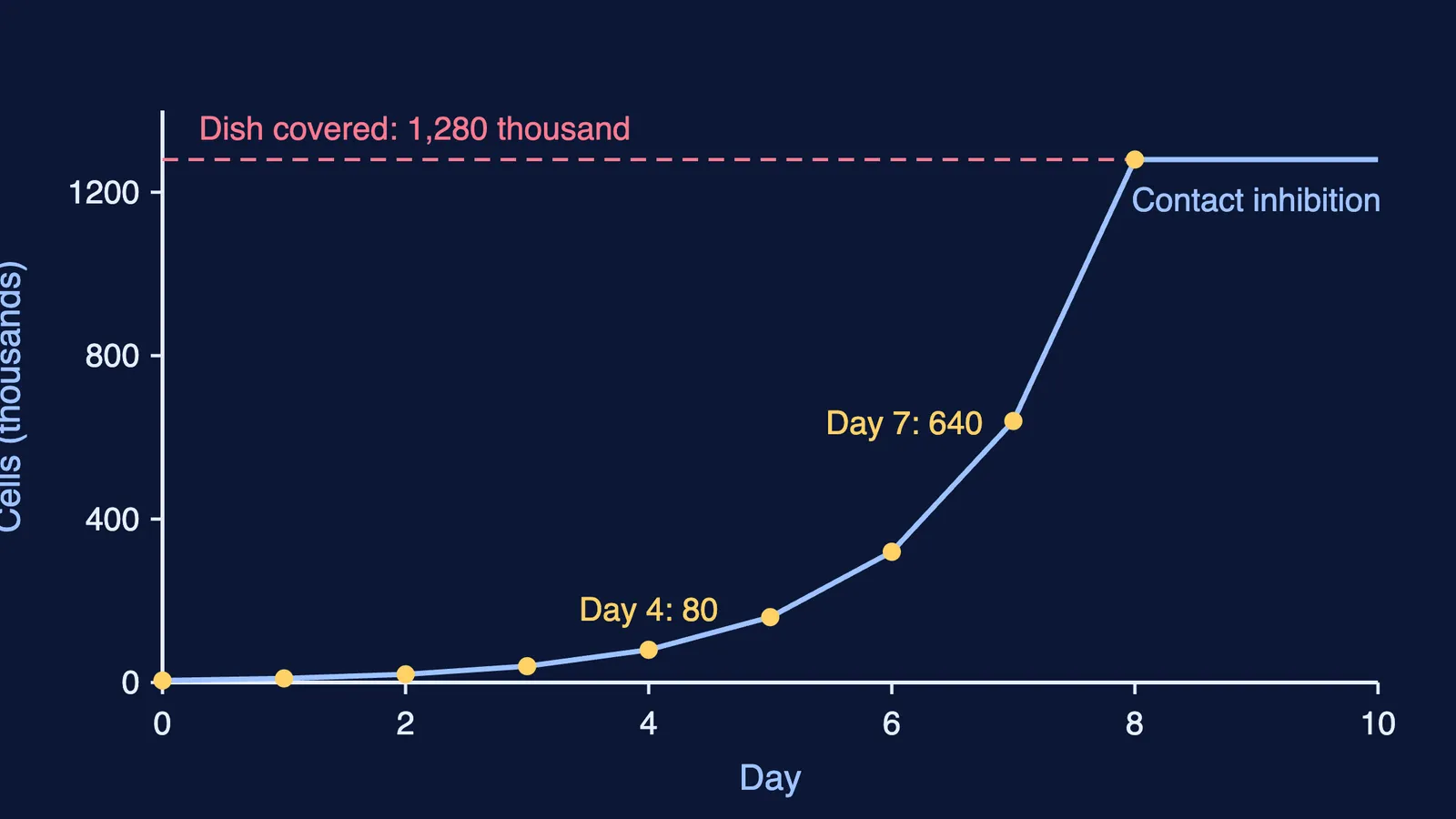
A Bengaluru lab grows skin cells in culture: a sterile, nutrient-rich medium at the right temperature, acidity and moisture. A technician seeds a dish with 5,000 cells. In these conditions each cell divides once every 24 hours, and every new cell is genetically identical to its parent. When the dish surface is fully covered, at about 1,280,000 cells, the cells stop dividing. In a second dish, cells taken from a tumour keep dividing after the surface is covered and pile up in layers.
(i) Which type of cell division increases the number of cells in the first dish? (a) Meiosis (b) Mitosis (c) Both (d) Neither
(ii) How many cells are in the first dish after 4 days?
(iii) On which day is the dish covered? Name the process that stops division then, and say what the tumour cells have lost.
(iv) An intern suggests using meiosis instead, "because one cell gives four". Give two reasons from the chapter why this would not work.
Answers.
(i) (b). Mitosis produces two genetically identical daughter cells and is the division used for growth and repair.
(ii) The number doubles each day: 5,000 × 2⁴ = 5,000 × 16 = 80,000 cells.
(iii) 1,280,000 ÷ 5,000 = 256 = 2⁸, so the dish is covered on day 8. Division stops by contact inhibition, when cells touch their neighbours. The tumour cells have lost this control, which is how tumours form.
(iv) Meiosis occurs only in cells of reproductive organs, to make gametes. Its four daughter cells have half the number of chromosomes and are not identical to the parent, so they could not replace skin cells.
How to attack case-study questions
Convert units before you divide. Field of view in mm becomes µm first (1 mm = 1,000 µm).
Write the formula, then the numbers. "Cell size = field diameter ÷ number of cells" shows your method even if the arithmetic slips.
Compare solute, not water, when naming solutions. More solute outside means hypertonic; less means hypotonic.
Separate cell wall from cell membrane. The wall is rigid and permeable; the membrane is selectively permeable.
For division, ask "identical or half?" Mitosis gives two identical cells; meiosis gives four cells with half the chromosomes.
To check any word you meet in a case, use our Cell Class 9 key terms, and for a step-by-step method that works in every subject, read how to answer case-based questions. If one idea, such as osmosis, still feels slippery, the Fermi Concept Library has every concept in physics, chemistry, biology, mathematics and computing, each with its own lesson.