On this page
If you are in Class 9 in 2026-27, your science book is the new NCERT textbook Exploration (first edition, April 2026), and its second chapter is "Cell: The Building Block of Life" (NCERT contents and imprint page). Here is how the new chapter is built, with a worked size estimate and the usual mistakes.
What is in Cell: The Building Block of Life class 9?
The chapter runs from page 8 to page 27 and moves in five steps:
How to study cells (2.1). The eye's limit of resolution is about 0.1 mm at 25 cm, so cells need a microscope. Robert Hooke first saw cork cells in 1665. You also estimate a cell's real size yourself.
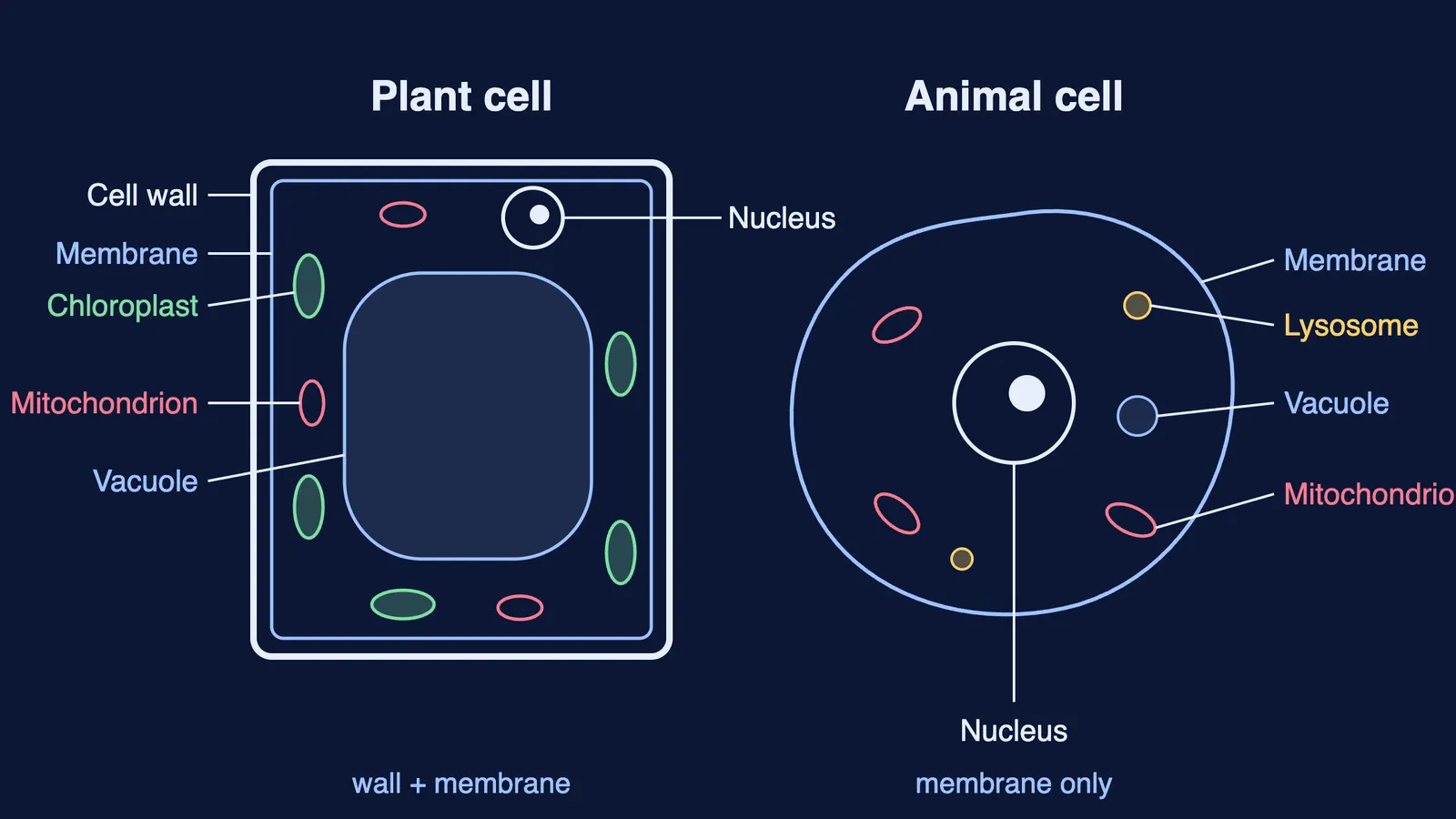
Structure of a cell (2.2). The cell membrane is selectively permeable and about 7 to 10 nm thick, described by the fluid-mosaic model. Potato pieces in water and in 20 per cent salt or sugar solution show osmosis. The cell wall is rigid but permeable.
The cell interior (2.3). Prokaryotic versus eukaryotic cells, then the nucleus, ribosomes, ER, Golgi apparatus, lysosomes, mitochondria, plastids and vacuoles.
How cells grow and divide (2.4). An onion root-tip squash, then mitosis (two identical daughter cells) and meiosis (four cells with half the chromosomes).
Cell theory (2.5). Schleiden (1838), Schwann (1839) and Virchow (1855), plus contact inhibition and why cancer cells keep dividing.
Boxes add context: the Puga Valley hot springs in Ladakh, botanist Arun Kumar Sharma's chromosome work, and Craig Venter's 2010 bacterium with a lab-made genome, where only the DNA was synthetic.
How many marks is the cell chapter in CBSE 2026-27?
CBSE does not give marks per chapter. The CBSE Class IX Science curriculum for 2026-27 puts Chapter 2 in Unit I, World of Living, with Chapters 3, 11 and 12; that unit carries 27 of the 80 theory marks. The same document gives the cell 12 teaching periods and splits the paper into 50 per cent knowledge, 30 per cent application and 20 per cent formulating, analysing, evaluating and creating. Practical 4 on the list is a stained temporary mount of onion peel or Rhoeo leaf and of cheek cells, so drawing and labelling count too; our guide to recording and drawing Class 9 science practicals covers that part.
How do you estimate the size of a cell under a microscope?
Activity 2.1 in the chapter divides the width of the field of view by the number of cells lined up across it. Try it with different, illustrative numbers:
Field of view across the eyepiece: 4.5 mm, which is 4,500 µm (1 mm = 1,000 µm).
Onion peel cells counted along that diameter: 30.
Size of one cell = 4,500 µm / 30 = 150 µm.
A field that wide goes with a low-power lens: with a 10X eyepiece and a 4X objective, total magnification is 10 × 4 = 40X, so the cell looks 40 times larger. Measure and count with the same objective; at 40X objective (400X total) the field shrinks to roughly a tenth, under 0.5 mm.
Compare the membrane: the book gives a thickness of 7 to 10 nm, and our illustrative 150 µm cell is 150,000 nm wide, so it is roughly 15,000 to 21,000 times wider than its membrane is thick (150,000 ÷ 10 and 150,000 ÷ 7).
Why do plant cells not shrink in sugar solution?
The membrane lets water through but not the dissolved sugar or salt, so water moves towards the more concentrated side. Use the outside solution as your reference:
Hypotonic outside (less solute than the cell): water enters, the cell swells.
Isotonic outside: no net change.
Hypertonic outside (more solute): water leaves. A cheek cell shrinks. In a Rhoeo or onion cell the contents shrink and the membrane pulls away from the wall, but the wall keeps the cell's shape.
The same idea explains why salt draws water out of a salad.
What mistakes cost marks in this chapter?
Calling the cell wall selectively permeable. In this chapter the membrane is selectively permeable; the wall is permeable.
Saying solute moves in osmosis. Osmosis is water crossing a selectively permeable membrane; diffusion is any net movement from higher to lower concentration.
Mixing up the counts: mitosis gives two identical cells, meiosis gives four with half the chromosomes.
Forgetting that bacteria have ribosomes and a nucleoid but no membrane-bound nucleus or organelles.
Saying Venter's team made life from scratch. Only the DNA was made in the lab.
For quick revision, keep our one-line list of cell organelles and their functions next to Fig. 2.10. If an organelle's job still feels like a word to memorise, the Fermi Concept Library covers every concept in physics, chemistry, biology, mathematics and computing, each with its own lesson and its place in the map.