On this page
You toss a bowl of kachumber with salt, leave it while the rotis are made, and come back to a pool of juice at the bottom. Most of that water came out of the vegetable cells, pulled by the salt. This is osmosis from Class 9 cell biology, and you can time it on your kitchen counter.
Why does salad release water after adding salt?
USDA FoodData Central lists raw cucumber with peel at 95.23 g of water per 100 g and raw onion at 89.11 g of water per 100 g. Most of that water sits inside living cells, much of it in each cell's large central vacuole.
Each cell is wrapped in a membrane that lets water through easily but holds back most dissolved substances. Osmosis is "the movement of free water molecules through a semipermeable membrane according to the water's concentration gradient across the membrane", as the OpenStax Biology 2e chapter on passive transport defines it.
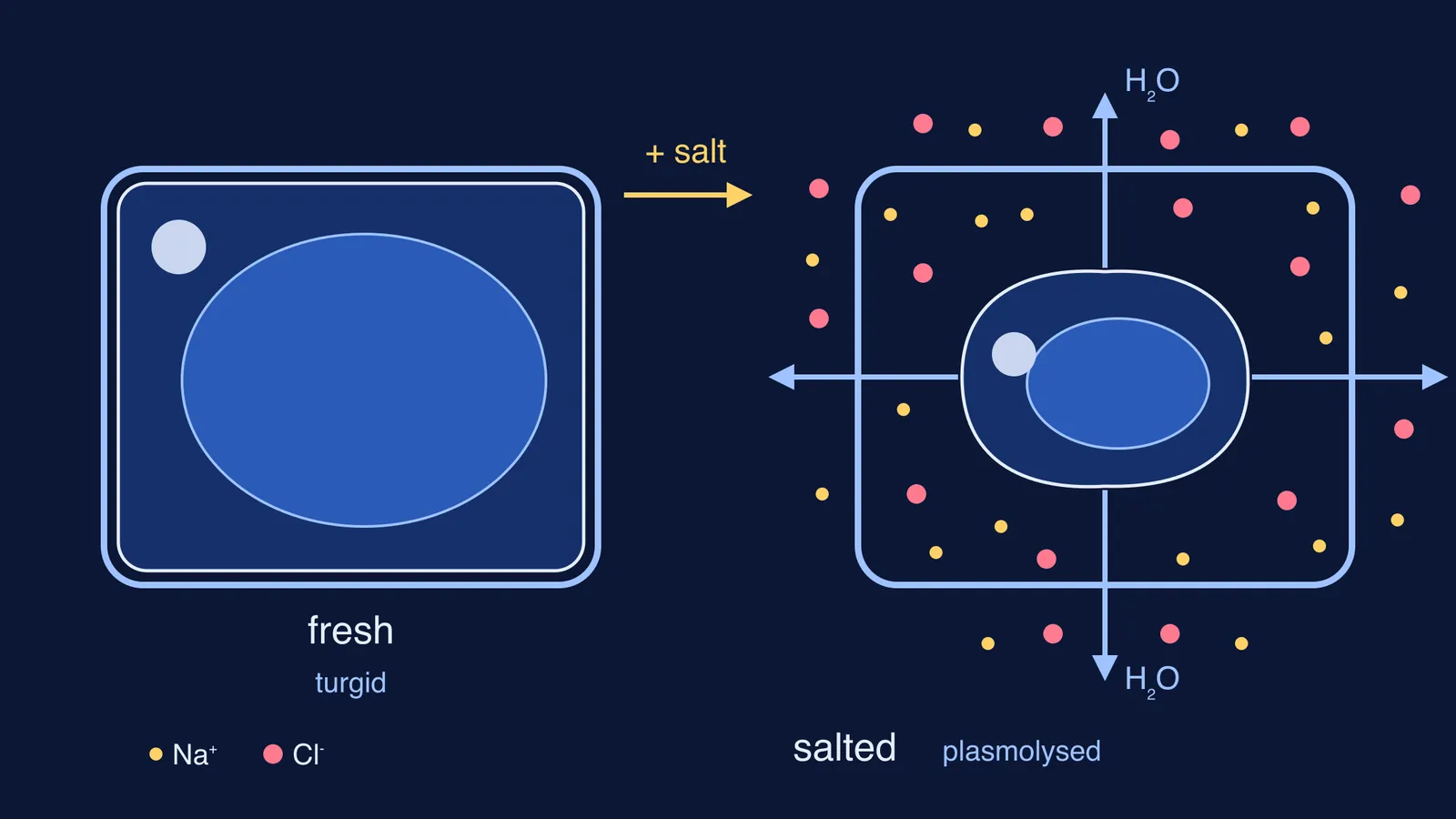
When you sprinkle salt, the crystals dissolve in the thin film of juice on each cut surface and turn it into a strong brine. That liquid is now hypertonic, which OpenStax describes as having a higher osmolarity than the cell's cytoplasm. Water moves out of the cells towards the saltier side and runs down to the bottom of the bowl, where it dissolves more salt and keeps the pull going.
What happens inside a cucumber cell?
A plant cell has a stiff wall outside its membrane. When water leaves, the wall keeps its shape but the living part shrinks. In hypertonic conditions, according to OpenStax, the membrane detaches from the wall and squeezes the cytoplasm inwards: plasmolysis. The lost turgor pressure is also why plants wilt, and why salted cucumber bends instead of snapping. For the firm-cell side of the story, read our explainer on turgor pressure and why plants wilt, and to watch plasmolysis under a microscope, try the Rhoeo leaf peel plasmolysis practical.
One caveat: some juice comes from cells broken during slicing, salt or no salt. The unsalted control bowl below shows how much.
This is syllabus, not just kitchen lore. CBSE's 2026-27 Class 10 science curriculum says Science in Grades 9 to 10 is taught using an integrated approach, and its competencies include explaining the role of cell parts "including the semi-permeability of cell membrane".
How can you time it at home?
You need one cucumber, one onion, salt, three identical bowls, a teaspoon, a phone timer and, if possible, a kitchen scale.
Cut the cucumber into rounds of equal thickness and split them into two equal heaps (100 g each if you can weigh).
Bowl A: cucumber, no salt. This is your control.
Bowl B: cucumber tossed with half a level teaspoon of salt.
Bowl C: the same weight of sliced onion with the same salt.
Write down which bowl you expect to give the most liquid by 10 minutes.
At 5, 10, 20 and 30 minutes, pour each bowl's liquid into a small cup on the scale (or count teaspoons) and record the running total.
At the end, bend one slice from A and one from B. Which snaps?
If osmosis is the main cause, bowl B should give clearly more liquid than A, and its slices should go limp. If A and B are about the same, the juice is mostly from cut cells.
How much of the cucumber's water comes out?
Say bowl B started with 100 g of cucumber and gave 9 g of liquid by 30 minutes, while bowl A gave 1 g. These are made-up numbers to show the method. By the USDA FoodData Central figure, 100 g of raw cucumber holds about 95 g of water. The extra liquid due to salt is 9 − 1 = 8 g, so about 8 ÷ 95 ≈ 8% of the cucumber's water left in half an hour. The liquid carries some dissolved salt too, so treat this as an overestimate.
If the direction of water flow keeps flipping in your head, the Fermi Simulation Lab has interactive simulations for ideas that are easier to see than to read. The Fermi Concept Library gives each biology concept its own lesson and its place in the map.
How do you stop salad going watery?
Add salt just before serving, not when you chop.
For raita or sandwiches, salt the cucumber first, let it stand, then squeeze or drain off the liquid. Your own timings from the experiment tell you how long to wait.
Keep salt and dressing on the side so everyone adds their own.
Cut thicker pieces: less cut surface for their weight should mean slower water loss. Test it with a fourth bowl.
To measure osmosis with numbers rather than juice, try the potato osmosis experiment with weighed strips in salt and plain water.