On this page
Chapter 2 of the new Class 9 science book Exploration (first edition, 2026) is "Cell: The Building Block of Life" (NCERT contents page). Here are its key terms from the chapter text. For the chapter's layout and a worked size estimate, see our Class 9 Cell chapter guide.
How do we study cells that are too small to see?
Cell: the basic unit of life; every living thing has one or more (NCERT, Ch. 2). Robert Hooke named the boxes he saw in cork "cells" in 1665.
Unicellular and multicellular: one cell (bacteria, yeast) versus many cells working together (a fish, a neem tree).
Limit of resolution: the smallest gap at which two points can still be seen as two. For the human eye it is about 0.1 mm at 25 cm, which is why most cells need a microscope (NCERT, Ch. 2).
Magnification: how many times larger an object looks. Total magnification is the eyepiece power multiplied by the objective power, so 10X with 10X gives 100X. Don't confuse with: resolution, the clarity that separates two close details.
Electron microscope: uses a beam of electrons instead of light, showing nanometre-scale detail.
What controls what enters and leaves a cell?
Cell membrane (plasma membrane): the thin outer boundary of every cell, about 7 to 10 nm thick and made of lipids and proteins (NCERT, Ch. 2).
Selectively permeable: lets some substances through and blocks others. Example: in the chapter's potato activity, water crosses it but salt does not.
Fluid-mosaic model: the membrane pictured as a lipid bilayer with proteins embedded in it, arranged like tiles in a mosaic; its molecules can move sideways, flip and rotate, so it is fluid.
Diffusion: particles spreading from where they are more concentrated to where they are less concentrated; it happens with or without a membrane. Example: a drop of dye spreading through water.
Osmosis: water diffusing through a selectively permeable membrane, from the more dilute side to the more concentrated side. Example: a potato piece swells in plain water and shrinks in 20 per cent salt solution. Don't confuse with: diffusion, which needs no membrane.
Hypotonic, isotonic, hypertonic: compare the outside solution with the cell. Hypotonic has less solute (water enters, cell swells), isotonic is equal (no net change), hypertonic has more (water leaves, cell shrinks).
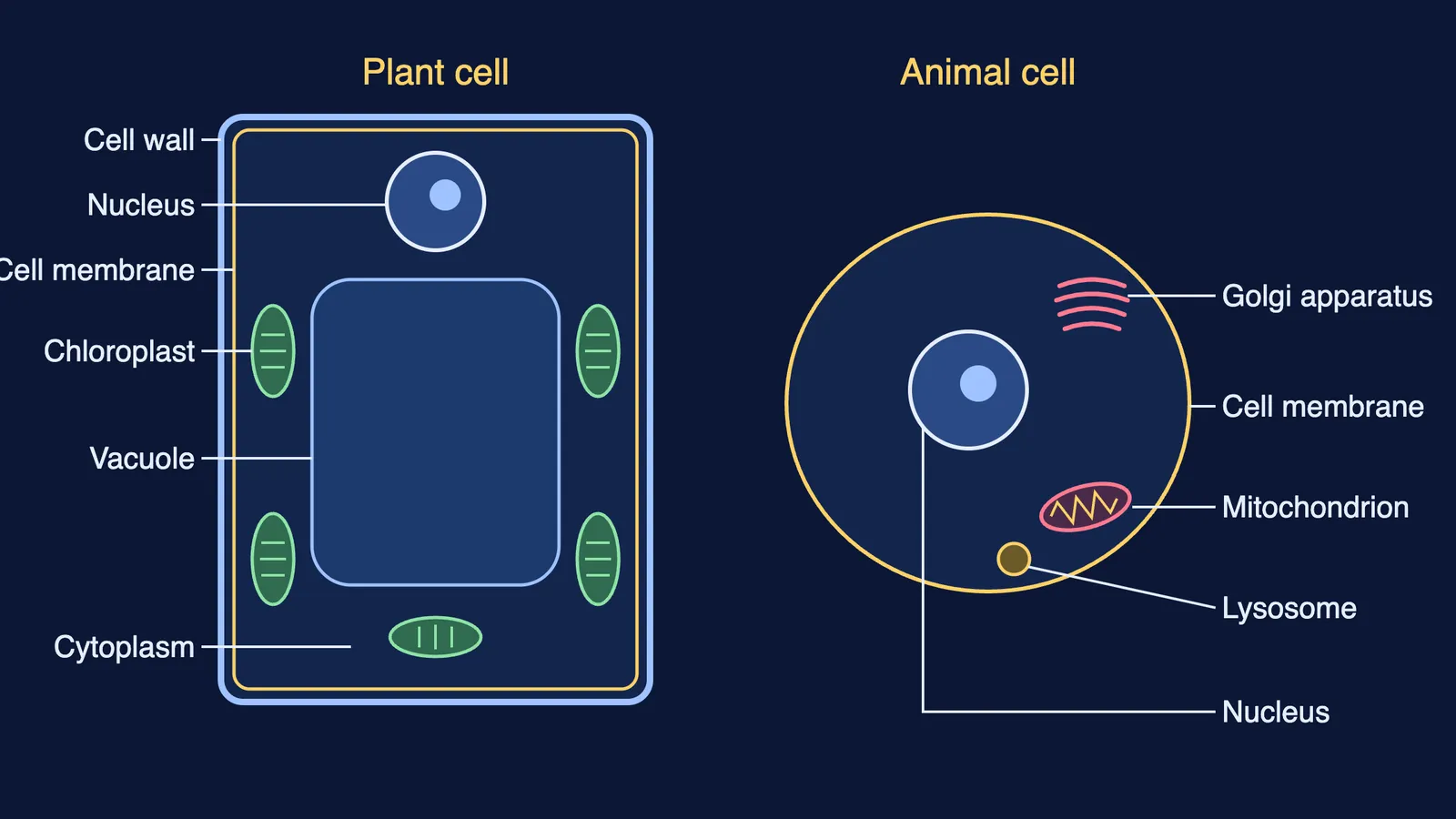
Cell wall: a rigid layer outside the membrane in plants, fungi and bacteria that keeps shape and gives support. Don't confuse with: the membrane. The wall is permeable; the membrane is selectively permeable.
Cellulose: the carbohydrate of linked glucose units that makes up the plant cell wall; in food it is roughage.
Prokaryotic or eukaryotic: what is the difference?
Cytoplasm: the semi-fluid, jelly-like material inside the membrane; in eukaryotic cells it holds the organelles.
Organelle: a structure inside a cell with a specific job.
Prokaryotic cell: a cell with no well-defined nucleus and no membrane-bound organelles, typically 1 to 10 µm across (NCERT, Ch. 2). Example: a bacterium.
Eukaryotic cell: a cell with a membrane-bound nucleus and membrane-bound organelles, typically 10 to 100 µm. Example: onion peel and cheek cells.
Nucleoid: the region of a prokaryotic cell holding its single circular DNA, with no membrane around it. Don't confuse with: the nucleus, which has a double membrane.
What does each organelle do?
Nucleus: holds the cell's coded instructions inside a double nuclear membrane with pores.
Nucleolus: a dense, rounded region of the nucleus that builds the two subunits of ribosomes.
DNA and gene: DNA is the molecule carrying genetic information; a gene is a functional segment of DNA.
Chromatin and chromosome: the same DNA-and-protein material. Chromatin is a tangle of threads; before division it packs into rod-shaped chromosomes.
Ribosome: a tiny structure where proteins are made, free in the cytoplasm or attached to the ER.
Endoplasmic reticulum (ER): a membrane network that makes and carries proteins and lipids. Don't confuse RER (ribosomes attached, proteins) with SER (no ribosomes, fats and hormones).
Golgi apparatus: stacks of flattened sacs that receive proteins and lipids, change and sort them, and send them off in small vesicles.
Lysosome: a sac of enzymes that breaks down waste and worn-out cell parts.
Mitochondrion: a double-membrane organelle where cellular respiration releases energy from glucose, stored as ATP. Its inner folds, cristae, add surface area.
Chloroplast: a double-membrane plastid with green chlorophyll that captures light for photosynthesis; its fluid is the stroma. Don't confuse with: chromoplast, a plastid with yellow, orange or red pigments in petals and fruits.
Leucoplast: a colourless plastid that stores food. Example: starch in potato cells.
Vacuole: a sac of cell sap storing water, minerals, sugars and waste; a mature plant cell's large central vacuole keeps it firm.
How do cells divide, and what is cell theory?
Mitosis: one cell divides into two daughter cells with the same DNA and chromosome number. Example: skin cells replacing lost cells.
Meiosis: two divisions in a row giving four cells with half the chromosomes each; it takes place only in reproductive organs (testes, ovaries, anthers) and leads to gametes.
Gamete: a sperm or egg; two fuse at fertilisation, restoring the full chromosome number.
Cell theory: all living things are made of cells, the cell is the unit of structure and function, and all cells come from pre-existing cells. It grew from the work of Schleiden (1838), Schwann (1839) and Virchow (1855) (NCERT, Ch. 2).
Contact inhibition: many animal cells stop dividing on touching neighbours; cancer cells lose this control and form tumours.
The chapter leaves the stages of cell division for higher grades.
How to learn these terms
Learn them in pairs. The chapter's Revise, Reflect, Refine questions ask you to tell pairs apart, such as membrane and wall or chloroplast and chromoplast (NCERT, Ch. 2).
Draw, then label. Sketch both cells from memory, label them, then check Fig. 2.10. Our post on drawing biology diagrams from memory is for NEET, but the method works here.
Attach a job to each name, not just a nickname like "post office" for Golgi. See when rote memorising is fine.
If an organelle still feels abstract, the Fermi Concept Library covers every concept in physics, chemistry, biology, mathematics and computing, each with its own lesson and its place in the map.