

On this page
"Don't mug up, understand it." Every JEE and NEET aspirant hears this, usually from someone who also expects them to know the atomic number of every element up to 30. Both pieces of advice are right, for different kinds of material.
Is rote memorisation bad for JEE and NEET?
Not by itself. The trouble starts when memorising is the only thing you do. An OECD analysis of PISA 2012 maths results by Alfonso Echazarra compared 15-year-olds by how they said they studied.
On an easy item that about 87% of students answered correctly, students who used memorisation did about as well as those who used other strategies. On the hardest item, which only 3% of students solved, those who relied mainly on memorisation were much less likely to get it right than students who connected ideas or worked out what was important to learn, the OECD found.
PISA is not an entrance exam, but you may see the same pattern in mock tests: memorised material holds up on direct questions and gives way when familiar ideas appear in an unfamiliar arrangement, as in the harder JEE Advanced and NEET-UG questions.
What should you simply memorise?
Memorise anything that has no reason you could rebuild in the exam hall.
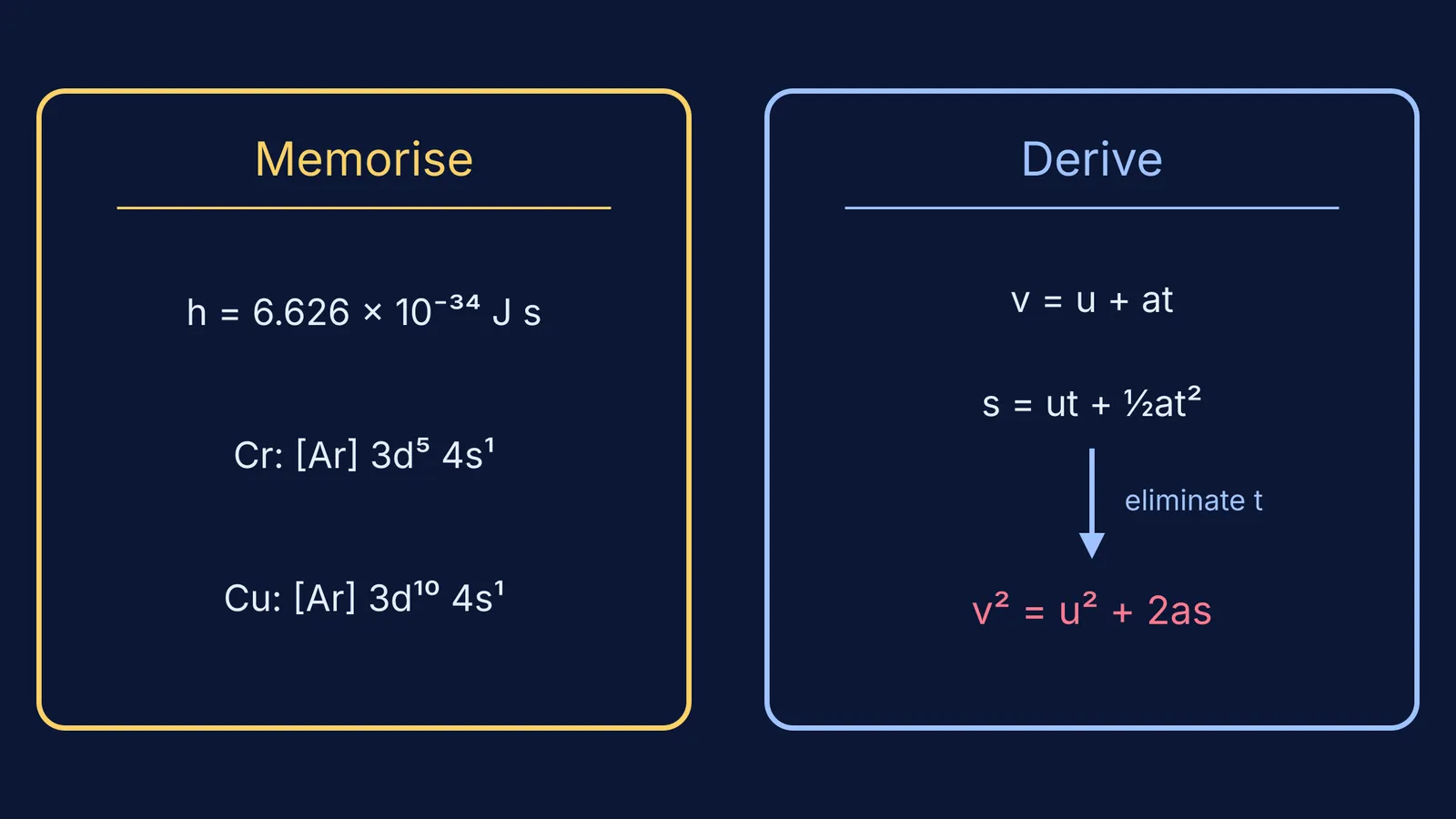
Constants. The Planck constant is exactly 6.626 070 15 × 10⁻³⁴ J Hz⁻¹ (joule-seconds), as NIST lists it. No derivation gives you those digits.
Names and labels. Scientific names, discoverers, diagram labels, reagent names.
Exceptions. Chromium is [Ar]3d⁵ 4s¹ and copper is [Ar]3d¹⁰ 4s¹, per PubChem's periodic table data, not the configurations the filling order predicts. Knowing why helps, but you still have to remember which elements break the rule.
NCERT facts and examples. NEET biology rewards knowing the textbook's own examples. Our guide on how to remember NCERT biology examples for NEET covers ways to make them stick.
Learning these by heart is not lazy. It frees your attention for the reasoning parts of a question.
How do you know if memorising is hiding a missing concept?
Ask three questions about anything you have memorised:
Could I rebuild it from something more basic if I forgot it?
Could I use it in a question I have never seen?
Could I explain, in one or two sentences, why it is true?
For a constant or a name, three "no" answers are fine. For a formula or a method, a "no" means the memory is covering a gap.
Take v² = u² + 2as. Asha has memorised it. Rohan knows it comes from v = u + at and s = ut + ½at²: make t the subject of the first, substitute into the second, and the time drops out. Now a ball is thrown straight up at 20 m/s; how high does it rise? Asha has to remember a sign convention as a separate fact. Rohan sees that a = −g opposes the motion and that v = 0 at the top, so the height is u²/2g, about 20 m. Same formula, but only one of them can bend it to fit the question.
We go deeper in should you memorise derivations or understand them and why memorising physics formulas fails.
How should you memorise the things worth memorising?
Test yourself, and spread the testing out. A review of ten study techniques by Dunlosky and colleagues rated practice testing and distributed practice as high utility, and rereading and highlighting as low utility, even though most students report using them.
In Roediger and Karpicke's 2006 experiments, restudying beat self-testing on a test five minutes later, but testing produced substantially better retention after two days and after one week. Restudying also made students more confident, which may help explain why rereading feels more effective than it is.
Karpicke and Blunt (2011) found that practising retrieval produced greater gains in meaningful learning than studying with concept maps, including on questions that required inferences.
A plan for your next chapter
List everything the chapter asks you to know: constants, names, formulas, reactions, examples.
Mark each item M (memorise: arbitrary), D (derive: has a reason you can rebuild) or ? (not sure why it is true).
Put M items on flashcards. Test yourself the next day, a few days later and the following week.
Rederive D items on a blank page once a week. If you get stuck partway, that step is what to study.
Treat every ? as a concept gap, not a memory problem. The Fermi Concept Library has a lesson for every concept in physics, chemistry, biology and mathematics, so you can fill the gap before going back to practice questions.
For D items that fall apart in problems, the Fermi Problem Library has worked problems with a step-by-step solver that explains the reasoning rather than printing an answer.
Pick one chapter tonight, sort it into M, D and ?, and start with the question marks.


