

On this page
You can explain the water canal system of sponges in your sleep. Then a question asks which animal is a sea lily, every option is a Latin name, and the mark slips away.
Examples are part of the syllabus. The National Medical Commission's NEET-UG 2026 syllabus, released on 22 December 2025, asks students to learn "three to five salient features and at least two examples" for each animal category, non-chordates to phylum level and chordates to class level (Medical Dialogues report on the NMC notice). Details can change yearly, so check the current syllabus on the NMC website.
Why are NCERT biology examples so hard to remember?
They come as lists of names with nothing holding them together. In the Class 11 Animal Kingdom chapter, Mollusca alone comes with eight examples, from Pila (apple snail) to Chaetopleura (chiton) (chapter notes that reproduce the NCERT examples). Read in textbook order, they blur.
A 2013 review of ten study techniques rated rereading and highlighting as low utility, and practice testing and distributed practice as high utility (Dunlosky and colleagues, Psychological Science in the Public Interest).
How do you group NCERT examples by theme?
Group them by the trap: names that sound alike but sit in different phyla. Three groups from Animal Kingdom, using the NCERT examples (chapter notes):
The "sea" names. Sea anemone (Adamsia), sea pen (Pennatula) and sea fan (Gorgonia) are Coelenterata. Sea urchin (Echinus), sea lily (Antedon) and sea cucumber (Cucumaria) are Echinodermata. Sea hare (Aplysia) is a mollusc.
The "fish" that are not fish. Cuttlefish (Sepia) and devilfish (Octopus) are molluscs. Starfish (Asterias) is an echinoderm.
The parasitic worms. Tapeworm (Taenia) and liver fluke (Fasciola) are Platyhelminthes. Roundworm (Ascaris), filaria worm (Wuchereria) and hookworm (Ancylostoma) are Aschelminthes. The blood-sucking leech (Hirudinaria) is an annelid.
Check every name against your own NCERT copy. The same method works for any chapter with long example lists: put look-alike names side by side.
Do stories and silly links actually help?
They can. In a 1969 experiment by Gordon Bower and Michal Clark, people learned 12 lists of 10 unrelated nouns. On the final test, those who wove each list into a story recalled 93% of the words, against 13% for those who simply studied them (averages of median scores, as summarised in a 2026 Evolutionary Psychology paper; original paper).
Keep your story short and tied to one group. For the "sea" names: a diver at the reef swims past a sea anemone, a sea pen and a sea fan, three cousins in one family (Coelenterata). She kneels next to a sea urchin, a sea lily and a sea cucumber, a second family (Echinodermata). A sea hare slides away to join the snails and squids (Mollusca).
Memory tricks have limits. The same 2013 review rated the keyword mnemonic, a related memory trick, as low utility, partly because its benefits appeared limited to some materials and to short retention intervals (Dunlosky and colleagues). The story gets an example into your head; testing helps keep it there.
How should you test examples before each mock?
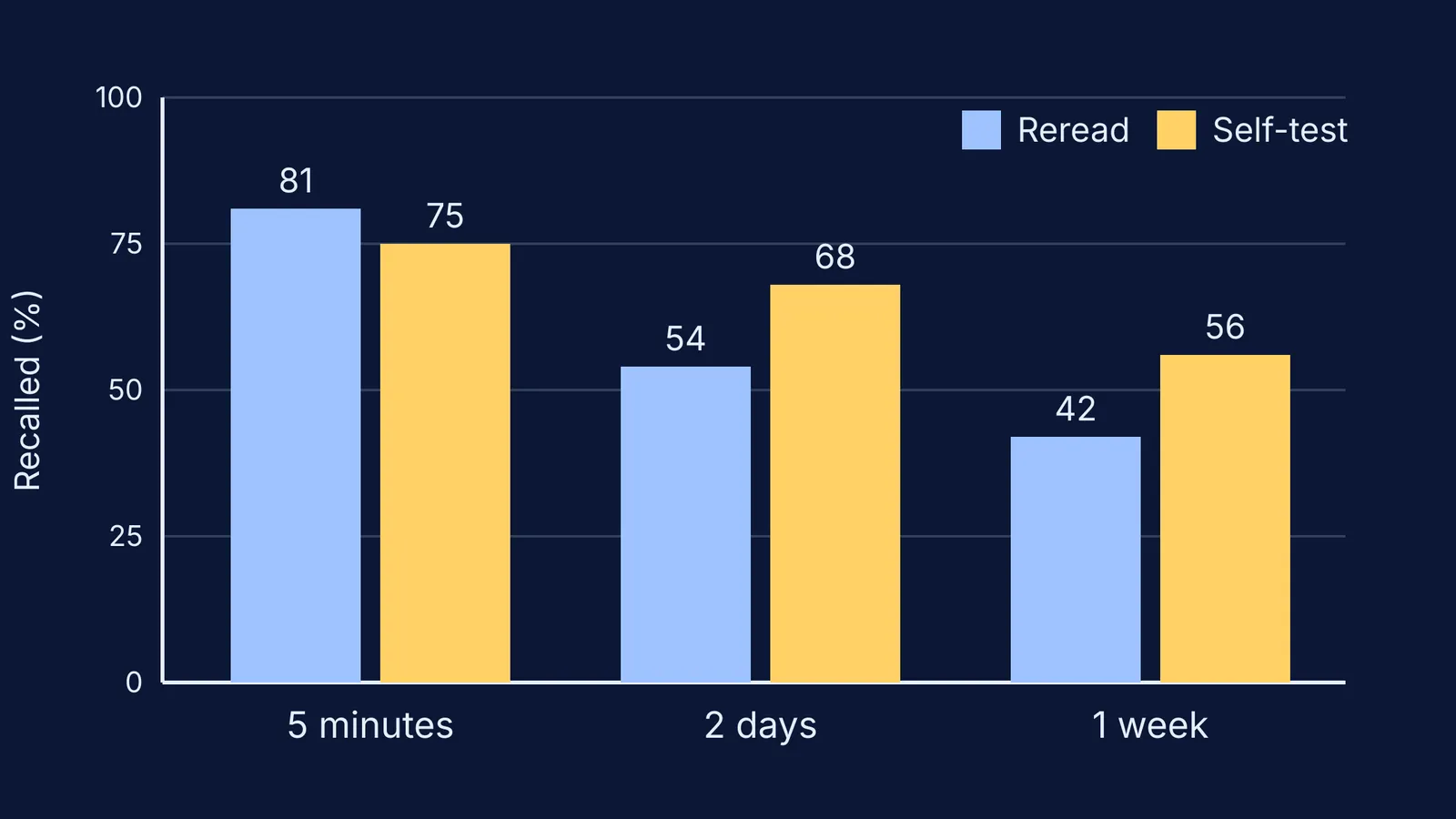
Turn every group into quick cards and quiz yourself instead of rereading. In Roediger and Karpicke's 2006 experiment with 120 university students, those who took a recall test on a passage remembered 56% of it a week later, against 42% for those who restudied it (Psychological Science). Five minutes after studying, rereading looked better (81% against 75%), and the paper reports that repeated studying made students more confident, even though it lost on the delayed tests.
A 15-minute routine for the days before a mock:
Two days before, pull out the example groups for the chapters the mock covers.
Make cards both ways. Front: "Sea lily: genus and phylum?" Back: "Antedon, Echinodermata." Then a second card with "Antedon" on the front.
Go through the deck once, saying or writing each answer before you flip.
Put misses in a separate pile, reread that group's story, and test the pile again.
The day before the mock, run only the miss pile.
After the mock, add a card for every example question you got wrong, with the trap written on the back, such as "not a fish: mollusc".
Spread sessions out rather than cramming; distributed practice was the other technique the 2013 review rated as high utility (Dunlosky and colleagues).
If a card keeps failing because you are unsure what makes a mollusc a mollusc, the gap is the concept. The Fermi Concept Library has a lesson for every concept in biology, so you can fix the features first and give the examples somewhere to land.
Start tonight with one chapter and three groups. If you are not sure which chapter to start with, Fermi's AI tutor can work out what you already know and build a plan for the session.


