

On this page
Before board exams, physics students often hear two opposing pieces of advice: memorise every derivation line by line, or ignore memorisation entirely and rely on intuition.
Both extremes fail. Rote memorisation breaks under exam stress, while vague intuition leaves you stranded halfway through three marks of algebra. The real skill is learning a derivation as a reconstructible chain of four or five key physical moves.
Why does rote memorisation fail during exams?
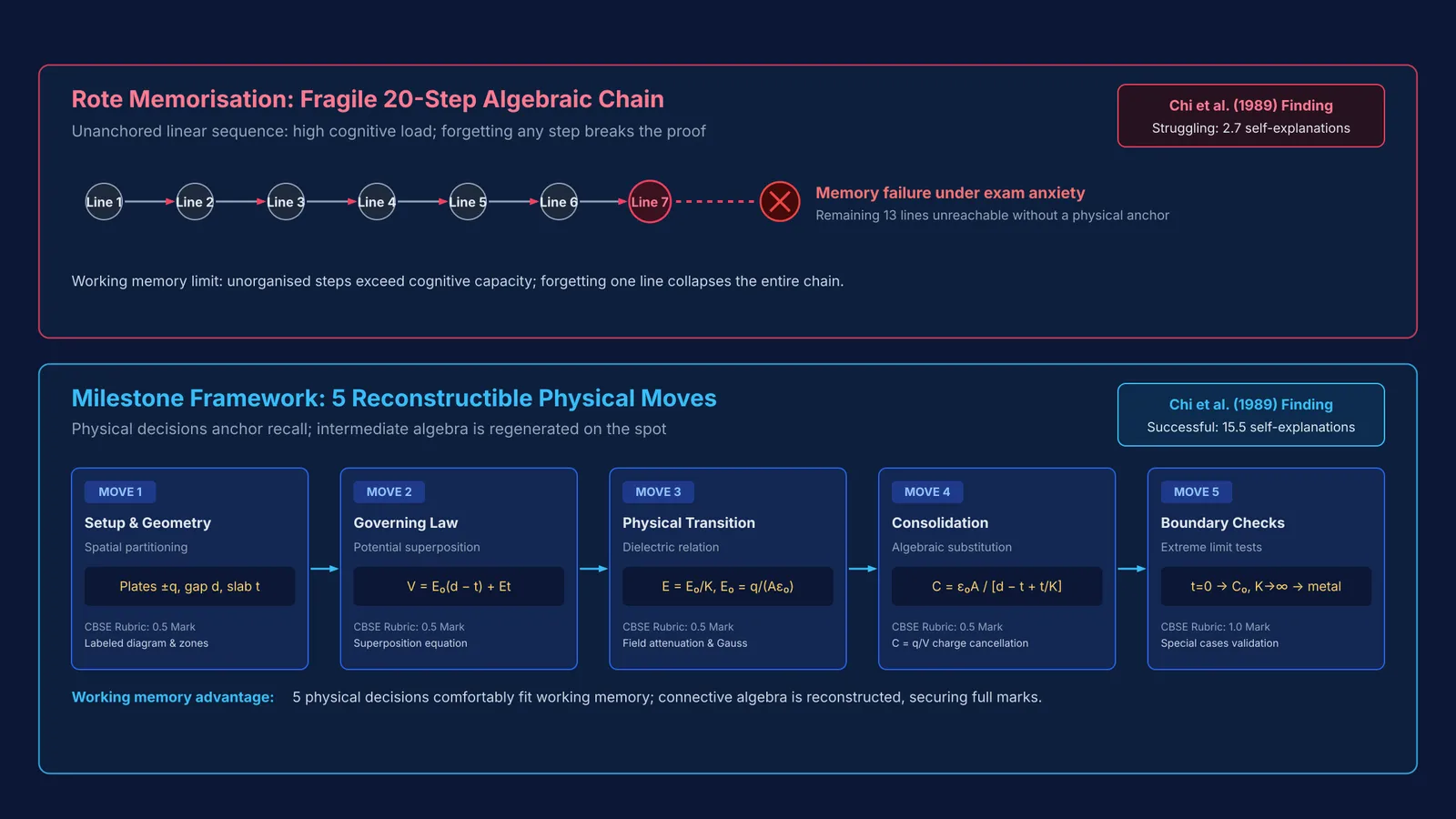
Rote memorisation fails because of how human working memory handles unfamiliar sequences. In a foundational paper on cognitive load theory, educational psychologist John Sweller (Sweller, 1988) showed that conventional problem solving imposes heavy cognitive load on working memory, leaving insufficient capacity to acquire durable schemas. Because human working memory has strictly limited capacity for novel, unorganised information, memorising a derivation as an arbitrary sequence of twenty lines forces each step to compete for scarce processing capacity. Under exam pressure, forgetting step 7 destroys the chain because you lack an underlying structural anchor to rebuild step 8. Understanding these limits is central to Alan Baddeley's working memory model.
A landmark study by Michelene Chi and colleagues (Chi et al., 1989) showed this difference among physics students. High-performing students generated roughly 15.5 self-explanations per worked example compared to only 2.7 for struggling students—nearly six times as many. They also produced 9.3 statements identifying comprehension gaps, compared to 1.1 for struggling peers. Struggling students copied examples as recipes, while successful students linked each mathematical step to physical principles.
Why is pure intuition not enough for board marks?
Relying purely on intuition creates a different trap. Students often understand a concept qualitatively, only to lose marks because they cannot reproduce the exact mathematical proof.
Board exams like CBSE Class 12 evaluate derivations against explicit rubrics. In the official CBSE Class 12 Physics Marking Scheme, a standard 3-mark derivation is partitioned into discrete 0.5-mark and 1-mark criteria: a labeled diagram, stating governing laws, intermediate substitutions, and valid boundary conditions. Relying on intuition alone leads to omitted intermediate steps that cost marks. A guide to how examiners evaluate these steps is in Physics derivations in CBSE boards.
How does the key-moves framework work?
Instead of memorising twenty lines of algebra, you compress the derivation into four or five structural milestones. Each milestone represents a physical decision rather than mechanical calculation:
Setup and geometry: draw the charges or rays, define coordinates, and state assumptions.
Governing physical law: identify the core relation (such as Gauss's law or potential difference) that drives the system.
Physical transition: apply the system's specific conditions (such as dielectric attenuation) to transform the general law.
Algebraic consolidation: substitute expressions to eliminate intermediate variables.
Boundary checks: test the formula against extreme limits where the outcome is known.
What does a five-move derivation look like in practice?
Consider a classic board question: finding the capacitance of a parallel plate capacitor with a dielectric slab of thickness t between plates of separation d (where t < d).
Move 1 (Spatial partitioning): Draw plates of area A with charges +q and −q separated by distance d. A dielectric slab of thickness t and constant K divides space into an air gap of thickness (d − t) and a dielectric slab of thickness t.
Move 2 (Potential superposition): Total potential difference V equals the sum across both zones: V = E₀(d − t) + Et, where E₀ is the field in air and E is the field in the slab.
Move 3 (Dielectric relation and charge link): Polarization reduces the dielectric field to E = E₀/K. By Gauss's law, the vacuum field relates to charge by E₀ = σ/ε₀ = q/(Aε₀).
Move 4 (Algebraic substitution): Substitute E into the potential equation: V = E₀ [ (d − t) + t/K ] = (q / (Aε₀)) [ (d − t) + t/K ].
Move 5 (Capacitance definition and limits): Using C = q/V, charge q cancels: C = ε₀A / [ d − t + t/K ]. If t = 0, C = ε₀A/d (vacuum capacitor); if the slab is metallic (K → ∞), C = ε₀A/(d − t).
How should you practise derivations to rebuild them from memory?
To make derivations second nature, revision must rely on active retrieval. In a review of 10 learning techniques, John Dunlosky and colleagues (Dunlosky et al., 2013) rated practice testing as high utility and passive rereading as low utility, showing that rereading produces an illusion of competence without durable retention. Learn more in Ten study techniques rated: inside the 2013 Dunlosky review.
Use the "skeleton retrieval" protocol when preparing:
Write the five milestone titles on an index card without math.
Put your textbook away and reconstruct the complete proof from the milestone names alone.
If you freeze, peek only at the next milestone title, never at the algebra.
Repeat the derivation after 1 day, 3 days, and 7 days to consolidate recall.
When you get stuck reconstructing a proof, the Fermi Problem Library provides worked problems with a step-by-step solver that explains the reasoning rather than printing an answer. To test whether your underlying physical model holds up across variations, Fermi's AI tutor can work out what you already know, notice where you are stuck, and decide whether to explain, ask or show.


