On this page
Chapter 6 of *Khel Praveen*, the new NCERT Physical Education and Well-being book for Class 9 (First Edition, April 2026), explains why your pulse and breathing jump when you run. It sits in the book's Unit 2, Science and Sports (NCERT Unit 2 PDF). The CBSE 2026-27 Class 9 PEWB curriculum covers how these two body systems respond to exercise under its Unit 3, Sciences and Sports, so the unit numbers differ.
How many marks is the Cardiorespiratory System chapter worth?
This is a school-assessed subject, not a board exam. The CBSE 2026-27 PEWB curriculum sets theory at 20 marks: 2 marks × 8 units = 16 (MCQ, objective or short answer), plus a 4-mark viva; practicals carry 80. The 2 unit marks are shared with bones, muscles and growth, so this chapter has no separate figure.
What is the difference between breathing and respiration?
Breathing (ventilation) is mechanical: air moves in and out using the lungs, chest muscles and diaphragm.
Respiration is chemical, inside cells: oxygen helps release energy from food, leaving carbon dioxide and water.
At rest, the diaphragm is the main breathing muscle, helped by the intercostal muscles. Breathing in, it tightens and moves down so the lungs can fill; breathing out is mostly recoil. In hard breathing, the abdominal muscles help push air out.
The book names three types of respiration:
External respiration: in the alveoli of the lungs, oxygen diffuses into the blood and carbon dioxide diffuses out, each moving from higher to lower concentration.
Internal respiration: in the tissues, oxygen leaves the blood for the cells and carbon dioxide travels the other way.
Cellular respiration: in the mitochondria, glucose is broken down with oxygen to make ATP (adenosine triphosphate), which powers muscle work.
How does blood travel through the heart and body?
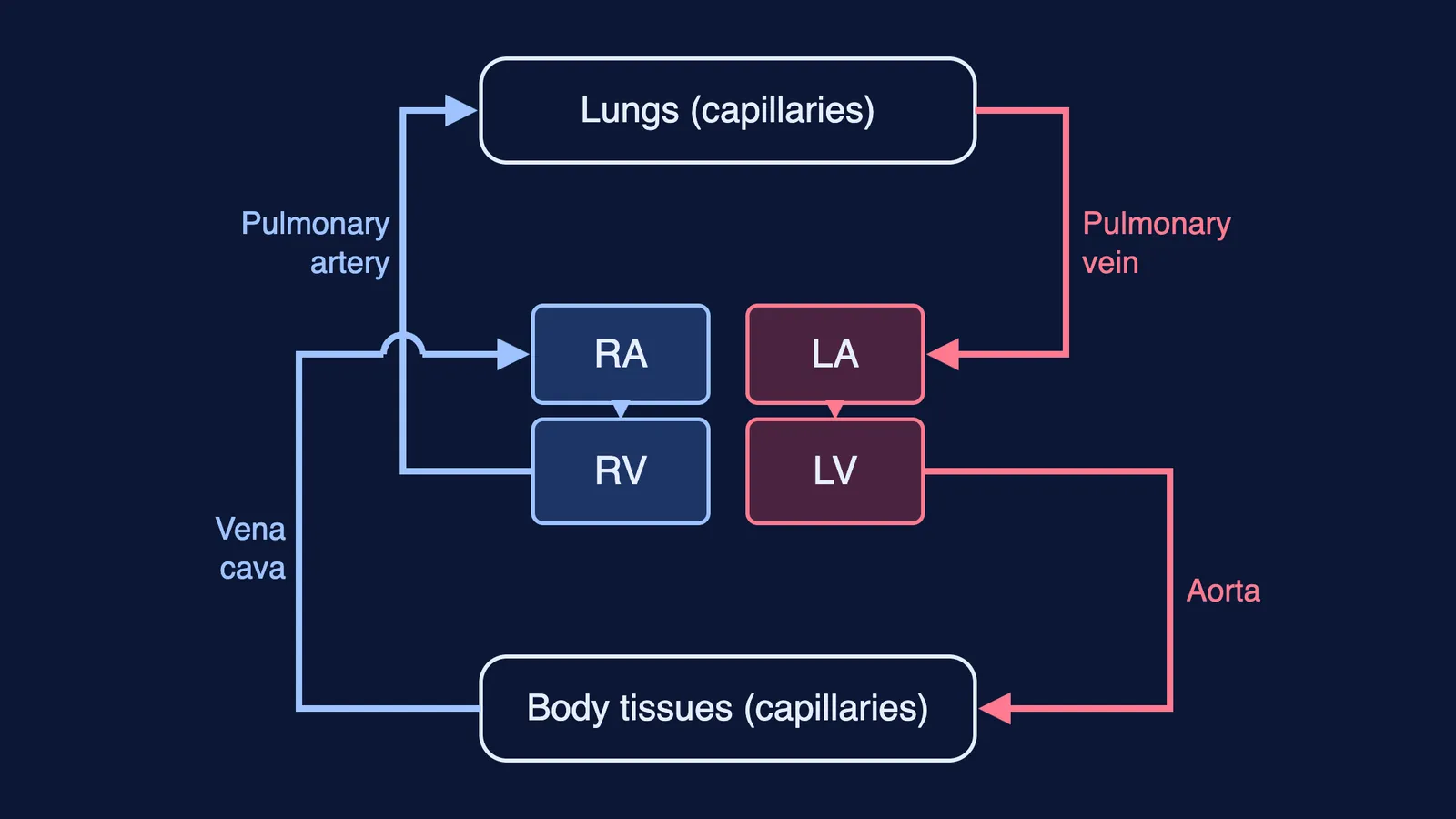
The heart works as two pumps. The right side sends blood from the body to the lungs; the left side sends oxygen-rich blood from the lungs to the body. Each side has an atrium (entry chamber) and a ventricle (pumping chamber).
Humans have double circulation: blood passes through the heart twice per full trip, keeping oxygen-rich and oxygen-poor blood apart.
Pulmonary circulation: right ventricle → pulmonary artery → lungs → pulmonary vein → left atrium.
Systemic circulation: left ventricle → aorta → body tissues → vena cava → right atrium.
Learn the vessel chain in order: arteries (strong walls, high pressure), arterioles (control flow into capillaries), capillaries (thin walls for exchange), venules, then veins (low pressure, a blood reservoir).
Also learn the heart sounds: "lub" comes from the mitral and tricuspid valves shutting, "dub" from the aortic and pulmonary valves shutting. Blood pressure has a systolic reading (heart contracting) and a diastolic reading (heart relaxing between beats).
What happens to the heart and lungs during exercise?
These figures are as printed in the NCERT chapter:
Heart rate is about 70 beats per minute at rest (a later box says 70–80 for adults) and becomes 2–3 times faster during exercise.
Cardiac output, the blood the heart pumps into the aorta each minute, is about 5 litres per minute at rest and up to 30 litres per minute in exercise, up to six times the resting figure.
Blood flow to muscles rises 15–25 times; flow to the gut falls.
Breathing rate: about 12–15 breaths a minute resting, over 40 in intense exercise.
With regular training the heart grows larger and stronger, lung capacity rises, and muscles grow new capillaries (capillarisation). The book notes trained athletes may rest at 40–50 beats per minute.
Worked example: the opening pulse activity
The chapter opens by asking you to record pulse at rest, after 2 minutes of jumping jacks, and after 3 minutes of rest. The book does not fix a counting method; here we assume a 15-second count multiplied by 4. These numbers are illustrative, to show the method, not targets or normal values:
Rest: 18 beats in 15 s → 18 × 4 = 72 beats/min
After jumping jacks: 33 beats in 15 s → 132 beats/min, about 1.8 times the resting rate
After 3 minutes' rest: 24 beats in 15 s → 96 beats/min
Explain each change in one line; this links to the curriculum learning outcome "relate exercise to physiological changes".
What questions can you practise for this chapter?
Mark labels are our suggestion.
Which muscle does most of the work in quiet breathing? (1 mark)
Name the vessel that carries oxygen-poor blood from the right ventricle to the lungs. (1 mark)
Distinguish between external respiration and cellular respiration. (2 marks)
Explain double circulation with one advantage. (2 marks)
Give two immediate and two long-term effects of exercise on the heart and lungs. (2 marks)
Going further: see anatomy and physiology in sports for Class 11, physiology and injuries in sports for Class 12 and the biology view in Body Fluids and Circulation for Class 11.
Not sure where to start? Fermi's AI tutor works out what you already know and builds a plan for the session.