On this page
Body Fluids and Circulation is Chapter 15 of Class 11 NCERT Biology. Here are the 2026-27 syllabus, the chapter in points, a worked example and our practice questions.
What does the 2026-27 syllabus include for this chapter?
The CBSE Biology curriculum for 2026-27 places it in Unit V, Human Physiology, which carries 18 marks of the 70-mark Class XI theory paper. Chapters 14 to 19 share those 18 marks; CBSE gives no per-chapter figure. This chapter is not on the curriculum's formative-only list, so it counts in the theory exam.
That list is in the NCERT rationalised content booklet for Class XI. CBSE's curriculum still lists Digestion and Absorption, but for formative assessment only, not the theory paper. We followed the current NCERT chapter (Reprint 2026-27).
What are blood and lymph made of?
Figures from the NCERT chapter.
Blood is a special connective tissue: plasma (nearly 55 per cent) and formed elements (nearly 45 per cent).
Plasma: 90-92 per cent water, 6-8 per cent proteins: fibrinogen (clotting), globulins (defence), albumins (osmotic balance). Plasma without clotting factors is serum.
RBCs: 5 to 5.5 million per mm³ in a healthy adult man; no nucleus in most mammals; 12-16 g haemoglobin per 100 mL of blood; live about 120 days.
WBCs: 6000-8000 per mm³. Neutrophils are the most (60-65 per cent), basophils the fewest (0.5-1 per cent).
Platelets: fragments of megakaryocytes, 150,000-350,000 per mm³; they release clotting factors.
Blood groups: O is the universal donor, AB the universal recipient. An Rh-ve mother carrying an Rh+ve foetus risks erythroblastosis foetalis in later pregnancies.
Clotting: thrombokinase is needed to form thrombin from prothrombin; thrombin turns fibrinogen into fibrin. Calcium ions matter.
Lymph: tissue fluid drained by the lymphatic system; colourless, with lymphocytes. Lacteals in the villi absorb fats.
How does the human heart work?
From the NCERT chapter:
Valves: tricuspid (right side), bicuspid or mitral (left), semilunar at the pulmonary artery and aorta.
Nodal tissue: the SAN fires 70-75 action potentials a minute, so it is the pacemaker. The impulse passes to the AVN, AV bundle, bundle of His and Purkinje fibres.
Cardiac cycle: joint diastole, atrial systole (adds about 30 per cent to ventricular filling), ventricular systole, relaxation. At 72 beats a minute NCERT gives 0.8 s per cycle.
Heart sounds: lub is the tricuspid and bicuspid valves closing; dub is the semilunar valves closing.
ECG: P-wave, atrial depolarisation; QRS, ventricular depolarisation; T-wave, ventricular repolarisation, its end marking the end of systole.
Double circulation: right ventricle, lungs, left atrium (pulmonary); left ventricle, aorta, tissues, vena cava, right atrium (systemic).
Regulation: the heart is myogenic. Sympathetic signals and adrenal medullary hormones raise cardiac output; parasympathetic signals lower it.
Disorders: hypertension (repeated readings of 140/90 or higher), coronary artery disease, angina and heart failure, which differs from cardiac arrest and heart attack.
How do you calculate cardiac output?
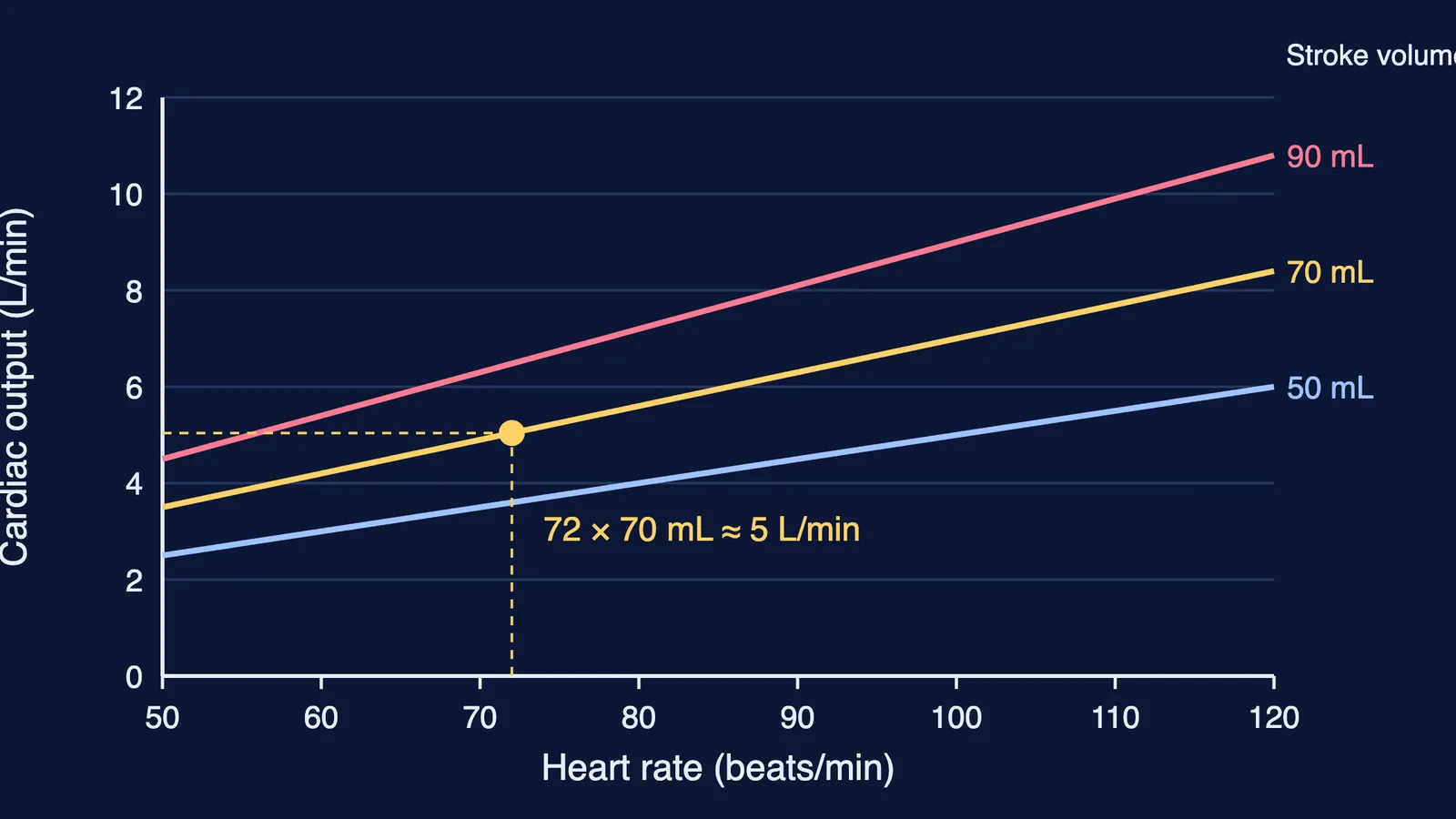
NCERT defines cardiac output as stroke volume times heart rate: about 70 mL at 72 beats a minute, roughly 5 litres a minute, as the chart above shows. Our own numbers:
Heart rate 80 beats/min, stroke volume 65 mL: 65 × 80 = 5200 mL/min, or 5.2 L/min.
One cardiac cycle: 60 s ÷ 80 = 0.75 s.
An ECG strip shows 15 QRS complexes in 12 s: 15 × (60 ÷ 12) = 75 beats/min.
What practice questions should you try?
Mark labels are our suggestion, not CBSE's; formats follow the Class XII Biology sample paper for 2026-27, as no Class XI paper is published.
(1 mark) Plasma has anti-A antibodies and no anti-B. Name the blood group.
(1 mark) Which point on a standard ECG marks the end of systole?
(2 marks) Heart rate 60 beats/min, stroke volume 90 mL. Find the cardiac output and the length of one cycle.
(2 marks) Order these as a cut stops bleeding: fibrinogen, thrombokinase, thrombin, prothrombin, fibrin. Name the ion needed.
(3 marks) Trace blood from the right ventricle until it next enters the right atrium, naming both circuits.
(5 marks) An adult's repeated readings are 150/96 mm Hg. Explain both numbers, say whether this is hypertension, name two organs affected, and distinguish heart failure from cardiac arrest.
Answers: 1. B. 2. End of the T-wave. 3. 5400 mL/min; 1 s. 4. Thrombokinase, prothrombin, thrombin, fibrinogen, fibrin; calcium. 5. Pulmonary artery, lungs, pulmonary veins, left atrium (pulmonary); left ventricle, aorta, tissues, vena cava (systemic). 6. Systolic 150, diastolic 96; yes, at or above 140/90; brain and kidney; failure is weak pumping, arrest is the heart stopping.
How should you revise this chapter?
Redraw the circulation loop and ECG from memory. Compare the frog's three-chambered heart in Structural Organisation in Animals for Class 11 and follow one cell through double circulation in humans. Preparing for NEET too? Read Human Physiology for NEET.
Not sure where to start? Fermi's AI tutor works out what you already know and builds a plan for the session, so you start from the gap.