On this page
These are the key terms of Chapter 14, Breathing and Exchange of Gases, in the current NCERT Class 11 Biology textbook (Reprint 2026-27), grouped the way the chapter runs. Definitions are in our own words, so read them beside the textbook. For full notes, worked sums and practice questions, use our Breathing and Exchange of Gases Class 11 chapter guide.
Which organs do animals use to breathe?
The CBSE 2026-27 Class XI Biology syllabus marks respiratory organs in animals as "recall only", so this group is short.
Breathing: taking in oxygen-rich air and releasing the carbon dioxide cells make. Don't confuse with: cellular respiration, the breakdown of food inside cells.
Tracheal tubes: air tubes that carry air straight to the tissues. Example: insects.
Gills (branchial respiration): blood-rich structures that take oxygen from water. Example: fishes.
Lungs (pulmonary respiration): blood-rich air sacs of land animals. Example: amphibians, reptiles, birds and mammals.
Cutaneous respiration: gas exchange through moist skin. Example: frogs.
The human respiratory system
Larynx: the cartilage "sound box" at the top of the trachea, reached through the pharynx, the shared passage for food and air.
Epiglottis: a small, flexible flap of cartilage that closes over the glottis when you swallow, so food goes down the food pipe instead of into the larynx. Don't confuse with: glottis, the opening it covers.
Trachea, bronchi and bronchioles: the windpipe and its branches. The trachea splits into right and left primary bronchi at the 5th thoracic vertebra (NCERT).
Alveoli: tiny, thin-walled, blood-rich sacs at the ends of terminal bronchioles, the main site of gas exchange.
Pleura: the two-layered covering of each lung; a thin film of pleural fluid between the layers lets the lung surface move with little friction.
Conducting part: nostrils to terminal bronchioles; it carries, cleans, moistens and warms air. Don't confuse with: the exchange part (alveoli and their ducts), where diffusion happens.
How does breathing actually work?
Inspiration: air flows in when the pressure inside the lungs (intra-pulmonary pressure) falls below atmospheric pressure, because the dome-shaped diaphragm contracts and the external intercostal muscles between the ribs lift the ribs and sternum.
Expiration: air flows out when these muscles relax and lung pressure rises slightly above atmospheric pressure.
Spirometer: an instrument that measures breathing volumes to assess lung function.
A healthy person breathes 12-16 times a minute, according to the NCERT chapter.
What are lung volumes and capacities?
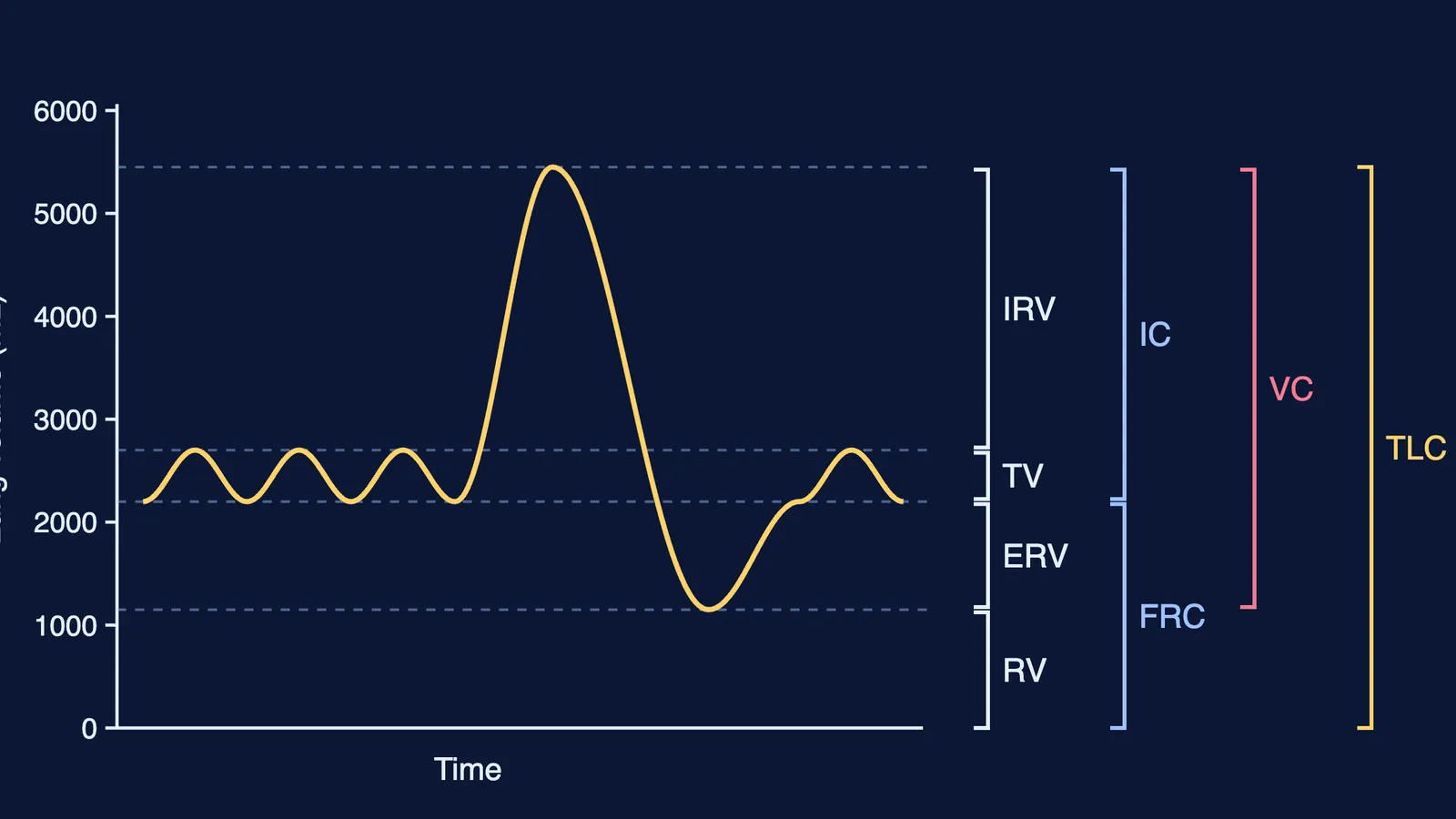
A volume is one measured slice of air; a capacity adds two or more volumes. Figures are the chapter's averages (NCERT).
Tidal volume (TV): air moved in one quiet breath, about 500 mL.
Inspiratory reserve volume (IRV): extra air you can force in after a normal breath in, 2500-3000 mL.
Expiratory reserve volume (ERV): extra air you can force out after a normal breath out, 1000-1100 mL.
Residual volume (RV): air left in the lungs even after a forced breath out, 1100-1200 mL.
Inspiratory capacity (IC): TV + IRV.
Expiratory capacity (EC): TV + ERV.
Functional residual capacity (FRC): ERV + RV, the air left after a normal breath out. Don't confuse with: residual volume, left after a forced one.
Vital capacity (VC): ERV + TV + IRV, the most air you can breathe out after the deepest breath in.
Total lung capacity (TLC): VC + RV. Don't confuse with: vital capacity, which leaves out RV.
How are oxygen and carbon dioxide exchanged and carried?
Partial pressure: the part of a gas mixture's pressure due to one gas, written pO2 or pCO2. Example: pO2 is 104 mm Hg in alveoli and 40 mm Hg in tissues (NCERT Table 14.1).
Diffusion membrane: three layers (alveolar squamous epithelium, capillary endothelium, basement substance), together much thinner than a millimetre.
Oxyhaemoglobin: haemoglobin reversibly bound to oxygen; each haemoglobin carries at most four O2. RBCs carry about 97 per cent of oxygen (NCERT).
Oxygen dissociation curve: the sigmoid (S-shaped) plot of haemoglobin's percentage oxygen saturation against pO2.
Carbamino-haemoglobin: CO2 bound to haemoglobin, carrying 20-25 per cent of CO2. Don't confuse with: oxyhaemoglobin.
Carbonic anhydrase: an enzyme, concentrated in RBCs, that speeds the reversible change of CO2 and water into bicarbonate (HCO3-) and H+. About 70 per cent of CO2 travels as bicarbonate.
How blood itself moves these gases is in our Body Fluids and Circulation Class 11 guide.
Regulation and disorders of breathing
Respiratory rhythm centre: the medulla centre mainly responsible for breathing rhythm.
Pneumotaxic centre: a pons centre that can shorten inspiration and so change breathing rate. Don't confuse with: the rhythm centre.
Chemosensitive area: a region beside the rhythm centre that responds to rising CO2 and H+; receptors in the aortic arch and carotid artery sense the same changes. Oxygen's role in regulation is minor.
Asthma: difficult, wheezy breathing from inflamed bronchi and bronchioles.
Emphysema: a chronic disorder in which damaged alveolar walls shrink the exchange surface; smoking is a major cause. Don't confuse with: asthma, which affects the airways.
Occupational respiratory disorders: lung damage and fibrosis from long exposure to work dust, such as in stone-breaking.
Cellular respiration is a separate chapter; see our Respiration in Plants Class 11 guide.
How to learn these terms
Draw the airway from nostrils to alveoli from memory and mark where the conducting part ends.
Stack RV, ERV, TV and IRV as a bar, then bracket each capacity, as in the diagram at the top. The FRC-versus-RV difference becomes easy to see.
Learn in pairs: oxyhaemoglobin and carbamino-haemoglobin, rhythm and pneumotaxic centres, asthma and emphysema.
Trace one O2 and one CO2 molecule through the chapter, naming each term on the way.
If partial pressure or the dissociation curve still feels fuzzy, the Fermi Concept Library gives every biology concept its own lesson and its place in the map.