On this page
The Bohr model gets hydrogen and He⁺ right and is usually said to fail completely for neutral helium. That is only half true. It fails badly if you ignore the push between the two electrons. Put that push back in, with one simple picture, and the same model lands within about 5% of the measured energy. This is a stretch exercise, not NCERT content: NCERT says the Bohr model applies to one-electron atoms, and that remains the right statement for your exam. But it is good practice in Coulomb's law, quantisation and energy bookkeeping.
What does the Bohr model predict for helium if you ignore repulsion?
Bohr's formula for one electron around a nucleus of charge Ze is E = −13.6 Z²/n² eV. For helium, Z = 2. If each electron simply ignored the other, each would sit at −13.6 × 4 = −54.4 eV, and the pair would have −108.8 eV.
The measured total comes from adding helium's two ionisation energies. The NIST atomic ionisation energy tables for helium give 24.587 eV for removing the first electron and 54.418 eV for the second. So the ground state of helium sits 79.0 eV below two free electrons and a bare nucleus. The no-repulsion guess is about 30 eV too deep, an error of 38%. Our post on where the Bohr model breaks and why uses exactly this gap to show the model's limits. Here we ask how much of the gap the repulsion explains.
How do you put electron repulsion into the Bohr model?
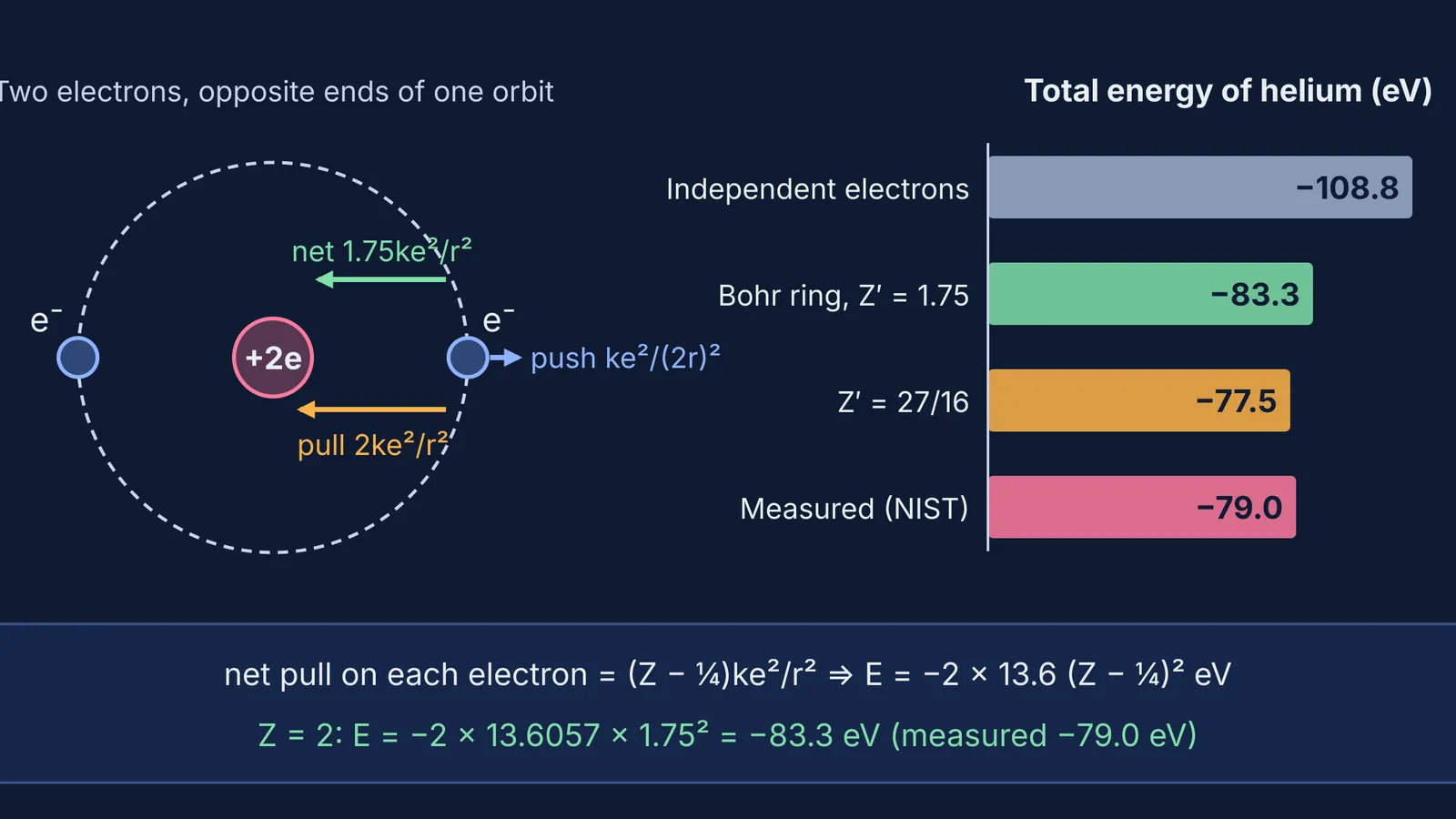
Make one assumption: both electrons move on the same circle of radius r, always at opposite ends of a diameter. The electrons then stay as far apart as they can, 2r, and the picture is symmetric, so both electrons have the same speed and energy.
Forces on one electron, with k = 1/4πε₀:
Pull of the nucleus: charge 2e at distance r gives 2ke²/r², towards the centre.
Push of the other electron: charge e at distance 2r gives ke²/(2r)² = ¼ ke²/r², directly away from the centre, because the other electron sits on the far side.
Net force: (2 − ¼)ke²/r² = 1.75 ke²/r², towards the centre.
Both forces lie along the same line, so the net force is still central and still falls off as 1/r². An electron in that orbit cannot tell it apart from a hydrogen-like ion with nuclear charge Z′ = 1.75. For any two-electron ion the rule is Z′ = Z − ¼.
How do you get the total energy of the two electrons?
Use Bohr's two rules with Z′ = 1.75 in place of Z.
Force balance: mv²/r = Z′ke²/r².
Quantisation (n = 1): mvr = ħ.
These give r = a₀/Z′ and v = Z′αc, exactly as for a hydrogen-like ion. With a₀ = 52.9 pm, r = 52.9/1.75 = 30.2 pm, and v = 1.75 × 2.19 × 10⁶ = 3.83 × 10⁶ m/s.
Now count the energy carefully. This is where students slip, because the repulsion energy belongs to the pair, not to each electron.
Kinetic energy of each electron: ½mv² = 13.6 × Z′² = 13.6057 × 3.0625 = 41.67 eV. Both together: 83.33 eV.
Potential energy with the nucleus, each electron: −2ke²/r. Since ke²/a₀ = 27.21 eV and r = a₀/1.75, this is −2 × 27.21 × 1.75 = −95.24 eV. Both together: −190.48 eV.
Repulsion between the electrons, counted once: +ke²/(2r) = 27.21 × 1.75/2 = +23.81 eV.
Total potential energy: −190.48 + 23.81 = −166.67 eV.
Total energy: 83.33 − 166.67 = −83.33 eV.
Check: the total energy equals minus the total kinetic energy, the same virial relation as for one Bohr electron. It holds because every force here is inverse-square, and it gives a shortcut. Each electron "has" −13.6 × Z′² eV, and adding the two gives −2 × 13.6057 × 1.75² = −83.3 eV, with the repulsion already counted correctly.
How close is the Bohr answer to the measured value?
Put the numbers side by side.
Independent electrons: −108.8 eV, 37.8% too deep.
Bohr ring with Z′ = 1.75: −83.3 eV, 5.5% too deep.
Measured (NIST): −79.0 eV.
The first ionisation energy is a harder test. Removing one electron leaves He⁺, a true one-electron ion with energy −54.42 eV. The ring model therefore predicts 83.33 − 54.42 = 28.9 eV to remove the first electron. The measured value is 24.6 eV, so this smaller number is off by about 18%. The total looks good partly because it is dominated by the He⁺ part, which Bohr gets exactly.
The same rule works for other two-electron ions, and it improves as the nuclear charge grows, because the repulsion becomes a smaller share of the total. For Li⁺ (Z = 3), Z′ = 2.75 gives −2 × 13.6057 × 2.75² = −205.8 eV. The NIST tables for lithium give 75.640 + 122.454 = 198.1 eV for removing both of Li⁺'s electrons, so the error falls to 3.9%.
Why is the Bohr ring picture still wrong?
Treat the 5.5% agreement with suspicion. This is an estimate, not a correct theory.
The real ground state of helium has zero orbital angular momentum. Bohr's ring gives each electron ħ. This is the same flaw the model has for hydrogen.
Electrons do not move on circles or stay exactly opposite. Quantum mechanics describes each electron by a spread-out 1s wavefunction, and the two electrons are often closer than 2r, which raises the repulsion.
The good total energy is partly luck. Two errors pull in opposite directions and partly cancel.
Quantum mechanics gives a cleaner version of the same idea. Each electron partly screens the nucleus from the other. If you use hydrogen-like 1s wavefunctions with an adjustable charge and minimise the energy (the variational method, beyond the JEE syllabus), the optimum charge is Z′ = 27/16 = 1.69, and the energy is −2 × 13.6057 × (27/16)² = −77.5 eV, within 2% of experiment.
For the history of the one-electron ion that Bohr did explain exactly, read about Pickering's helium series and He⁺. For a refresher on the rules used above, see Bohr's postulates explained one at a time.
Why is this worth doing for JEE Advanced?
JEE Advanced often sets atoms questions that change one detail of the Bohr picture: a different force, a different charge, a muon in place of an electron. The method stays the same. Find the net central force, write force balance and mvr = nħ, then add kinetic and potential energy with each interaction counted once. Helium is a compact rehearsal of all three steps.
If you are preparing for JEE Main and Advanced, Fermi Test Prep offers personalised preparation with an AI tutor, live classes, adaptive mocks, mentorship and a study plan that updates based on mastery. To work more atoms problems on your own, the Fermi Problem Library has a step-by-step solver that explains the reasoning.
Quick checklist
Net pull on each electron: (Z − ¼)ke²/r², so Z′ = 1.75 for helium.
Radius a₀/Z′ = 30.2 pm; each kinetic energy 13.6 Z′² eV.
Count the electron–electron repulsion once: +ke²/2r = +23.8 eV.
Total energy −2 × 13.6 × 1.75² = −83.3 eV against −79.0 eV measured.
First ionisation energy predicted 28.9 eV against 24.6 eV measured.
In exams, the Bohr model is still stated as valid for one-electron species only.