On this page
This JEE favourite started as a real puzzle in starlight, and you can solve it the way Niels Bohr did in 1913.
What did Pickering see in the light of ζ Puppis?
In 1896, Edward Charles Pickering, director of the Harvard College Observatory, reported "peculiar spectra" in the southern star ζ Puppis, which he put down to an "element not yet found in other stars or on earth", according to a 2024 history by Maria McEachern and Bretislav Friedrich. One of his 1896 reports appeared as Harvard College Observatory Circular No. 12 in The Astrophysical Journal.
The same history notes that Pickering himself credited Williamina Fleming, one of the observatory's "computers", with the discovery. The lines still carry his name.
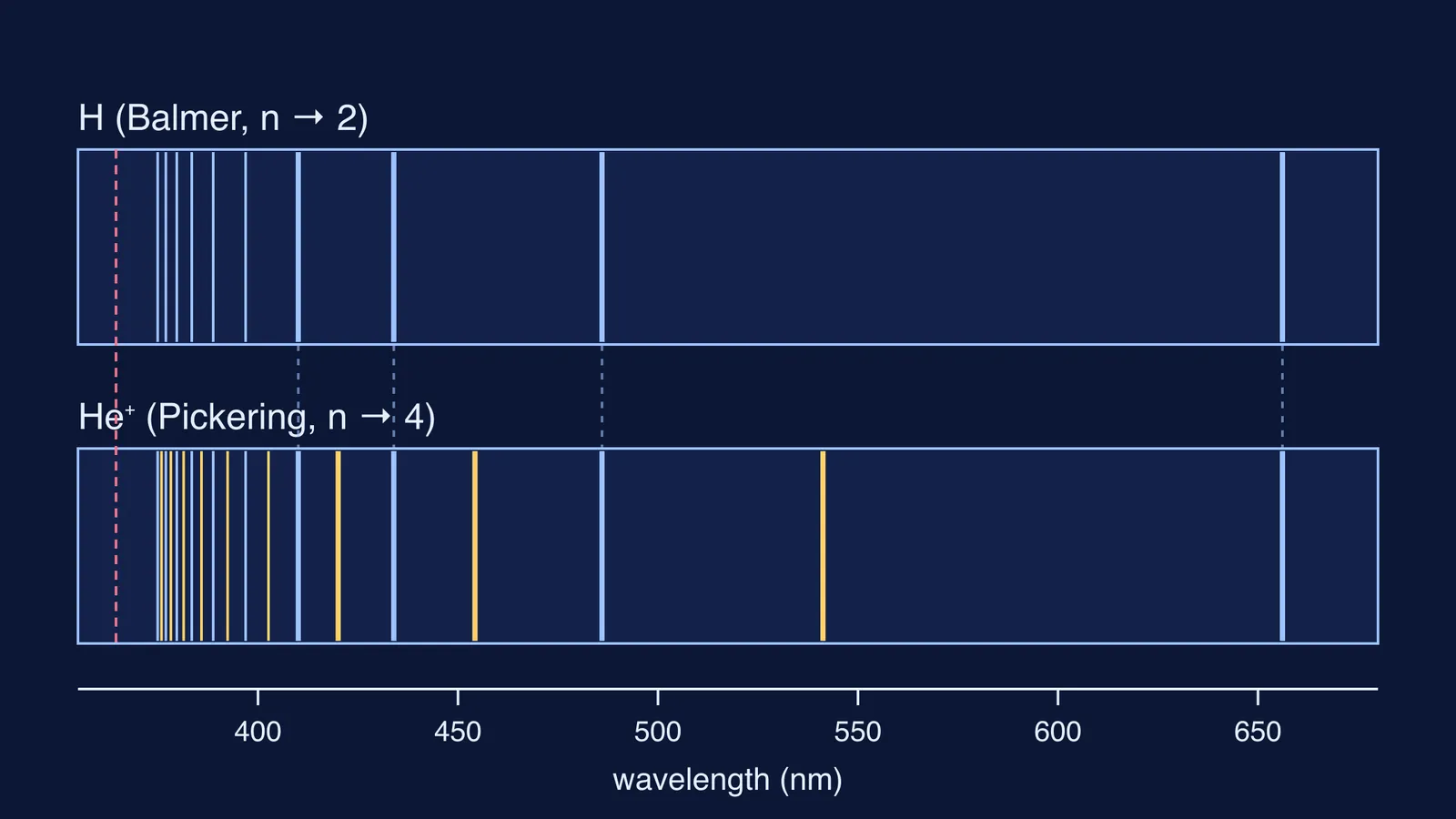
The lines looked like hydrogen's Balmer series, but with extra lines squeezed in between, and some scientists took them for an unusual form of hydrogen. In 1912, Alfred Fowler reported the same lines from a laboratory tube holding a mixture of hydrogen and helium, but not from one with only hydrogen, as the American Institute of Physics account of the He⁺ spectrum describes.
How did Bohr show the lines came from He⁺?
In his first 1913 paper, On the constitution of atoms and molecules, Bohr wrote that his theory could "account naturally for these series of lines if we ascribe them to helium" (readable copy). His idea was simple. A helium atom that has lost one electron is like hydrogen, with one electron, but its nucleus has charge 2e.
In Bohr's model every energy level scales as Z², so for He⁺ (Z = 2) the Rydberg formula gains a factor of 4. Bohr showed that putting the lower level at 4 gives "the series observed by Pickering", and that "every second of the lines in this series is identical with a line in the Balmer series" (same paper, page 10 of the copy above).
The final test came from tiny numbers. Measurements from Fowler's laboratory gave a ratio of about 4.0016 between the He⁺ and hydrogen Rydberg constants, not exactly 4. Once Bohr allowed for the nucleus moving too (the reduced mass), his theory gave 4.00163, a five-digit match, as the AIP account explains. For the story of the model itself, read our post on how Niels Bohr built his model of the atom.
What is the Pickering series in hydrogen-like atoms?
The Pickering series is the set of He⁺ spectral lines for transitions from n = 5, 6, 7 and higher down to n = 4.
For any one-electron ion, the Rydberg formula becomes 1/λ = RZ²(1/n₁² − 1/n₂²), the same pattern Johannes Rydberg found for hydrogen with Z² added. The Rydberg constant is R = 10 973 731.568 m⁻¹ (NIST, CODATA 2022).
Set Z = 2 and n₁ = 4, and the factor Z²/n₁² = 4/16 = 1/4 is the same as hydrogen's Balmer factor 1/2². That is why the two series look alike.
Worked example: which He⁺ line matches hydrogen's red line?
A JEE-style question: which He⁺ transition gives the same wavelength as hydrogen's first Balmer line (n = 3 to 2)? Then find the longest and shortest Pickering wavelengths, ignoring the reduced mass. We use the NIST value of R given above.
Hydrogen, 3 to 2: 1/λ = R(1/4 − 1/9) = 5R/36, so λ = 36/(5R) ≈ 656.1 nm.
He⁺: 1/λ = 4R(1/n₁² − 1/n₂²). Set this equal to R(1/4 − 1/9): you need 1/n₁² − 1/n₂² = 1/16 − 1/36.
So n₁ = 4 and n₂ = 6. The answer is 6 to 4, a Pickering line.
Longest wavelength (5 to 4): 1/λ = 4R(1/16 − 1/25) = 9R/100, so λ = 100/(9R) ≈ 1012.5 nm, in the infrared.
Shortest wavelength (series limit, n₂ very large): 1/λ = 4R/16 = R/4, so λ = 4/R ≈ 364.5 nm, the same limit as the Balmer series.
An odd line, 7 to 4: 1/λ = 4R(1/16 − 1/49) = 33R/196, so λ ≈ 541.2 nm. No hydrogen line sits here: this is one of the extra lines that puzzled astronomers.
A related post covers matching He⁺ and hydrogen spectral lines with more practice cases.
How do you avoid mistakes on these questions?
Write Z² first, before any n values. Forgetting it is a common slip.
Name the series by the lower level n₁, not the upper one.
Longest wavelength means the smallest jump; shortest means n₂ goes to infinity.
To match a hydrogen line, double both levels for He⁺, or triple them for Li²⁺ (Z = 3).
If you keep getting a factor of 4 wrong, the step-by-step solver in the Fermi Problem Library explains the reasoning behind each line rather than printing an answer. To revise energy levels from the start, each topic in the Fermi Concept Library has its own lesson.