On this page
Every term below comes from the current NCERT chapter, Biotechnology and its Applications (Reprint 2026-27), in plain words. In the CBSE 2026-27 Biology curriculum, this chapter sits in Unit IX with Biotechnology: Principles and Processes, and the unit carries 12 of the 70 theory marks.
The syllabus also names vaccine production and stem cell technology, which the NCERT chapter does not cover, so they are left out. For full answers, see our Biotechnology and its applications board answer guide.
Which tissue culture terms do you need?
Explant: the piece of plant tissue, from any part of the plant, that is removed and used to start a culture in a sterile medium.
Totipotency: the ability of a single plant cell or explant to grow back into a whole plant. Don't confuse with: explant, which is the piece; totipotency is the ability.
Nutrient medium: sucrose as carbon source, plus inorganic salts, vitamins, amino acids and growth regulators such as auxins and cytokinins.
Micropropagation: rapid mass multiplication of plants by tissue culture, giving thousands of plants in a short time. Example: tomato, banana and apple on a commercial scale.
Somaclones: plants from micropropagation that are genetically identical to the parent plant.
Meristem culture: culturing the apical or axillary meristem, which stays virus-free in an infected plant, to get healthy plants. Example: banana, sugarcane, potato.
Protoplast: a plant cell whose cell wall has been digested away, leaving the cell inside its plasma membrane.
Somatic hybridisation: fusing protoplasts from two plant varieties to grow a hybrid plant (a somatic hybrid). Example: pomato, from tomato and potato. Don't confuse with: micropropagation, which copies one plant; somatic hybridisation combines two.
How do Bt crops and RNAi protect plants?
GMO (genetically modified organism): a plant, bacterium, fungus or animal whose genes have been deliberately altered. Example: golden rice, enriched in vitamin A.
Bacillus thuringiensis (Bt): the bacterium whose toxin gene was moved into crops. Example: Bt cotton, Bt corn.
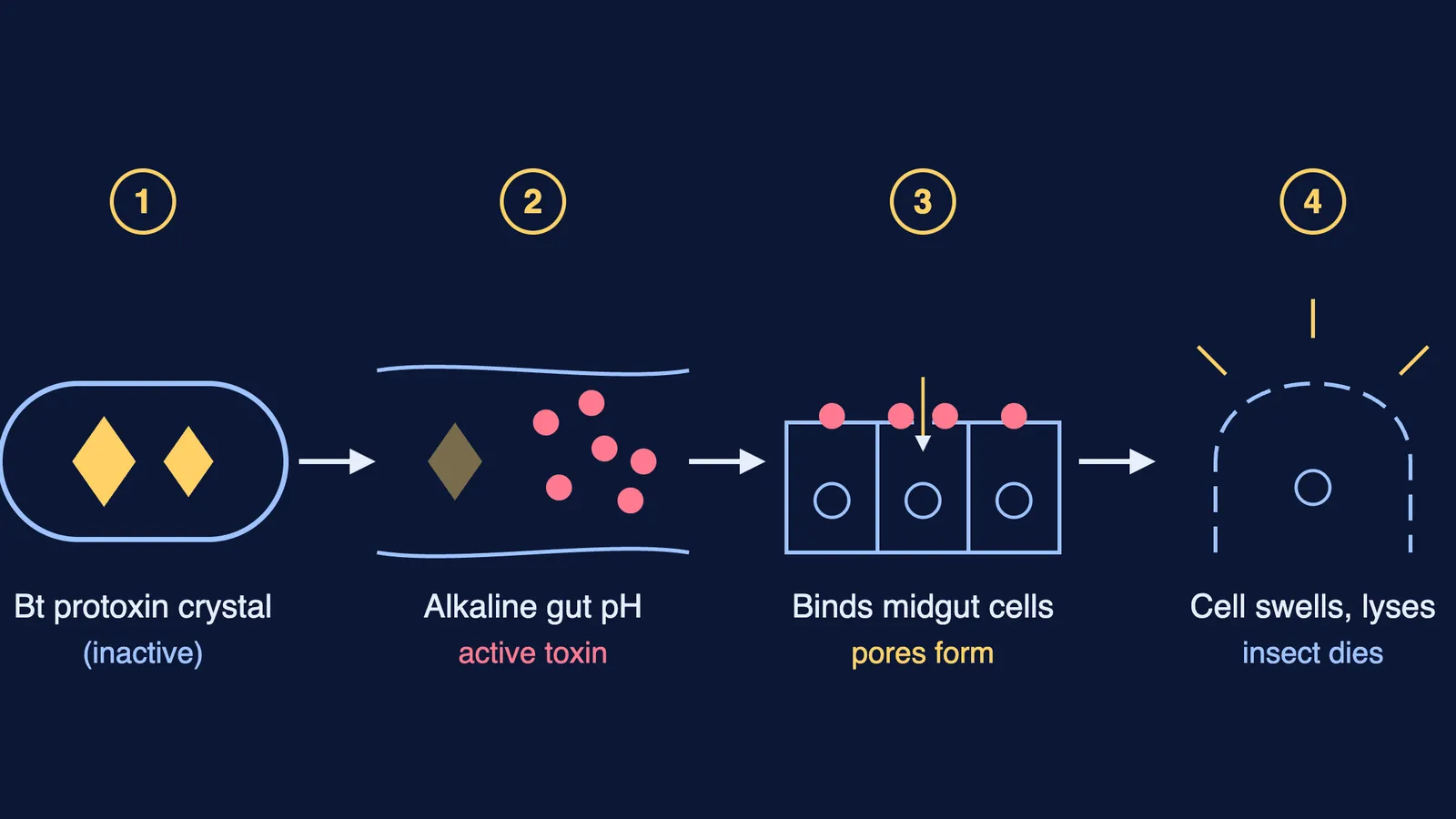
Protoxin: the inactive crystal form of Bt toxin, so it does not harm the bacterium. Alkaline insect gut pH activates it; the toxin then makes pores in midgut cells, which swell and burst.
cry genes and Cry proteins: cry genes (written in lowercase italics) code for the Cry toxin proteins. Example: the proteins coded by cryIAc and cryIIAb control cotton bollworms; the one coded by cryIAb controls corn borer. Don't confuse with: the protein, Cry, written with a capital C.
RNA interference (RNAi): a defence in all eukaryotes where a complementary double-stranded RNA silences a specific mRNA so it is not translated.
Sense and antisense RNA: two complementary RNA strands that pair to form dsRNA and trigger RNAi. Example: tobacco made both against the root nematode Meloidogyne incognita (spelt Meloidegyne incognitia in NCERT), so the parasite could not survive.
Agrobacterium vector: the bacterium that carried the nematode-specific genes into tobacco.
What are the medical applications of biotechnology?
Recombinant therapeutics: medicines made by rDNA technology, without the immune reactions seen with animal-derived products.
Pro-insulin: the inactive precursor of insulin, which carries an extra stretch called the C peptide. Don't confuse with: mature insulin, which has no C peptide.
Chains A and B: insulin's two short polypeptides, held together by disulphide bridges. Example: in 1983 Eli Lilly made the two chains separately in E. coli and joined them.
Gene therapy: putting a normal gene into a person's cells to make up for a faulty one. Example: the first clinical case, in 1990, a 4-year-old girl with ADA deficiency.
ADA deficiency: an immune disorder caused by deletion of the gene for the enzyme adenosine deaminase.
Enzyme replacement therapy: injecting working ADA. Don't confuse with: gene therapy, which supplies the gene, not the enzyme.
Retroviral vector: the virus that carries functional ADA cDNA into the patient's lymphocytes, cultured outside the body and then returned.
PCR in diagnosis: amplifying a pathogen's nucleic acid so tiny amounts are detected before symptoms appear. Example: detecting HIV. For the PCR steps themselves, see our Biotechnology principles and processes guide.
Probe: a single-stranded DNA or RNA tagged with a radioactive molecule that pairs with its complementary DNA.
Autoradiography: detecting the probe on photographic film; a clone with a mutated gene does not show up.
ELISA: a test based on antigen-antibody interaction that detects a pathogen's antigens or the antibodies made against it. Don't confuse with: PCR, which detects nucleic acid.
What are transgenic animals used for?
Transgenic animal: an animal that has been given a foreign gene, which it carries in its DNA and expresses. Example: over 95 per cent of existing transgenic animals are mice, according to NCERT.
Disease model: a transgenic animal built to study how genes cause a human disease. Example: cancer, Alzheimer's.
Alpha-1-antitrypsin: a human protein made by transgenic animals and used to treat emphysema.
Rosie: the first transgenic cow (1997), whose milk carried human alpha-lactalbumin at 2.4 grams per litre.
Vaccine safety testing: using transgenic mice to check vaccines are safe before use on humans. Example: transgenic mice testing polio vaccine safety.
Toxicity testing: exposing transgenic animals made more sensitive to toxins, so chemical safety results come faster.
What do GEAC, patents and biopiracy mean?
GEAC (Genetic Engineering Approval Committee): the Indian government body that judges GM research and the safety of releasing GM organisms.
Patent: a legal right over a product or process. Example: the 1997 US patent an American company got on a Basmati variety derived from Indian farmers' varieties.
Biopiracy: companies or organisations using a country's bio-resources or traditional knowledge without permission and without paying compensation. Don't confuse with: a patent, the legal claim; biopiracy is the unfair use behind some claims.
How to learn these terms
Learn in pairs: protoxin and toxin, cry and Cry, pro-insulin and insulin, PCR and ELISA, gene therapy and enzyme replacement.
Tie every term to one named example: pomato, Rosie, Meloidogyne incognita, the 1990 ADA case, Basmati.
Revise the same ideas with our NEET post on Bt crops, RNAi and gene therapy, then revisit the terms you missed.
If a term like dsRNA or retroviral vector still feels abstract, the Fermi Concept Library has every concept in biology, each with its own lesson and its place in the map.