On this page
Biomolecules is Chapter 9 of the NCERT Class 11 Biology textbook (reprint 2026-27). The CBSE Biology syllabus for 2026-27 covers the structure and function of proteins, carbohydrates, lipids and nucleic acids, plus enzyme types, properties and action. It excludes the bond linking monomers in a polymer, the dynamic state of body constituents, the metabolic basis of living and the living state. For the whole chapter, see our Biomolecules Class 11 chapter guide.
How do scientists find out what a tissue is made of?
Figures in this section come from the NCERT chapter.
Acid-soluble pool (filtrate): the liquid that passes through cloth after tissue is ground in trichloroacetic acid. It holds thousands of small organic compounds.
Acid-insoluble fraction (retentate): what the cloth holds back: proteins, nucleic acids, polysaccharides and lipids.
Biomolecules: any carbon compound isolated from a living tissue.
Micromolecules: biomolecules below 1,000 daltons (Da). Example: amino acids, sugars.
Macromolecules (biomacromolecules): the molecules of the acid-insoluble fraction; apart from lipids, they weigh 10,000 Da or more. Don't confuse with: lipids, which are small but land here because ground-up membranes form insoluble vesicles.
Primary metabolites: compounds with known roles in normal body processes.
Secondary metabolites: compounds, mostly in plants, fungi and microbes, whose roles in the host are not all understood. Example: morphine, carotenoids, ricin, rubber.
Which small molecules build the big ones?
The NCERT chapter draws most of these in Figure 9.1.
Amino acid (alpha-amino acid): a substituted methane whose alpha-carbon carries a hydrogen, an amino group, a carboxyl group and a variable R group. Example: glycine (R is hydrogen), alanine (methyl).
Zwitterionic form: the form with both amino and carboxyl groups ionised, carrying a positive and a negative charge together; it depends on pH.
Essential amino acids: those our body cannot make, so they must come from food.
Fatty acid: a carboxyl group attached to an R group. Example: palmitic acid, 16 carbons including the carboxyl carbon. Saturated ones have no C=C double bond; unsaturated ones have at least one.
Triglyceride: glycerol (trihydroxy propane) with three fatty acids esterified to it. Fats and oils are both glycerides; oils melt lower, so gingelly oil stays liquid in winter.
Phospholipid: a lipid that carries a phosphate-bearing organic group as well as its fatty acid part; a building material of cell membranes. Example: lecithin.
Purines and pyrimidines: the two ring types of nitrogen bases. Adenine and guanine are purines; cytosine, thymine and uracil are pyrimidines.
Nucleoside: a nitrogen base attached to a sugar. Example: adenosine. Don't confuse with: a nucleotide, which also has a phosphate on the sugar, such as adenylic acid.
What are biomacromolecules made of?
Facts here are from the NCERT chapter.
Homopolymer vs heteropolymer: a homopolymer repeats one kind of monomer; a heteropolymer mixes several. Cellulose (glucose only) is a homopolymer; a protein, which draws on 20 types of amino acids, is a heteropolymer.
Protein (polypeptide): a linear chain of amino acids joined by peptide bonds. Collagen is the most abundant protein in the animal world; RuBisCO, in the whole biosphere.
Polysaccharide: a long chain of monosaccharides. Example: cellulose in plant cell walls, starch storing energy in plants, glycogen in animals, inulin (a fructose polymer), chitin in arthropod exoskeletons.
Starch-iodine colour: starch's helices hold iodine (I2) and turn blue. Don't confuse with: cellulose, which lacks such helices and cannot hold iodine.
Nucleic acid: a polynucleotide; each nucleotide has a nitrogen base, a sugar and a phosphate. DNA has deoxyribose; RNA has ribose.
What are the four levels of protein structure?
Primary structure: the order of amino acids, from the N-terminal (first) to the C-terminal (last).
Secondary structure: parts of the chain folded locally, as a helix (only right-handed ones occur in proteins) or a beta-pleated sheet.
Tertiary structure: the complete chain packed into a compact 3-D shape (NCERT pictures a hollow ball of wool); many protein functions depend on it.
Quaternary structure: how two or more folded chains (subunits) are arranged together. Example: adult human haemoglobin, with two alpha and two beta subunits, as the NCERT chapter notes.
Enzyme terms: from active site to cofactors
Facts and numbers here are from the NCERT chapter.
Enzyme: a biological catalyst; almost all are proteins. Don't confuse with: a ribozyme, a nucleic acid that acts as an enzyme.
Active site: a pocket in the folded enzyme into which the substrate (the chemical being converted) fits.
Enzyme-substrate (ES) complex: the short-lived union of enzyme and substrate that catalysis needs; it becomes an enzyme-product (EP) complex before product and free enzyme separate.
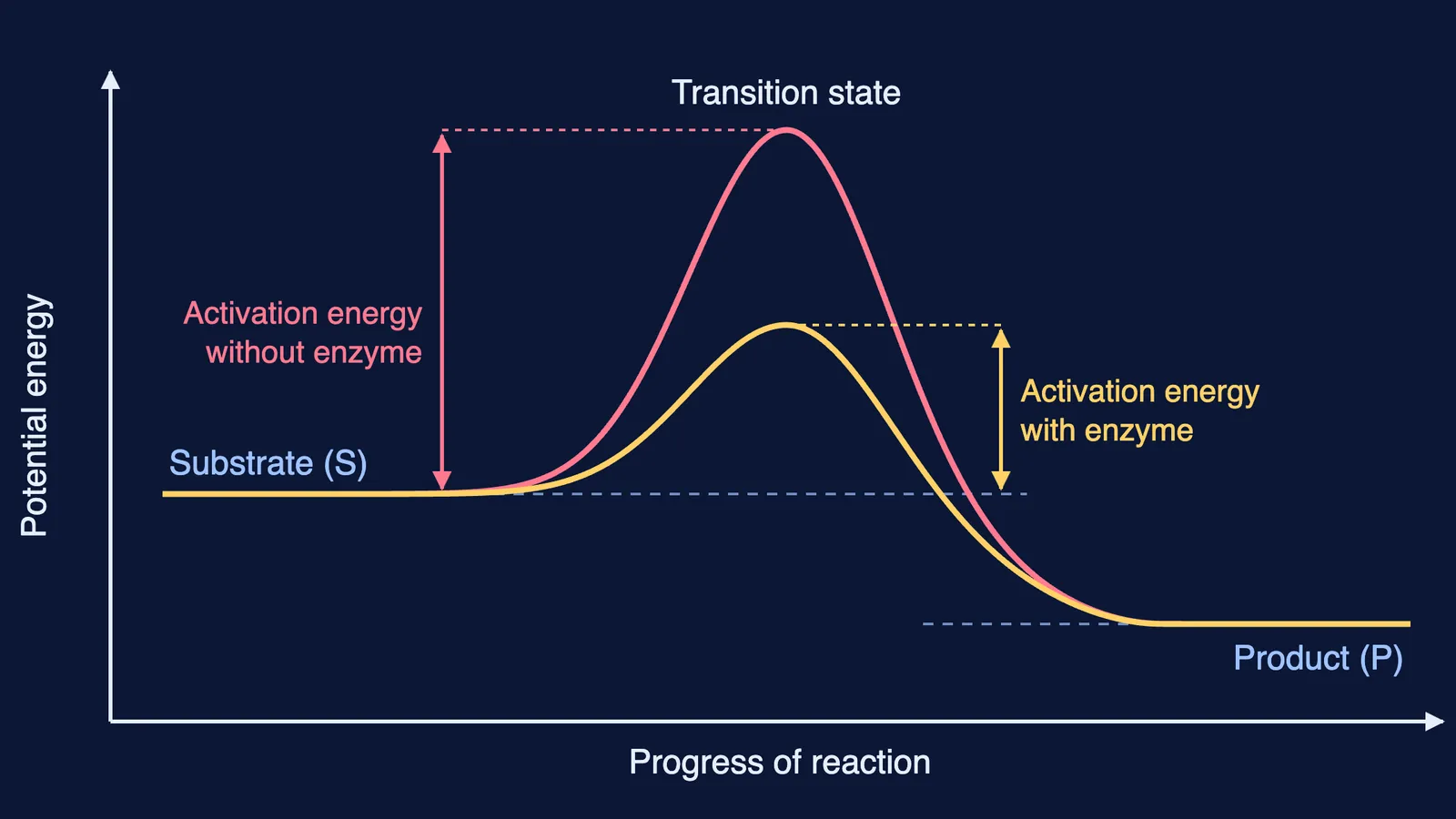
Transition state: the unstable, high-energy structure the substrate passes through on its way to product.
Activation energy: the energy gap between substrate and transition state. Enzymes lower it; carbonic anhydrase speeds its reaction about 10 million times.
Optimum temperature and pH: the conditions at which an enzyme works best. High temperature denatures it.
Vmax: the maximum reaction velocity, reached once every enzyme molecule is saturated with substrate.
Competitive inhibitor: a substrate look-alike that competes for the binding site. Example: malonate blocks succinic dehydrogenase because it resembles succinate.
Enzyme classes: six groups by reaction type: oxidoreductases/dehydrogenases, transferases, hydrolases, lyases, isomerases, ligases. Don't confuse lyases (remove groups without hydrolysis, leaving double bonds) with ligases (join two compounds).
Cofactor and apoenzyme: a cofactor is a non-protein part an enzyme needs to be active; the protein part alone is the apoenzyme. Metal ions can be cofactors, such as zinc for carboxypeptidase.
Prosthetic group: an organic cofactor tightly bound to the apoenzyme. Example: haem in catalase.
Coenzyme: an organic cofactor that binds only briefly, usually during catalysis; many contain vitamins, as NAD contains niacin. Don't confuse with: a prosthetic group, which stays bound.
How to learn these terms
Learn the mix-ups as pairs: nucleoside vs nucleotide, homopolymer vs heteropolymer, prosthetic group vs coenzyme, lyase vs ligase.
Draw the activation energy graph from memory and label substrate, product, transition state and both energy gaps.
Describe haemoglobin at each level of protein structure, one line per level.
Test yourself with our Biomolecules practice questions, and read our post on enzyme kinetics, inhibition and cofactors.
If a term still feels abstract, the Fermi Concept Library covers every concept in biology, each with its own lesson and its place in the map.