On this page
Biomolecules: Building Blocks opens Unit II, Molecules of Life, in Class 11 Biotechnology (045). It covers the small units; the polymers they form belong to the next chapter, Macromolecules: Structure and Function.
Which topics and marks does the 2026-27 syllabus set?
Under the 2026-27 CBSE Biotechnology (045) curriculum, Unit II, Molecules of Life, is worth 20 of the 70 theory marks in Class XI. That 20 covers the whole unit, Macromolecules included; the curriculum does not divide it by chapter.
CBSE prescribes its own A Text Book of Biotechnology for Class XI, but no official PDF of it turned up online. This guide therefore sticks to the curriculum's topic list and takes as its reference NCERT Biotechnology Class XI, Chapter 3, Biomolecules (Reprint 2026-27).
Core Biology, covered in our guide to Biomolecules in Class 11 Biology, puts polymers and enzymes in one chapter. The elective splits that ground and asks for more chemistry on each unit: chiral carbons, fatty acid shorthand, nucleotide names.
How are sugars and their derivatives built?
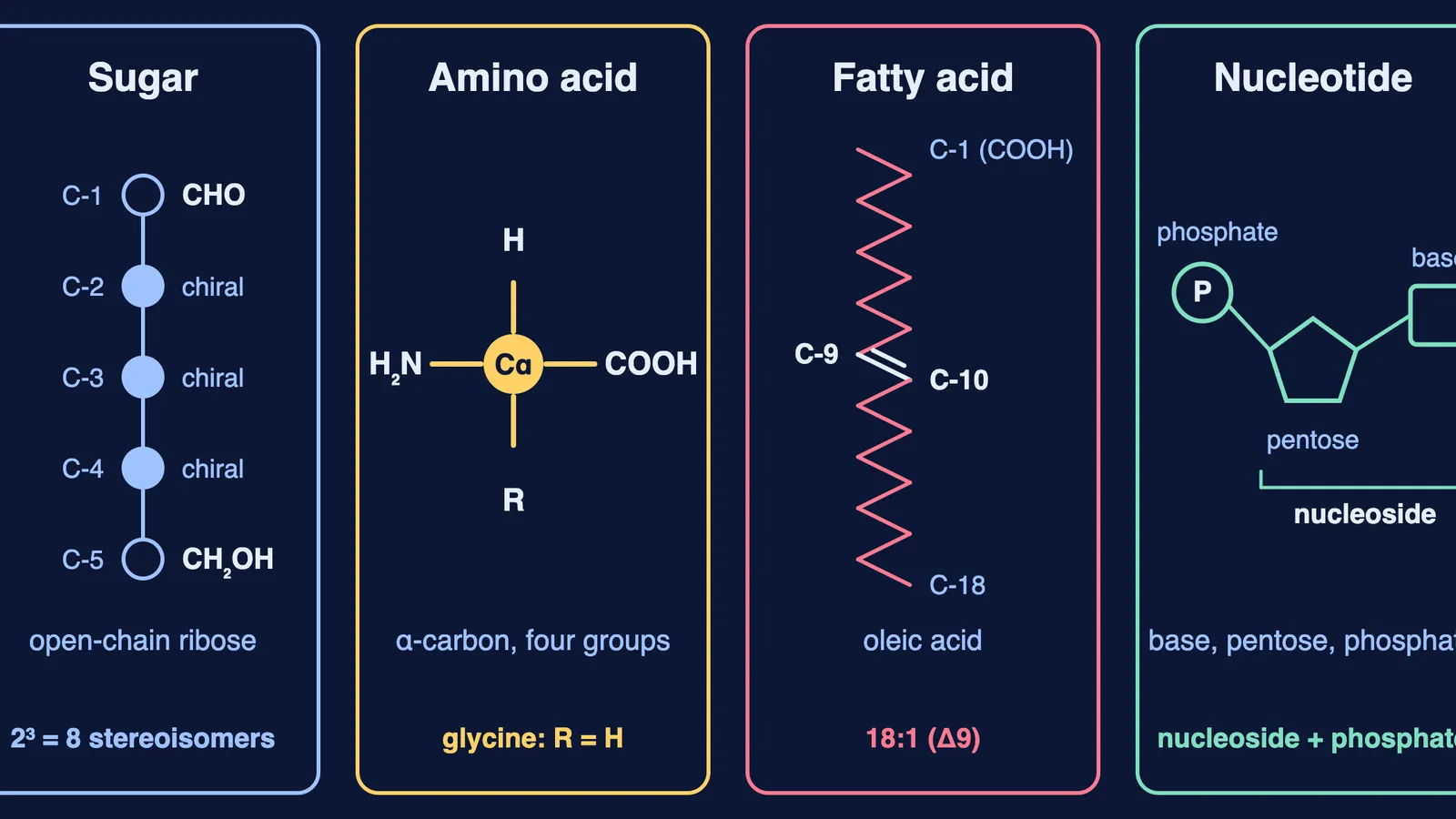
In the NCERT chapter, monosaccharides are aldehyde or ketone sugars that cannot be hydrolysed further, with the general formula Cn(H2O)n. They are grouped by carbon count (trioses to hexoses) and by group: aldoses carry –CHO, ketoses carry >C=O.
NCERT's rule: n chiral centres give 2^n stereoisomers.
Keep three terms apart. D or L depends on the –OH farthest from the carbonyl carbon. Anomers (α, β) differ only at the ring-closing carbon. Epimers differ at one other carbon, as mannose (C-2) and galactose (C-4) do from glucose.
Among sugar derivatives, N-acetyl-D-glucosamine builds chitin and pairs with N-acetylmuramic acid in bacterial peptidoglycan; α-D-galacturonic acid forms pectin. Agarose, from red algae, gels for separating nucleic acids, which returns in Class 12 biotechnology principles and processes.
What makes an amino acid an amino acid?
According to NCERT, each amino acid has an α-carbon carrying four groups: –COOH, –NH2, a hydrogen and a side chain R. Only R changes across the 20 standard amino acids, from H in glycine to –CH3 in alanine.
Except in glycine, the α-carbon is chiral, so L and D forms exist; proteins use L. NCERT sorts the 20 by R group: non-polar aliphatic, aromatic, polar uncharged, positively charged (lysine, arginine, histidine) and negatively charged (aspartate, glutamate).
At pH 7 both ends are ionised, –COO– and –NH3+, giving a zwitterion. Linking two amino acids costs one H2O, and a chain of n residues has n − 1 links: 5 residues, 4 peptide bonds, 4 waters.
How do fatty acids, glycerol and cholesterol differ?
NCERT's lipid section says natural fatty acids are built from two-carbon units, so most have even carbon counts, numbered from the carboxyl carbon (C-1).
The shorthand reads carbons:double bonds (Δ positions). Stearic acid is 18:0, saturated. Oleic acid is 18:1 (Δ9), one double bond from C-9 to C-10. Arachidonic acid, 20:4 (Δ5,8,11,14), has four, starting at C-5, C-8, C-11 and C-14. Try one yourself: a 14-carbon chain with one double bond between C-9 and C-10 is written 14:1 (Δ9).
Glycerol is the backbone: three fatty acids joined by ester bonds give a triacylglycerol, and glycerophospholipids carry a modified phosphate on its third carbon. Cholesterol is a steroid with four fused rings, made mainly in the liver; it is the precursor of steroid hormones and stiffens eukaryotic plasma membranes.
What is inside a nucleotide?
Start with a nitrogenous base bonded to a pentose: that pair is a nucleoside. Attach a phosphate group and it becomes a nucleotide, per the NCERT chapter. DNA uses 2'-deoxy-D-ribose and RNA uses D-ribose. The purines are adenine and guanine; cytosine is in both nucleic acids, thymine only in DNA and uracil only in RNA. The bases absorb light near 260 nm.
Names follow a pattern: deoxyadenosine plus phosphate is dAMP; in RNA it is AMP. Nucleotides join through phosphodiester linkages, so a strand of 6 nucleotides has 5.
Practice questions for Biomolecules: Building Blocks
Mark labels are our suggestion.
(1 mark) Name the sugar in RNA nucleotides.
(1 mark) Write the shorthand for a 16-carbon fatty acid with no double bonds.
(2 marks) Open-chain fructose is a ketohexose. Count its chiral carbons and its possible stereoisomers.
(2 marks) Distinguish a nucleoside from a nucleotide with one DNA example of each.
(3 marks) A tetrapeptide forms from four amino acids. How many peptide bonds and water molecules? Why is glycine not optically active?
(5 marks) Compare glycerol and cholesterol: structure, role in lipids and where each appears in the cell.
Answers: 1. D-ribose. 2. 16:0. 3. Three (C-3, C-4, C-5), so 2^3 = 8. 4. Deoxyguanosine; dGMP. 5. Three and three; its R group is H, so the α-carbon is not chiral. 6. Glycerol: three-carbon backbone, ester-linked to fatty acids in triacylglycerols (energy store, mainly adipose tissue) and glycerophospholipids (cell membranes). Cholesterol: four-ring steroid in plasma membranes, precursor of steroid hormones.
Taking NEET too? See our NCERT-first plan for Biomolecules in NEET.
Not sure where to start revising? Fermi's AI tutor works out what you already know and builds a plan for the session.