On this page
Some Basic Concepts of Chemistry is Unit 1 of NCERT Chemistry Part I (Reprint 2026-27), and the CBSE Chemistry curriculum 2026-27 lists it as Unit 1 of Class XI. For the full chapter, read our Some Basic Concepts of Chemistry Class 11 guide.
What are mixtures, elements and compounds?
From sections 1.2 and 1.3.1 of the NCERT chapter:
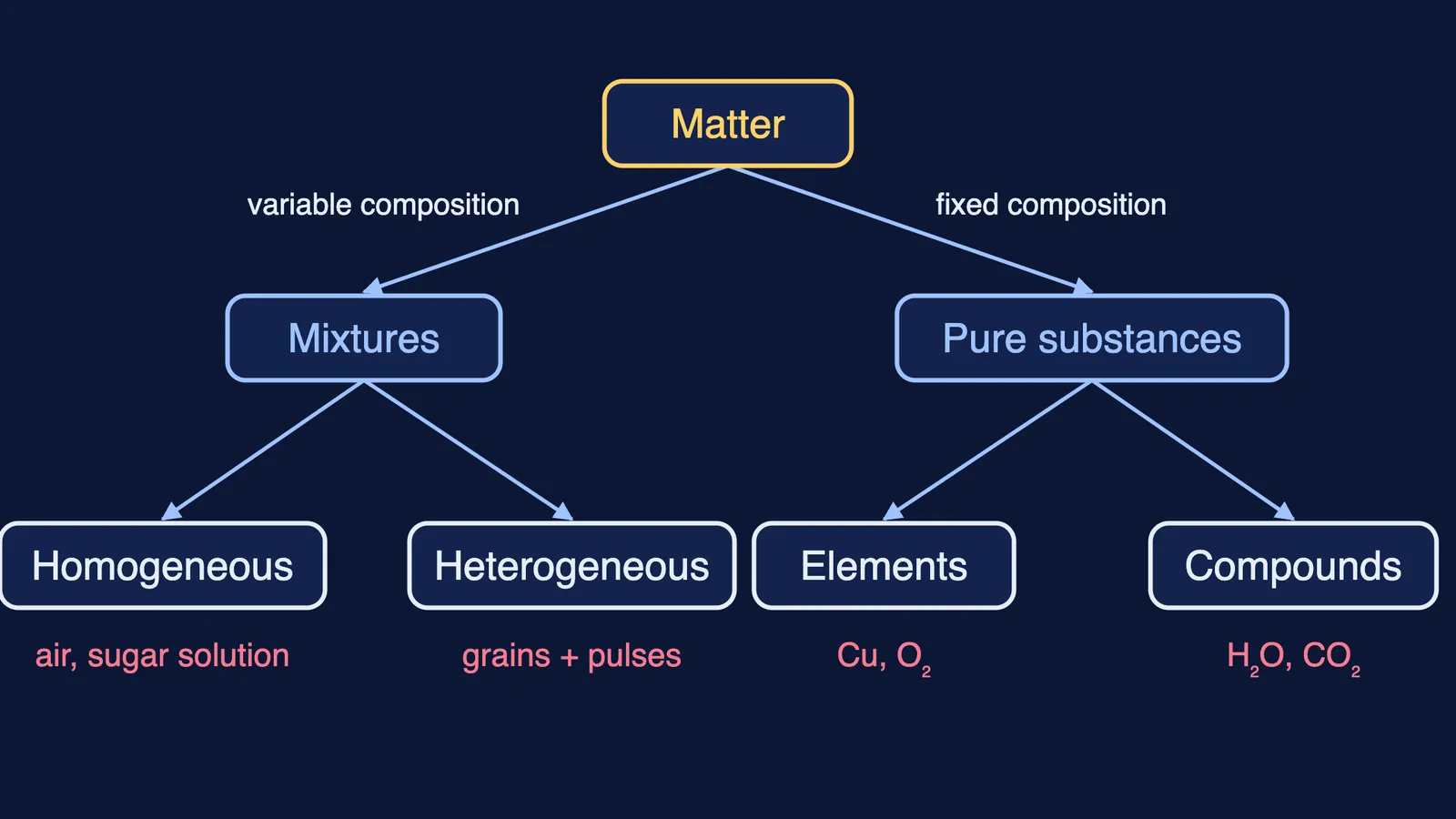
Pure substance: matter built from only one kind of particle, which is why its composition never varies. Example: water, glucose, copper.
Mixture: a blend of two or more pure substances whose proportions can vary; physical methods such as filtration pull them apart. Example: tea, air. Don't confuse with: compound, whose parts are in a fixed ratio.
Homogeneous mixture: a mixture with the same composition throughout. Example: sugar dissolved in water.
Heterogeneous mixture: a mixture whose composition varies; the parts are often visible. Example: grains and pulses with stone pieces.
Element: a pure substance made of one type of atom, present as single atoms or molecules. Example: copper (atoms), oxygen gas (two-atom molecules).
Compound: a pure substance formed when atoms of two or more elements combine in a fixed ratio. Example: carbon dioxide.
Physical property: one you can measure without changing what the substance is. Example: boiling point, density.
Chemical property: one you can only observe through a chemical change. Example: combustibility.
Which measurement terms does the chapter use?
SI unit: a unit of the International System of Units, which has seven base units, including the metre, kilogram and mole (NCERT section 1.3.3).
Mass: the amount of matter in an object; it is the same everywhere. Don't confuse with: weight, the force of gravity on it, which varies from place to place.
Density: mass per unit volume. SI unit kg m⁻³.
Scientific notation: writing a number as N × 10ⁿ with N from 1 to just under 10. Example: 232.508 = 2.32508 × 10².
Significant figures: every digit you are sure of in a measurement, plus the final, estimated one. Example: 0.200 g has three.
Precision: how close repeated measurements are to each other.
Accuracy: how close a measurement is to the true value. Don't confuse the two: readings of 1.95 g and 1.93 g for a true 2.00 g are precise but not accurate.
Dimensional analysis: converting units by multiplying by a ratio equal to 1, such as 2.54 cm / 1 in. Also called the unit factor method.
What are the laws of chemical combination?
From sections 1.5 and 1.6 of the NCERT text:
Law of conservation of mass: total mass does not change in physical or chemical changes (Lavoisier).
Law of definite proportions: a compound always contains the same elements in the same proportion by mass, whatever its source. Example: Proust's natural and synthetic cupric carbonate.
Law of multiple proportions: if two elements make more than one compound, hold the mass of one element constant and the masses of the other that join it form a simple whole-number ratio. Example: 2 g of hydrogen takes 16 g of oxygen in water, 32 g in hydrogen peroxide.
Gay Lussac's law of gaseous volumes: reacting and product gases are in simple volume ratios at the same temperature and pressure. Example: 100 mL hydrogen + 50 mL oxygen gives 100 mL water vapour.
Avogadro's law: at the same temperature and pressure, equal volumes of any gases contain the same number of molecules. Don't confuse with: Gay Lussac's law, which is about volume ratios, not molecule counts.
Dalton's atomic theory: matter is made of indivisible atoms that are identical within an element, join in fixed ratios and are only rearranged in reactions.
What is the difference between atomic mass, molecular mass and molar mass?
Values from sections 1.7 to 1.9 of the NCERT chapter:
Atomic mass unit (u): exactly one-twelfth of the mass of one carbon-12 atom; u has replaced the older amu.
Average atomic mass: an element's atomic mass averaged over its isotopes by natural abundance. Example: carbon, 12.011 u.
Molecular mass: add up the atomic masses of every atom in one molecule. Example: water, 18.02 u.
Formula mass: the same sum for substances without separate molecules. Example: NaCl, 58.5 u.
Mole: the SI unit for amount of substance, fixed so that one mole is exactly 6.02214076 × 10²³ elementary entities. That number is the Avogadro constant.
Molar mass: the mass in grams of one mole of a substance, numerically equal to its atomic, molecular or formula mass in u. Example: water, 18.02 g mol⁻¹. Don't confuse with: molecular mass, the same number in u for one molecule.
Empirical formula: the simplest whole-number ratio of atoms in a compound. Example: CH₂Cl.
Molecular formula: the actual number of each atom in a molecule. Example: C₂H₄Cl₂, twice CH₂Cl.
Which terms describe reactions and solutions?
From section 1.10 of the NCERT chapter:
Stoichiometry: working out the amounts of reactants needed and products formed (by mass, sometimes volume), using the balanced equation's coefficients as mole ratios.
Limiting reagent: the reactant used up first, which fixes how much product forms. Don't confuse with: the reactant with the smaller mass; compare moles with the equation.
Mole fraction: moles of one component divided by total moles in the solution.
Molarity (M): moles of solute per litre of solution; it changes with temperature, because volume does.
Molality (m): moles of solute per kilogram of solvent. Don't confuse with: molarity; molality does not change with temperature, because mass does not.
How to learn these terms
Learn them in pairs (precision and accuracy, mass and weight, molarity and molality), with one example that separates each pair.
Redraw the classification tree of matter from memory, with an example on each branch.
Tie each law to its numbers: 16 g and 32 g of oxygen is multiple proportions; 100 mL plus 50 mL is Gay Lussac.
If a term still feels slippery, the Fermi Concept Library gives every concept in physics, chemistry, biology, mathematics and computing its own lesson and its place in the map. Then practise with our Some Basic Concepts of Chemistry formulas with examples and the Class 11 case study questions.