On this page
Some Basic Concepts of Chemistry is Unit 1 of NCERT Chemistry Part I (Reprint 2026-27), and the CBSE Chemistry curriculum 2026-27 keeps it in Class XI. The rationalised chapter has no 22.4 L molar-volume relation. Examples use NCERT atomic masses (H 1.008 u, C 12.011 u, O 16.00 u). For the concepts, see our Some Basic Concepts of Chemistry Class 11 guide.
What are the measurement formulas in Class 11 chemistry?
Density d = m/V, mass m (g or kg) over volume V (cm³ or m³). SI unit kg m⁻³; 1 g cm⁻³ = 1000 kg m⁻³.
°F = (9/5)(°C) + 32; water freezes at 32 °F and boils at 212 °F.
K = °C + 273.15. Kelvin temperatures are never negative.
Scientific notation N × 10ⁿ: 1 ≤ N < 10 and n an integer; the unit stays with the number. Match exponents before adding.
Significant figures: multiplying or dividing, keep the fewest significant figures of any input; adding or subtracting, the fewest decimal places.
Unit factor method: multiply by a ratio equal to 1, such as (2.54 cm / 1 in), so units cancel.
Example: a 67.5 g block of volume 25.0 cm³ has d = 2.70 g cm⁻³ = 2700 kg m⁻³. 37 °C is 98.6 °F and 310.15 K.
Watch for: 4.26 g + 0.2 g + 13.375 g is reported as 17.8 g, not 17.835 g.
Atomic mass, molecular mass and the mole
1 u = (1/12) × mass of one carbon-12 atom = 1.66056 × 10⁻²⁴ g. "amu" is now written "u", the unified mass.
Average atomic mass (u) = Σ (fractional abundance × isotope mass, u), abundances adding to 1.
Molecular mass (u) = sum of the atomic masses (u) of all atoms in the molecule; for ionic solids such as NaCl the same sum is the formula mass (u).
One mole holds exactly 6.02214076 × 10²³ entities: N_A = 6.022 × 10²³ mol⁻¹.
n (mol) = m (g) / M (g mol⁻¹), where the molar mass M equals the molecular mass in u.
Number of entities N = n (mol) × N_A (mol⁻¹), a pure number.
Example: element X has isotopes of 24.0 u (75.0%) and 26.0 u (25.0%), so its average atomic mass is 0.750 × 24.0 + 0.250 × 26.0 = 24.5 u. For water (18.02 g mol⁻¹), 36.0 g is 2.00 mol: 1.20 × 10²⁴ molecules, or 3.61 × 10²⁴ atoms.
Watch for: molecules are not atoms; each H₂O molecule holds three atoms.
How do you find the empirical and molecular formula?
Mass % of an element = (mass of the element in 1 mol of compound, g) / (mass of 1 mol of compound, g) × 100.
Empirical formula: take 100 g, so each mass % becomes grams; divide each by its atomic mass (g mol⁻¹) to get moles; divide by the smallest; round to whole numbers.
n = molar mass (g mol⁻¹) / empirical formula mass (g mol⁻¹), a whole number; molecular formula = (empirical formula)ₙ.
Example: ethanoic acid, C₂H₄O₂, has M = 2(12.011) + 4(1.008) + 2(16.00) = 60.054 g mol⁻¹, giving C 40.00%, H 6.71%, O 53.29%. Back from these, 100 g holds 3.330 mol C, 6.657 mol H and 3.331 mol O, a 1 : 2 : 1 ratio, so the empirical formula is CH₂O (30.03 g mol⁻¹) and n = 60.05/30.03 = 2.
Watch for: a ratio such as 1 : 1.5 is not rounding error; multiply every value by 2 first.
How do you find the limiting reagent?
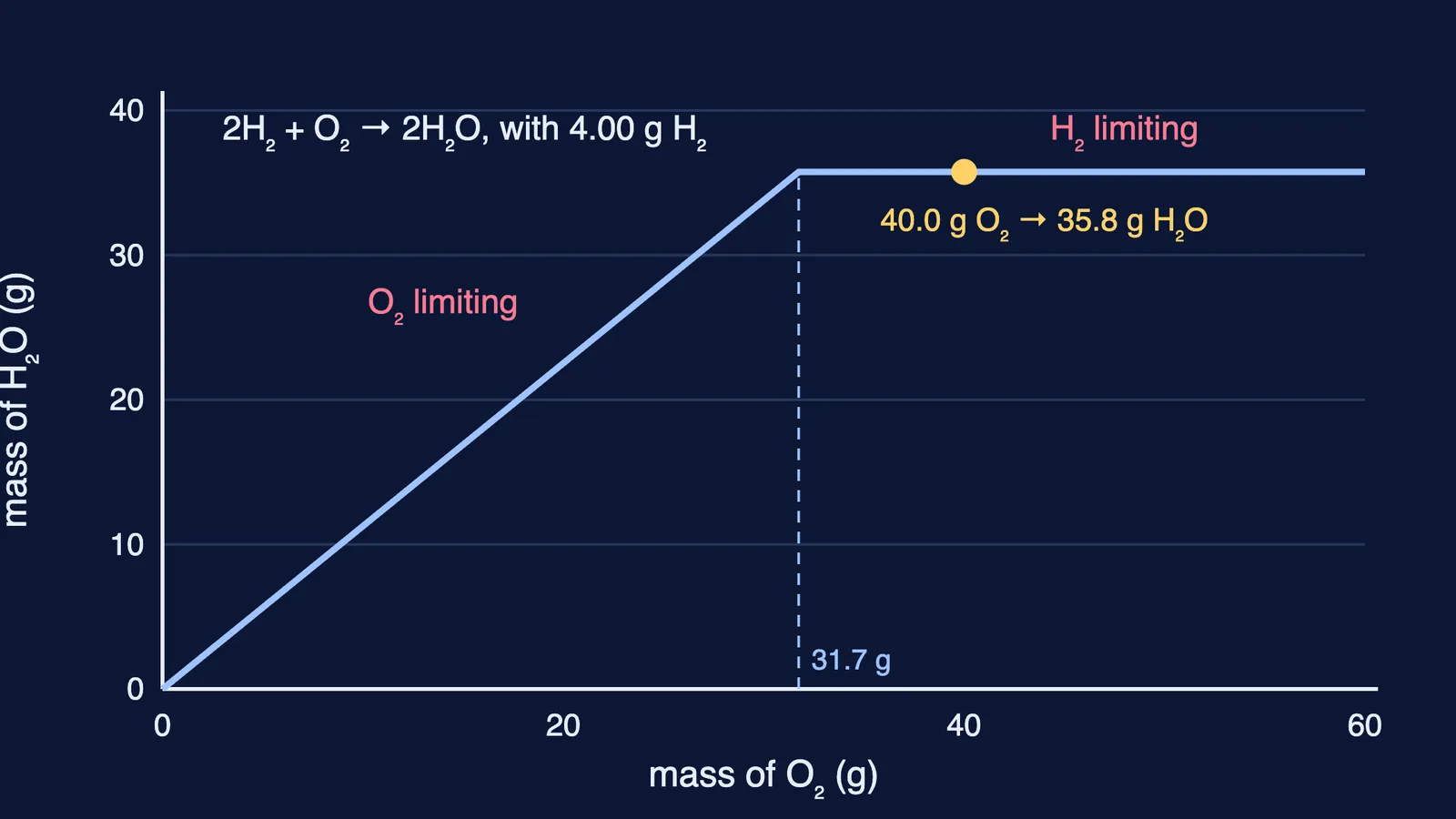
Mole ratios come from the balanced equation: in 2H₂(g) + O₂(g) → 2H₂O(g), 2 mol H₂ react with 1 mol O₂ to give 2 mol H₂O.
For each reactant, n (mol) = m (g) / M (g mol⁻¹), then divide by its coefficient. The smallest result identifies the limiting reagent, which is used up first.
Product (mol) = limiting reagent (mol) × (product coefficient / limiting coefficient); mass (g) = n (mol) × M (g mol⁻¹).
Example: 4.00 g H₂ (2.016 g mol⁻¹) is 1.984 mol and 40.0 g O₂ (32.00 g mol⁻¹) is 1.25 mol. Divided by coefficients: 0.992 for H₂, 1.25 for O₂, so H₂ is limiting. Water = 1.984 mol × 18.02 g mol⁻¹ = 35.8 g; 8.3 g O₂ is left over.
Watch for: compare moles divided by coefficients, not raw moles. H₂ has more moles here yet runs out first.
What are the formulas for concentration of a solution?
Mass per cent (%) = (mass of solute, g / mass of solution, g) × 100.
Mole fraction x_A = n_A (mol) / (n_A + n_B) (mol), no unit; x_A + x_B = 1.
Molarity, symbol M (mol L⁻¹; not the molar mass M) = moles of solute (mol) / volume of solution (L). It changes with temperature.
Molality, symbol m (mol kg⁻¹; not a mass) = moles of solute (mol) / mass of solvent (kg). It does not change with temperature.
Dilution: M₁V₁ = M₂V₂, M in mol L⁻¹ and V₁, V₂ in the same unit, because moles of solute stay constant.
Example: 5.85 g NaCl (58.5 g mol⁻¹) made up to 500 mL is 0.100 mol / 0.500 L = 0.200 mol L⁻¹. Dissolving 10.0 g NaOH (0.250 mol) in 250 g water gives 1.00 mol kg⁻¹, 3.85% by mass and x(NaOH) = 0.250/(0.250 + 13.87) = 0.0177. Diluting 50.0 mL of 2.0 mol L⁻¹ to 0.25 mol L⁻¹ needs V₂ = 400 mL.
Watch for: molarity divides by the volume of solution, molality by the mass of solvent alone.
How to revise this formula sheet
Rewrite the measurement formulas from memory, then convert 25 °C to °F and K.
For any compound: molar mass, mass % of each element, then back to the empirical formula.
In stoichiometry, write moles ÷ coefficient for each reactant first.
Keep a card contrasting molarity (mol L⁻¹, solution) with molality (mol kg⁻¹, solvent).
Practise with our Some basic concepts of chemistry case study questions for Class 11 and the assertion-reason set on this chapter.
When a mole problem goes wrong at the method, the Fermi Problem Library has worked problems with a step-by-step solver that explains the reasoning rather than printing an answer.