On this page
Three original case studies on a sugar cube, fertiliser bags and an antacid test, each with four graded parts and worked answers. For the chapter summary and common numericals, read our Some Basic Concepts of Chemistry Class 11 guide.
What do these case study questions cover?
Class 11 exams are set by your school, so the pattern varies. Treat these as practice in the case-based style: read a situation, pull out the data, then answer parts that build on each other.
Every fact follows Unit 1 of NCERT Class 11 Chemistry Part I (Reprint 2026-27) and Unit 1 of the CBSE 2026-27 Class XI Chemistry syllabus. One mole holds 6.022 × 10²³ particles, the value NCERT uses. Take H = 1, C = 12, N = 14, O = 16, Mg = 24, S = 32 and Cl = 35.5 g mol⁻¹ throughout.
Case 1: Counting atoms in a sugar cube
Ishaan, a Class 11 student in Kolkata, carries one sugar cube from the family tea tin to his school lab. He weighs it on the lab's analytical balance, which reads to the nearest milligram: 4.275 g. Table sugar is almost pure sucrose, C₁₂H₂₂O₁₁. Treat the cube as pure sucrose.
(i) How many significant figures are there in 4.275 g? (a) 2 (b) 3 (c) 4 (d) 5
(ii) Write the analytical balance reading in kilograms, in scientific notation.
(iii) Find the molar mass of sucrose and the number of moles in the cube.
(iv) How many carbon atoms does the cube contain?
Answers.
(i) (c) 4. All non-zero digits are significant.
(ii) 4.275 × 10⁻³ kg, still four significant figures.
(iii) M = (12 × 12) + (22 × 1) + (11 × 16) = 342 g mol⁻¹. Moles = 4.275 ÷ 342 = 0.01250 mol.
(iv) Each molecule has 12 C atoms: 0.01250 × 12 × 6.022 × 10²³ = 9.033 × 10²² atoms. Stopping at molecules (7.53 × 10²¹) is the trap.
Case 2: Fertiliser bags in a Ludhiana shop
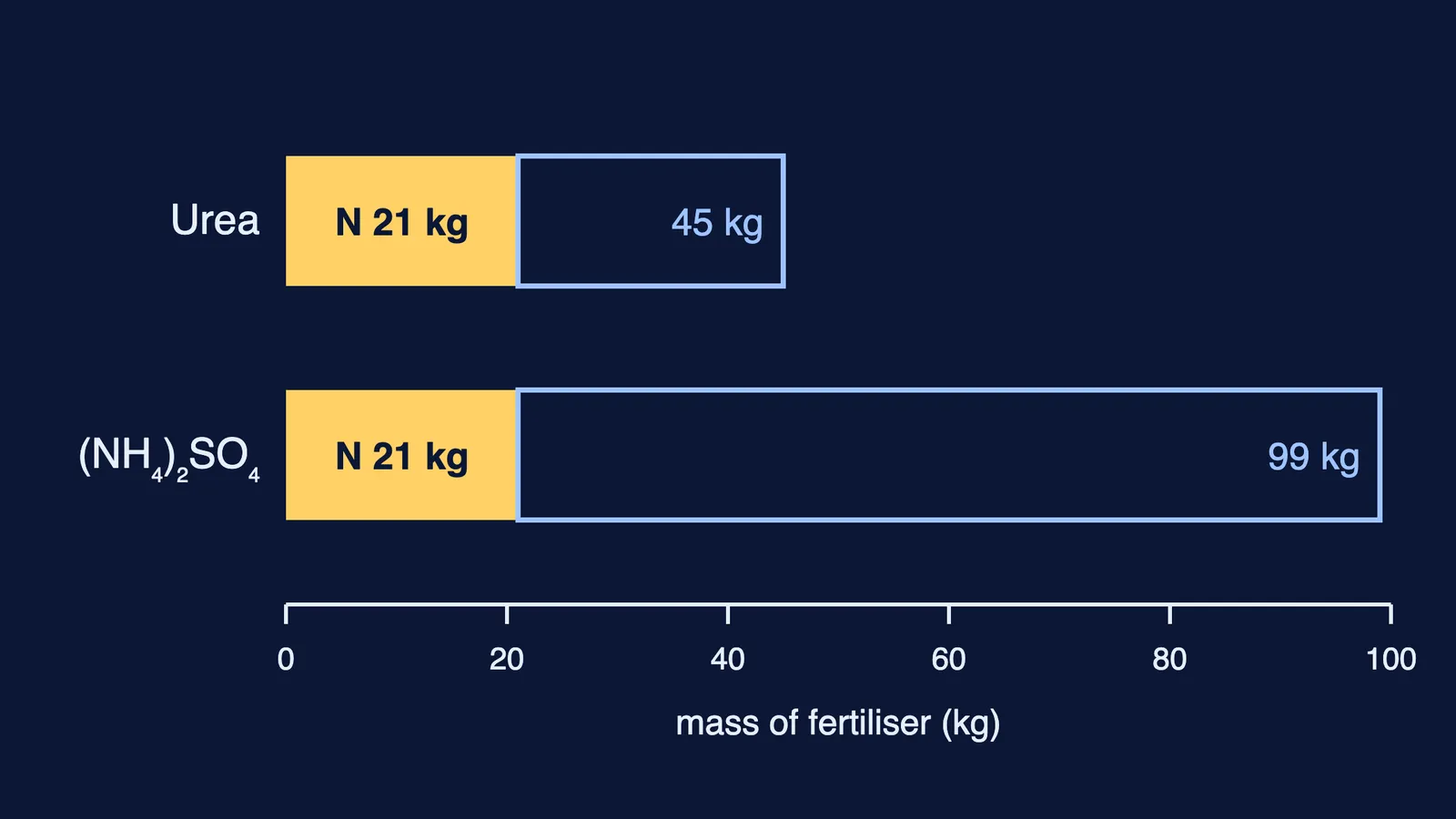
A farmer in Ludhiana wants 21 kg of nitrogen for one field. The shop sells 45 kg bags of urea, CO(NH₂)₂, and loose ammonium sulphate, (NH₄)₂SO₄. The farmer asks his daughter, a Class 11 student, to work out how much of each he would need. In the storeroom she also finds an unlabelled sack of white crystals. A soil-testing lab reports its composition as 35.0% N, 5.0% H and 60.0% O by mass, with a molar mass of 80 g mol⁻¹.
(i) The mass per cent of nitrogen in ammonium sulphate is about: (a) 10.6% (b) 21.2% (c) 26.4% (d) 46.7%
(ii) How much nitrogen is in one 45 kg bag of urea?
(iii) What mass of ammonium sulphate gives the same nitrogen as one bag of urea?
(iv) Find the empirical and molecular formulas of the unlabelled compound.
Answers.
(i) (b) M = 2(14 + 4) + 32 + 64 = 132 g mol⁻¹, with 28 g of N per mole. 28 ÷ 132 × 100 = 21.2%.
(ii) Urea: M = 12 + 16 + 2(14 + 2) = 60 g mol⁻¹. N = 45 × 28 ÷ 60 = 21.0 kg, exactly what the field needs.
(iii) 21.0 × 132 ÷ 28 = 99 kg, more than twice the mass.
(iv) In 100 g: N = 35.0 ÷ 14 = 2.5 mol, H = 5.0 ÷ 1 = 5.0 mol, O = 60.0 ÷ 16 = 3.75 mol. Dividing by 2.5 gives 1 : 2 : 1.5; doubling gives N₂H₄O₃ (80 g mol⁻¹). n = 80 ÷ 80 = 1, so the molecular formula is also N₂H₄O₃, written NH₄NO₃.
Case 3: Testing an antacid in a Hyderabad lab
A quality-control analyst at a pharmaceutical plant in Hyderabad checks a batch of chewable antacid tablets. The label says each tablet contains 0.29 g of magnesium hydroxide, Mg(OH)₂, as the only base. She first prepares 250 mL of 0.15 M hydrochloric acid by diluting a 1.5 M stock solution with distilled water. She then crushes one tablet, adds it to 50.0 mL of the 0.15 M acid in a conical flask, and stirs until no more solid dissolves and the reaction stops:
Mg(OH)₂ + 2HCl → MgCl₂ + 2H₂O
(i) On a hot afternoon the acid warms from 20 °C to 35 °C. Its molarity: (a) rises slightly (b) falls slightly (c) stays exactly the same (d) doubles
(ii) What volume of the 1.5 M stock did she dilute to make 250 mL of 0.15 M HCl?
(iii) Find the moles of each reactant and identify the limiting reagent.
(iv) Find the mass of MgCl₂ formed and the mass of Mg(OH)₂ left unreacted.
Answers.
(i) (b) The solution's volume grows slightly on warming, so moles per litre fall a little. Molality, based on solvent mass, would not change.
(ii) M₁V₁ = M₂V₂: 1.5 × V₁ = 0.15 × 250, so V₁ = 25.0 mL.
(iii) Mg(OH)₂: M = 24 + 2(16 + 1) = 58 g mol⁻¹, so 0.29 ÷ 58 = 0.0050 mol. HCl: 0.15 × 0.0500 L = 0.0075 mol. The tablet needs 2 × 0.0050 = 0.010 mol HCl but only 0.0075 mol is there, so HCl is limiting.
(iv) MgCl₂ = 0.0075 ÷ 2 = 0.00375 mol × 95 g mol⁻¹ = 0.356 g. Mg(OH)₂ left = 0.0050 − 0.00375 = 0.00125 mol × 58 = 0.0725 g. The data (0.29 g, 0.15 M) have two significant figures, so report 0.36 g and 0.073 g.
How do you attack mole concept case-study questions?
List the data first, with units, and convert every mass to moles before comparing.
Pick the limiting reagent by moles divided by each coefficient in the balanced equation, never by the smaller mass.
Read "atoms" and "molecules" carefully: Case 1 (iv) changes by a factor of 12.
In formula questions, keep two decimals in mole ratios, then scale to whole numbers.
Molarity uses litres of solution; molality uses kilograms of solvent.
For one-mark practice on the same chapter, try our assertion-reason questions on basic concepts of chemistry, or see how to handle case-based questions. If one step keeps going wrong, the Fermi Problem Library has worked problems with a step-by-step solver that explains the reasoning rather than printing an answer.