On this page
These eight original NEET-style questions run from one-line ideas to two-step problems. Each answer shows the working; each "Common slip" names the most tempting wrong option.
Every question stays inside Unit 18, Atoms and Nuclei, of the NMC's updated syllabus for NEET (UG)-2026. Radioactive decay law is not in that unit, so nothing here uses it.
How should you use this practice set?
In NEET (UG)-2026, a correct answer earned +4 and a wrong one cost 1 mark, with 180 single-correct questions in 180 minutes, according to the NTA information bulletin for NEET (UG)-2026. That is a minute a question, so:
Allow 10 minutes for all eight, solutions covered.
Mark each choice "sure" or "guess".
On a miss, write the slip in your error log in your own words.
NCERT Class 12 Physics Part II (Reprint 2026-27) has everything you need. Chapter 12, Atoms gives En = −13.6/n² eV, the orbit radius growing as n², L = nh/2π, K = e²/8πε0r and U = −e²/4πε0r. Chapter 13, Nuclei gives R = R0A^(1/3) and 1 u = 931.5 MeV/c². New to the chapter? Start with our guide on how to prepare Atoms and Nuclei for NEET.
Easy: do you know the core results?
Q1 (easy). Two nuclei have mass numbers 8 and 216. The ratio of their nuclear densities is
(A) 1 : 27 (B) 1 : 3 (C) 1 : 1 (D) 27 : 1
Answer: (C). Mass grows as A, and volume grows as R³ = R0³A, so density = mass/volume does not depend on A. Common slip: (B) is the ratio of the radii (2 : 6), not of the densities.
Q2 (easy). In a hydrogen atom, the electron moves to an orbit whose radius is 9 times larger. Its orbital speed becomes
(A) 1/9 of the old speed (B) 1/3 of the old speed (C) 3 times the old speed (D) unchanged
Answer: (B). Radius grows as n², so n triples. From mvr = nh/2π, v = nh/2πmr, which goes as n/n² = 1/n. The speed falls to a third. Common slip: (A) treats speed as following radius, as 1/n².
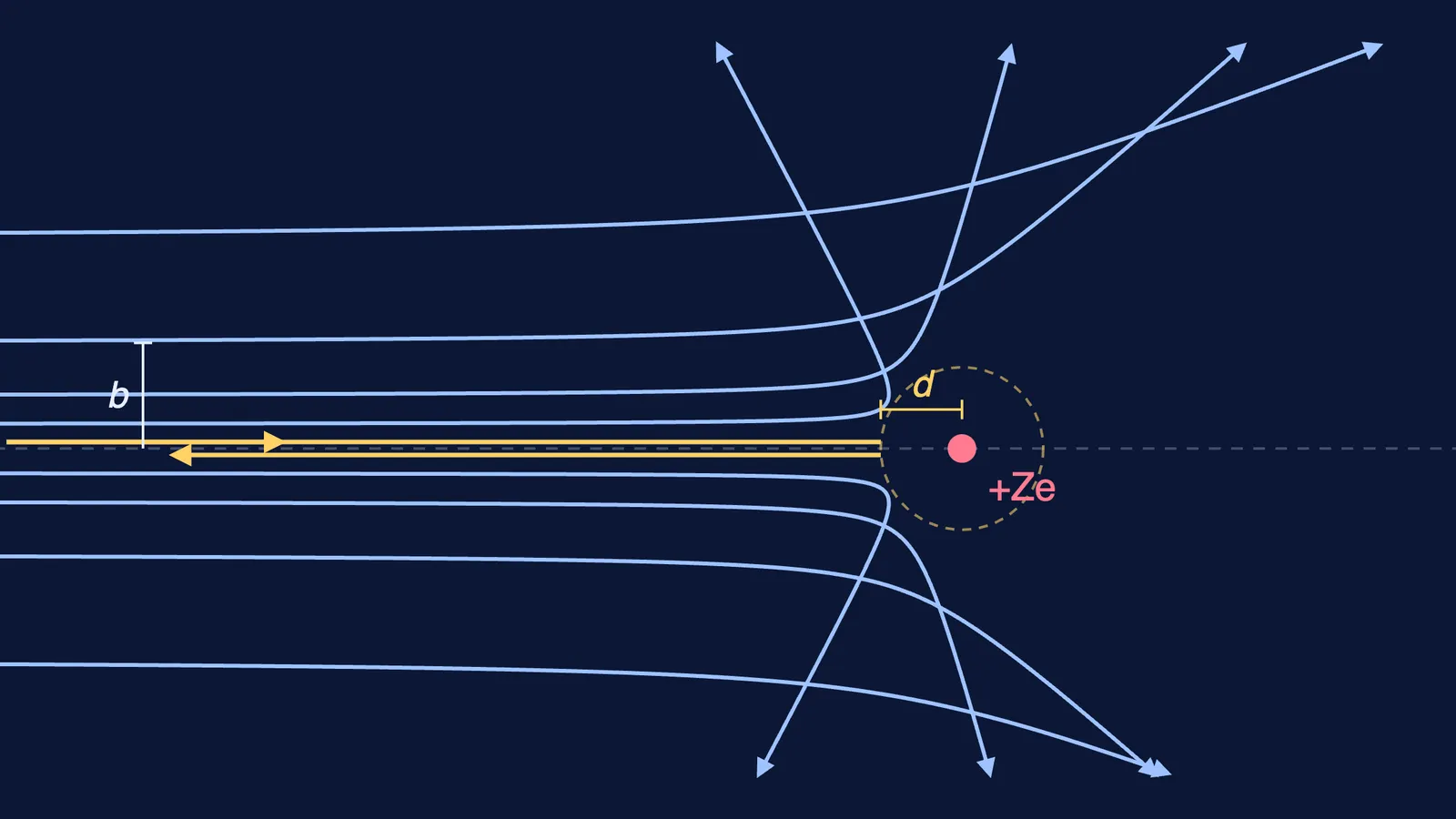
Q3 (easy). In the Geiger-Marsden experiment, an alpha particle aimed with a very small impact parameter at a gold nucleus
(A) passes almost undeviated (B) is captured by the nucleus (C) bounces back almost along its path (D) is deflected by about 90° every time
Answer: (C). NCERT section 12.2.1: the smaller the impact parameter, the larger the scattering, and a head-on alpha particle rebounds (θ ≈ π). Common slip: (B). Repulsion turns it round outside the nucleus.
Medium: can you link energy, orbits and mass?
Q4 (medium). The potential energy of the electron in a hydrogen atom is −3.02 eV. Its total energy is
(A) −1.51 eV (B) −3.02 eV (C) +1.51 eV (D) −4.53 eV
Answer: (A). From NCERT's expressions, U = −2K, so K = 1.51 eV and E = K + U = −1.51 eV (this is the n = 3 state). Common slip: (D) subtracts K instead of adding it; K is always positive.
Q5 (medium). Which hydrogen transition emits the photon with the shortest wavelength?
(A) n = 2 to n = 1 (B) n = 6 to n = 2 (C) n = 4 to n = 3 (D) n = 3 to n = 2
Answer: (A). Shortest wavelength means largest energy gap. The gaps are 13.6(1 − 1/4) = 10.2 eV, 13.6(1/4 − 1/36) = 3.02 eV, 0.66 eV and 1.89 eV. So 2 to 1 wins (about 122 nm). Common slip: (B) has the biggest jump in n, but the levels crowd together as n grows.
Q6 (medium). A nucleus with Z = 20 and A = 40 has a mass defect of 0.367 u. Its binding energy per nucleon is about
(A) 342 MeV (B) 17.1 MeV (C) 8.55 MeV (D) 0.0092 MeV
Answer: (C). Binding energy = 0.367 × 931.5 = 341.9 MeV. Per nucleon, divide by A = 40: 8.55 MeV. Common slip: (B) divides by Z, the number of protons, instead of all 40 nucleons. NCERT's Chapter 13, Nuclei puts the peak of the curve at about 8.75 MeV for A = 56.
Hard: can you handle two steps at once?
Q7 (hard). An alpha particle with kinetic energy K, aimed head-on at a nucleus, gets no closer than d. A proton with kinetic energy K/4 is aimed head-on at the same nucleus. Its distance of closest approach is
(A) d/2 (B) 2d (C) 4d (D) 8d
Answer: (B). At the turning point K = qZe/4πε0d, so d grows with the projectile's charge q and falls as 1/K. The proton has half the charge (halves d) and a quarter of the energy (multiplies d by 4), so the new distance is 2d. Common slip: (C) keeps the alpha particle's charge 2e for the proton.
Q8 (hard). A photon from the n = 3 to n = 1 transition in one hydrogen atom is absorbed by a second hydrogen atom that is in its n = 2 state. What happens?
(A) The electron leaves the atom with about 8.7 eV of kinetic energy (B) The electron leaves with 12.09 eV (C) The electron rises to n = 4 (D) Nothing, since 12.09 eV matches no gap from n = 2
Answer: (A). The photon carries 13.6(1 − 1/9) = 12.09 eV. From n = 2, only 3.4 eV is needed to free the electron, so the atom is ionised and the electron keeps 12.09 − 3.4 ≈ 8.69 eV. Common slip: (D). Exact matching applies only between bound levels; above the ionisation energy, any photon frees the electron.
What should you do after this set?
Sort each miss: recall (Q1 to Q3), linking two results (Q4 to Q6) or a two-step chain (Q7, Q8). Rework that kind for two days, then retry.
For Q6, read the binding energy per nucleon curve explained; for the Bohr questions, see Atoms Class 12 board exam: Bohr answers and traps.
If you pick the right formula but the wrong method, the Fermi Problem Library has worked problems with a step-by-step solver that explains the reasoning rather than printing an answer.