On this page
Eight original Atomic Structure questions for JEE Main, from quantum-number counting to a photoelectric problem that ends in a de Broglie wavelength. Two are numerical-value questions. Each "Trap" line names the wrong option a rushed student is most likely to pick.
Every question sits inside Unit 2, Atomic Structure, of the official JEE (Main) 2027 syllabus from NTA. Data come from the NCERT Class 11 Chemistry Part I textbook (Reprint 2026-27), Unit 2: rₙ = 52.9 n²/Z pm, Eₙ = −2.18 × 10⁻¹⁸ Z²/n² J (about −13.6 Z²/n² eV) and R = 109,677 cm⁻¹.
How should you use this practice set?
The JEE (Main) 2027 information bulletin gives Chemistry 20 multiple-choice questions in Section A and 5 numerical-value questions in Section B, with +4 for a correct answer and −1 for a wrong one in both sections.
Take 16 minutes for all eight before reading any solution.
For Q5 and Q8, enter a whole number, as on the exam screen.
For every miss, write the trap in your own words.
New to the chapter? Read our guide on how to prepare Structure of Atom for JEE Main.
Easy: can you count orbitals and electrons correctly?
Q1 (easy). How many electrons in a single atom can have n = 4, mₗ = +1 and mₛ = +½?
(A) 1 (B) 3 (C) 6 (D) 8
Answer: (B). For n = 4, l runs from 0 to 3. mₗ = +1 needs l ≥ 1, so it exists in 4p, 4d and 4f: three orbitals. Each holds one electron with mₛ = +½, so 3. Trap: (C) forgets the spin condition and counts both electrons in each orbital.
Q2 (easy). The ratio of the radius of the n = 3 Bohr orbit of Li²⁺ to that of the n = 2 orbit of He⁺ is
(A) 1 (B) 3/2 (C) 9/4 (D) 2/3
Answer: (B). rₙ is proportional to n²/Z. Li²⁺: 9/3 = 3. He⁺: 4/2 = 2. Ratio 3/2. Trap: (C) drops Z and compares only n²; (A) uses n instead of n².
Q3 (easy). Which pair of ground-state atoms has the same number of unpaired electrons?
(A) Cr and Fe (B) Mn and Ni (C) Cu and Sc (D) Ti and Zn
Answer: (C). Cu is [Ar]3d¹⁰4s¹ (one unpaired, in 4s) and Sc is [Ar]3d¹4s² (one unpaired). (Cr 6, Fe 4, Mn 5, Ni 2, Ti 2, Zn 0.) Trap: (A) works only if you write Cr as 3d⁴4s², which gives 4 unpaired like Fe. NCERT gives Cr as 3d⁵4s¹: a half-filled subshell is extra stable.
Medium: can you turn spectra and photons into numbers?
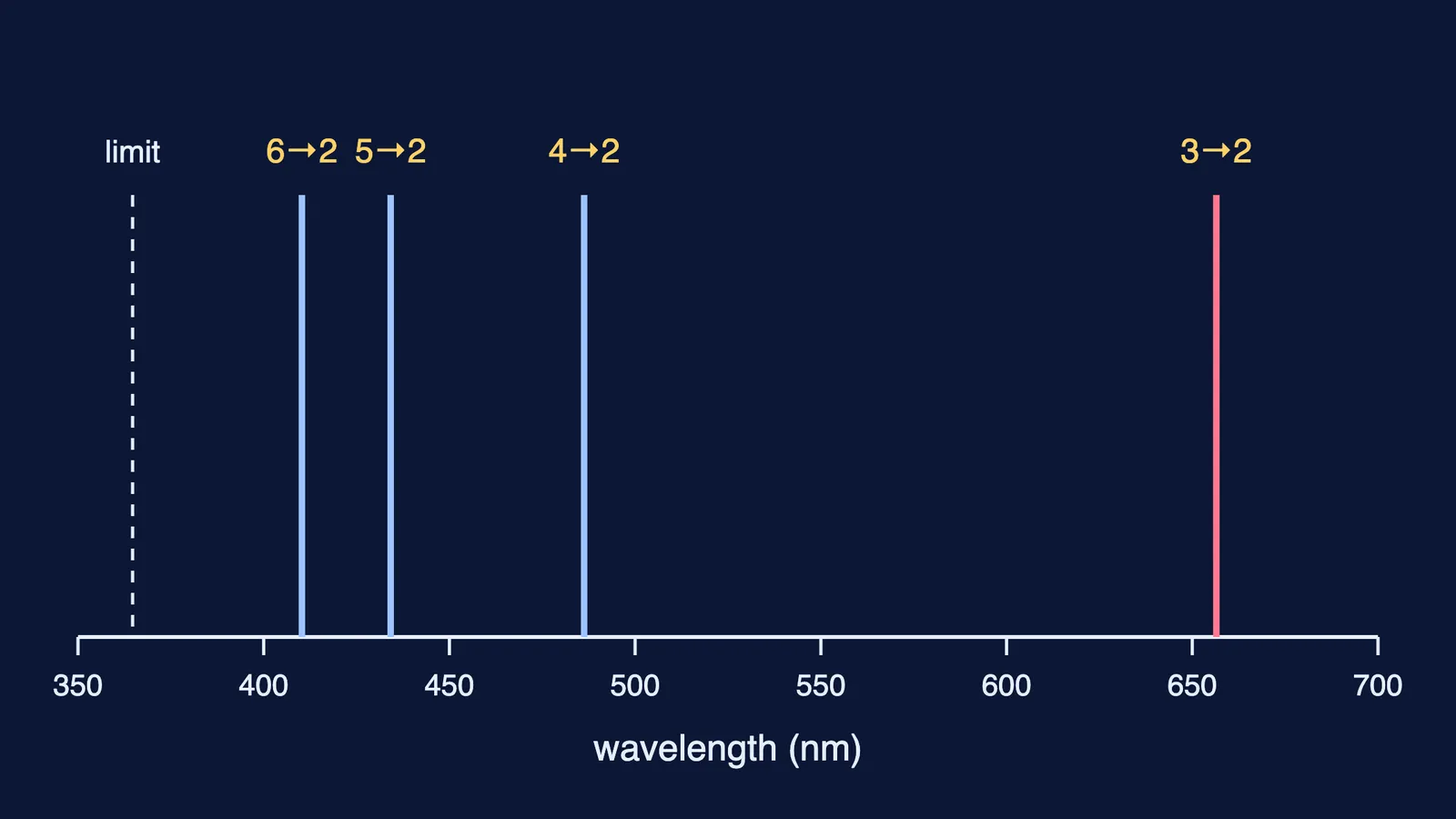
Q4 (medium). A sample of hydrogen atoms is excited to n = 6. As they return to the ground state, how many different lines of the Balmer series can appear?
(A) 4 (B) 5 (C) 10 (D) 15
Answer: (A). Balmer lines end at n = 2, and can start at n = 3, 4, 5 or 6: four lines. Trap: (D) is the total from n = 6, 6 × 5/2 = 15, across all series. (C) counts every transition among levels 2 to 6. See why one electron gives hydrogen so many spectral lines.
Q5 (medium, numerical). A lamp gives out 4.0 W of light, all of wavelength 550 nm. The number of photons it emits per second is N × 10¹⁸. Find N to the nearest integer. (h = 6.626 × 10⁻³⁴ J s, c = 3.0 × 10⁸ m s⁻¹)
Answer: 11. One photon carries hc/λ = 1.988 × 10⁻²⁵ ÷ 5.50 × 10⁻⁷ = 3.61 × 10⁻¹⁹ J. Photons per second = 4.0 ÷ 3.61 × 10⁻¹⁹ = 1.11 × 10¹⁹ = 11.1 × 10¹⁸, so N = 11. Trap: entering 1 means you stopped at 1.1 × 10¹⁹ without rescaling to 10¹⁸.
Q6 (medium). Using R = 109,677 cm⁻¹ and the Z² scaling for one-electron species, the wavelength of the series limit of the Balmer series of He⁺ is closest to
(A) 22.8 nm (B) 91.2 nm (C) 182.4 nm (D) 364.7 nm
Answer: (B). At the series limit n₂ → ∞, so 1/λ = RZ²(1/2²) = 109,677 × 4 × ¼ = 109,677 cm⁻¹ and λ = 9.12 × 10⁻⁶ cm = 91.2 nm. Trap: (D) is hydrogen's Balmer limit, without Z². (C) multiplies by Z, not Z². (A) uses n₁ = 1, the Lyman series. More on the series limit in the hydrogen spectrum.
Hard: can you chain two ideas in one question?
Q7 (hard). The electron in a Li²⁺ ion has an energy of −4.896 eV. Taking Eₙ = −13.6 Z²/n² eV, its Bohr angular momentum is
(A) 5h/4π (B) 5h/2π (C) 5h/π (D) 25h/2π
Answer: (B). With Z = 3: −122.4/n² = −4.896 gives n² = 25, so n = 5. Bohr's condition mvr = nh/2π gives 5h/2π. Trap: (D) uses n² instead of n. (C) drops the 2 from nh/2π, and (A) borrows h/4π from the uncertainty principle.
Q8 (hard, numerical). Light of wavelength 200 nm falls on a metal surface with a work function of 4.70 eV. Taking hc = 1240 eV nm, h = 6.626 × 10⁻³⁴ J s, mₑ = 9.109 × 10⁻³¹ kg and 1 eV = 1.602 × 10⁻¹⁹ J, the de Broglie wavelength of the fastest photoelectrons is x × 10⁻¹⁰ m. Find x to the nearest integer.
Answer: 10. Photon energy = 1240/200 = 6.20 eV, so the fastest electrons have 6.20 − 4.70 = 1.50 eV = 2.40 × 10⁻¹⁹ J. Then p = √(2mE) = 6.62 × 10⁻²⁵ kg m s⁻¹ and λ = h/p = 1.00 × 10⁻⁹ m = 10 × 10⁻¹⁰ m. Trap: using the full 6.20 eV gives 4.9 × 10⁻¹⁰ m, an answer of 5. Subtract the work function first.
What should you do after checking your answers?
7 or 8 right: move on to mixed timed sets.
4 to 6 right: redo every miss tomorrow on a blank page, starting from the formula.
3 or fewer: reread the NCERT sections on the Bohr model and quantum numbers, then retry in three days.
Sort misses by the rule you broke ("Z², not Z", "subtract the work function"), not by question number. If a method keeps slipping, the Fermi Problem Library has worked problems with a step-by-step solver that explains the reasoning rather than printing an answer.