On this page
Chapter 9 of the new NCERT Class 9 science book, Exploration, is called Atomic Foundations of Matter, and it follows Chapter 8, Journey Inside the Atom (NCERT, Chapter 9 PDF). The terms follow the chapter's order. For a study plan, see our Atomic Foundations of Matter class 9 chapter guide.
Scope: the mole concept is not in this chapter, and CBSE's 2026-27 key concepts for Atoms and Molecules do not list it (CBSE curriculum 2026-27).
What do the laws of chemical combination say?
Physical change: a change of form or state with no new substance; mass stays the same. Example: salt dissolving in water. Don't confuse with: chemical change.
Chemical change (chemical reaction): a change in which new substances form. Example: vinegar and baking soda giving carbon dioxide.
Law of Conservation of Mass: in a chemical reaction, the total mass of the products equals the total mass of the reactants, because matter is not created or destroyed. NCERT credits it to Antoine Lavoisier in 1789 (NCERT, Chapter 9). Example: vinegar and baking soda lose mass in an open flask only because carbon dioxide escapes; with a balloon sealing the flask, the mass stays the same.
Law of Constant Proportions (Law of Definite Proportions, Proust's Law): a pure compound always holds its elements in the same ratio by mass, whatever its source. Example: purified water always has hydrogen and oxygen in a 1:8 mass ratio (NCERT, Chapter 9). Don't confuse with: a mixture, whose proportions can vary.
Postulate: a statement taken as true without proof, on which a theory is built.
Dalton's Atomic Theory: John Dalton's set of postulates, presented in 1808: matter is made of indivisible atoms that are not created or destroyed in reactions and combine in simple whole-number ratios.
What is the difference between an atom, a molecule and an ion?
Atom: the tiny particle all matter is made of; in a reaction atoms rearrange but are not created or destroyed. Example: helium exists as single atoms because its atoms are already stable.
Molecule: a particle of two or more bonded atoms with no overall charge, which can exist on its own and behaves like the substance itself. Example: H₂, HCl.
Molecule of an element: atoms of the same element joined together. Example: O₂. Don't confuse with: molecule of a compound, atoms of different elements joined, such as H₂O.
Valence shell: the outermost shell of an atom; its electrons (valence electrons) take part in bonding.
Octet: eight electrons in the valence shell, a stable arrangement. Don't confuse with: duplet, two electrons when the K shell is the outermost shell, as in hydrogen.
Chemical bond: the force that holds atoms together.
How do atoms share electrons in a covalent bond?
Covalent bond: a bond formed when two atoms share electron pairs; each shared pair attracts both nuclei.
Single bond: one shared pair, drawn as one line. Example: H–H, Cl–Cl, H–Cl.
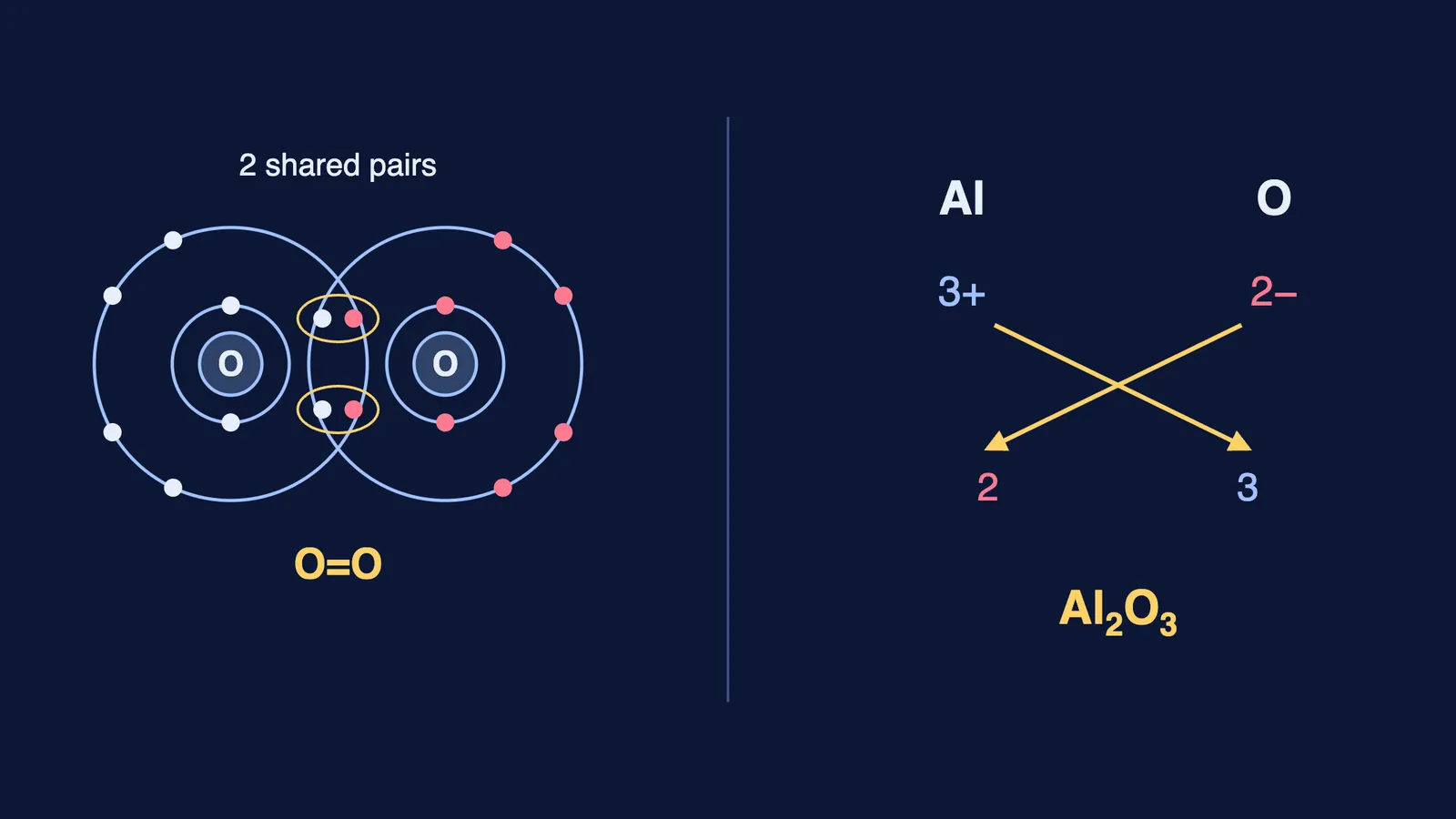
Double bond: two shared pairs, drawn as two lines. Example: O=O, where each oxygen has six valence electrons and needs two more.
Covalent compound: a compound whose atoms are held by shared electrons. Example: HCl, water, camphor, sugar.
Prefix naming: covalent compounds name the number of atoms with mono-, di-, tri-, tetra-, penta-, hexa-, and the second element ends in -ide. Example: CO is carbon monoxide; N₂O₅ is dinitrogen pentoxide.
How do atoms transfer electrons to form ions?
Ion: a charged particle formed when an atom loses or gains electrons.
Cation: a positive ion, formed by losing electrons. Example: Na⁺ has 11 protons and 10 electrons. Don't confuse with: anion, a negative ion formed by gaining electrons, such as Cl⁻ or S²⁻.
Ionic bond: the electrostatic attraction between oppositely charged ions. Example: Na⁺ and Cl⁻ in sodium chloride.
Ionic compound: a compound made of cations and anions, usually a metal with a non-metal. Example: calcium oxide.
Polyatomic ion: an ion made of two or more atoms. Example: SO₄²⁻, NH₄⁺. Don't confuse with: monoatomic ion, a single charged atom such as Mg²⁺.
Crystal structure: the regular, repeating 3-D arrangement of ions in an ionic solid; a crystal lattice shows the ions as points.
How do you write formulas and work out masses?
Valency: the number used to write formulas; for an ion in Table 9.1 it equals the size of its charge, and for covalent formulas the chapter uses values such as H 1, S 2 and C 4. Example: Al³⁺ has valency 3, O²⁻ has valency 2.
Chemical formula: symbols and subscripts showing which elements a compound has. For a covalent compound it gives the actual number of atoms; for an ionic compound, the simplest ratio of ions.
Crossover (criss-cross) method: write the symbols, write valencies or charges underneath, swap the numbers as subscripts and divide by any common factor. Example: Al³⁺ and O²⁻ give Al₂O₃; Mg²⁺ and O²⁻ give Mg₂O₂, written MgO. Use brackets for more than one polyatomic ion: Al(OH)₃.
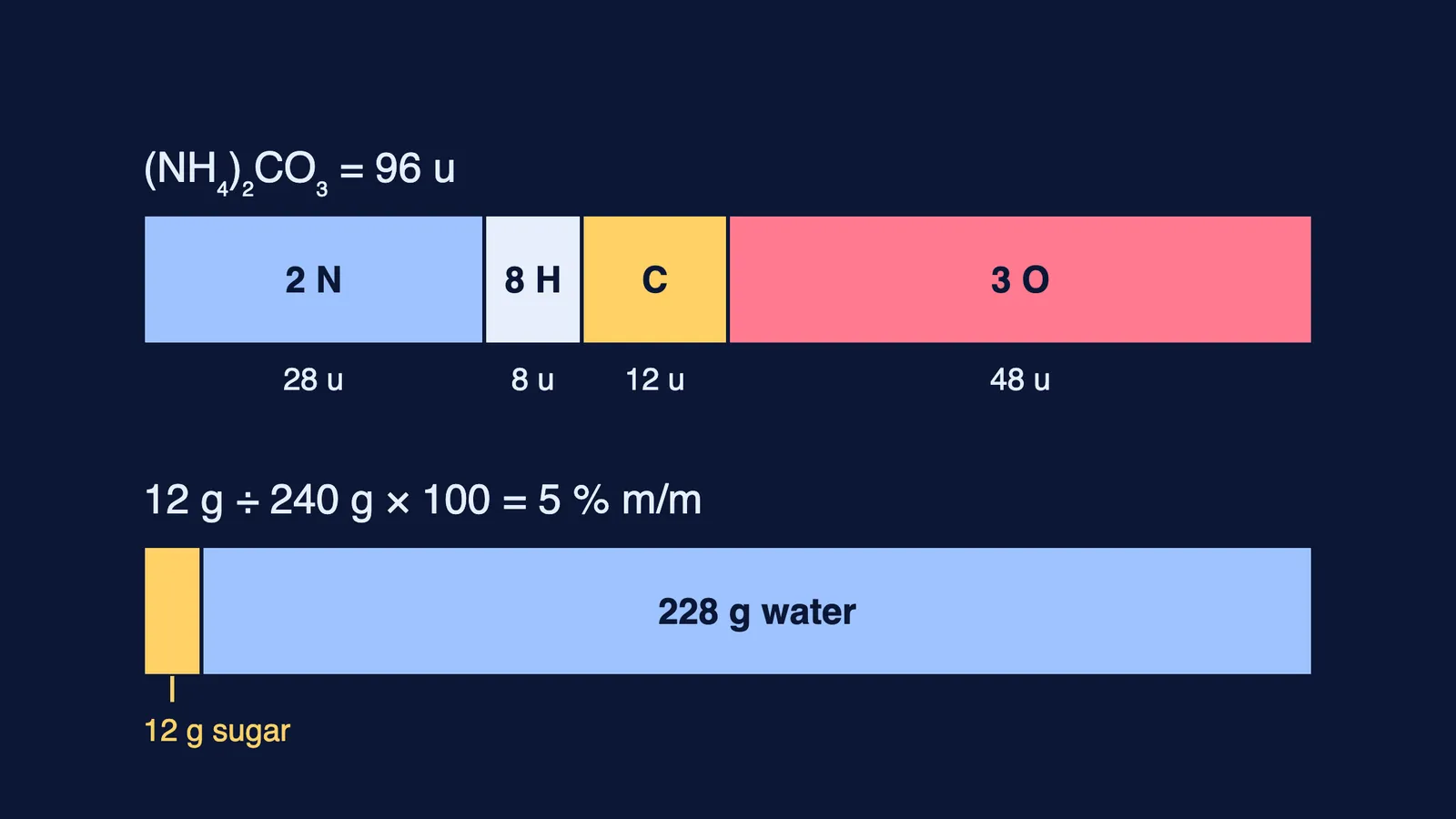
Molecular mass: the sum of the atomic masses of all atoms in a molecule of a covalent compound. Example: H₂O = (2 × 1 u) + 16 u = 18 u (NCERT, Chapter 9).
Formula unit: the simplest whole-number ratio of ions in an ionic compound, since ionic compounds form crystals, not molecules.
Formula unit mass: the mass of one formula unit. Example: Na₂O = (2 × 23 u) + 16 u = 62 u. Don't confuse with: molecular mass, which is only for covalent compounds.
How to learn these terms
Learn the pairs together: cation and anion, single and double bond, molecular mass and formula unit mass, physical and chemical change.
Draw H₂, O₂, HCl and NaCl from memory.
Make your own flashcards from Table 9.1: ion on one side, charge and valency on the other, then crossover five formulas a day.
Check mass-law sums yourself, as in the chapter's calcium carbonate example: 6.92 g of reactants give 6.92 g of products.
If an idea such as valency will not settle, the Fermi Concept Library gives each concept in chemistry its own lesson and its place in the map. When you are ready for what comes after Class 9, see our Class 11 chemical bonding guide and Some Basic Concepts of Chemistry Class 11.