On this page
Thermal Properties of Matter is Chapter 10 of the CBSE Class XI Physics syllabus for 2026-27, from expansion and calorimetry to Wien's and Stefan's laws. Every statement below was checked against NCERT Class 11 Physics, Chapter 10 (Reprint 2026-27).
How do you answer assertion-reason questions?
Judge each line true or false on its own. Only if both are true, ask: is R the direct reason for A?
Use these keys for Q1 to Q6:
(A) Both A and R are true and R is the correct explanation of A.
(B) Both A and R are true but R is NOT the correct explanation of A.
(C) A is true but R is false.
(D) A is false but R is true.
More on the method: assertion-reason question strategy.
Assertion-reason questions on thermal properties of matter
Q1 (easy). Assertion (A): A scald from steam at 100 °C is usually worse than one from the same mass of water at 100 °C. Reason (R): Each kilogram of steam at 100 °C gives out about 22.6 × 10⁵ J as it condenses to water at 100 °C.
Answer: (A). Both are true and R explains A: condensing steam delivers that latent heat to the skin.
Trap: equal temperature does not mean equal heat.
Q2 (easy). Assertion (A): Rice cooks more slowly in an open pot at a hill station than at sea level. Reason (R): Lower air pressure raises the boiling point of water.
Answer: (C). A is true. R is false: lower pressure lowers the boiling point, so the water boils below 100 °C.
Trap: knowing pressure matters but not which way.
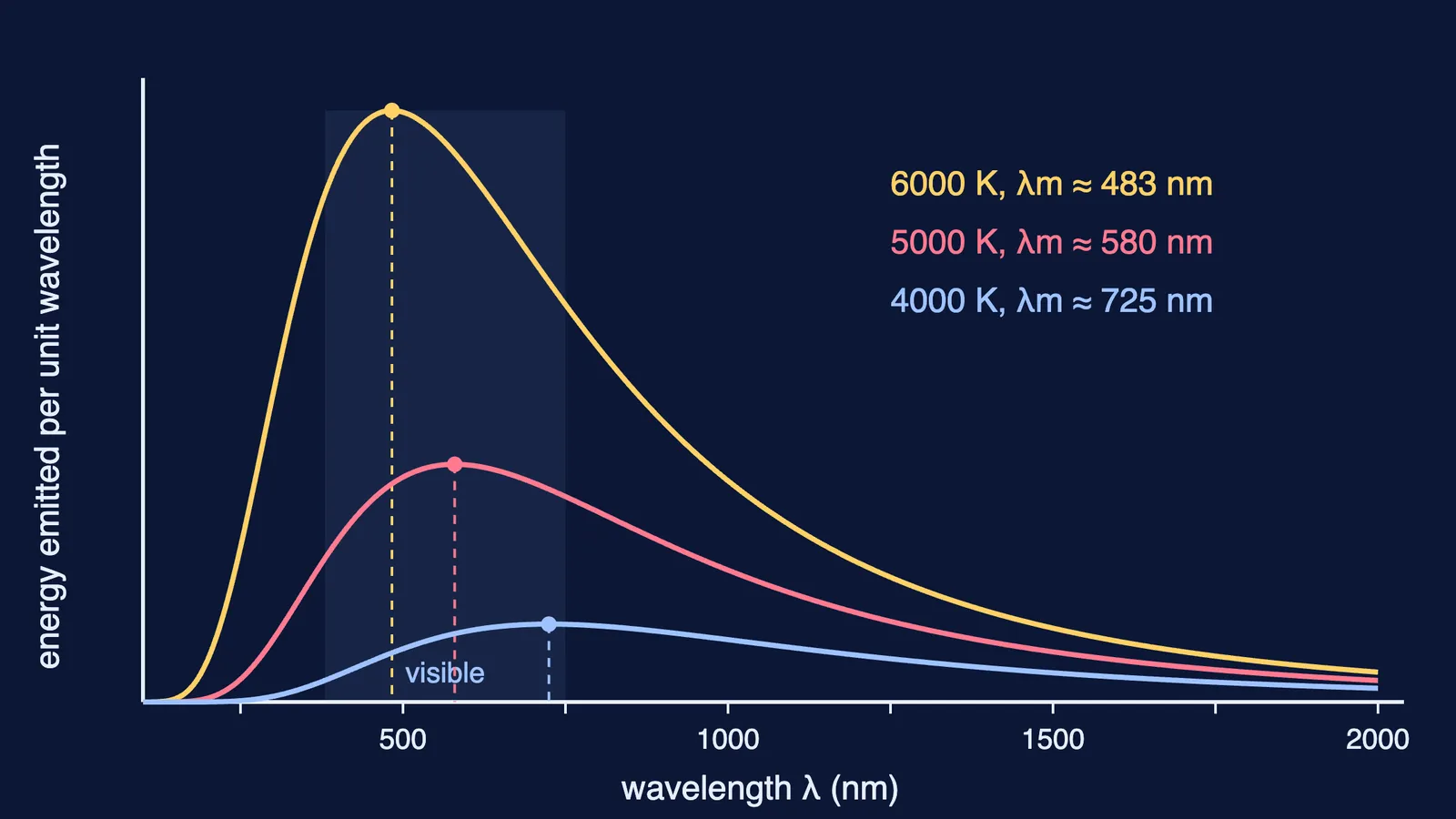
Q3 (medium). Assertion (A): As a black body gets hotter, its wavelength of strongest emission moves to longer values. Reason (R): For a black body, peak wavelength times absolute temperature is constant.
Answer: (D). A is false, R is true. By Wien's law, λm T = 2.9 × 10⁻³ m K, so the peak moves to shorter wavelengths: about 967 nm at 3000 K, 483 nm at 6000 K.
Trap: linking "more energy" with "longer wavelength".
Q4 (medium). Assertion (A): Constant-volume gas thermometers filled with different low-density gases give the same readings. Reason (R): At ordinary temperatures, gases expand much more than solids and liquids.
Answer: (B). Both are true, but R does not explain A. They agree because every low-density gas obeys PV = µRT, so P ∝ T for each.
Trap: accepting a true, related fact as the cause.
Q5 (medium). Assertion (A): In winter a lake freezes at the surface first, while water near the bottom stays near 4 °C. Reason (R): Water is densest at 4 °C, so water cooled below 4 °C is lighter and stays on top.
Answer: (A). Both are true and R explains A.
Trap: assuming the coldest water always sinks.
Q6 (hard). Assertion (A): Mixing 1 kg of ice at 0 °C with 1 kg of water at 50 °C in an insulated flask (neglect the flask) gives water at 25 °C. Reason (R): In an isolated system, heat lost by the hotter part equals heat gained by the colder part.
Answer: (D). A is false, R is true. Cooling the water to 0 °C releases 1 × 4186 × 50 ≈ 2.09 × 10⁵ J, less than the 3.33 × 10⁵ J needed to melt the ice. The mixture ends at 0 °C with about 0.37 kg of ice left.
Trap: averaging temperatures and forgetting latent heat.
Statement I and Statement II questions
Use these keys for Q7 to Q10:
(A) Both statements are correct.
(B) Both statements are incorrect.
(C) Statement I is correct, Statement II is incorrect.
(D) Statement I is incorrect, Statement II is correct.
Q7 (medium). Statement I: For an isotropic solid, the coefficient of volume expansion is about three times the linear one. Statement II: For an ideal gas at constant pressure, the coefficient of volume expansion rises with temperature.
Answer: (C). Statement I is correct: αv = 3αl. Statement II is wrong: for an ideal gas αv = 1/T, about 3.7 × 10⁻³ K⁻¹ at 0 °C but 2.7 × 10⁻³ K⁻¹ at 100 °C.
Trap: assuming everything expands more readily when hotter.
Q8 (medium). Statement I: Doubling the mass of an iron block doubles its specific heat capacity. Statement II: In the steady state, the rate of heat flow across a cross-section of a laterally insulated metal bar is greater near its hot end than near its cold end.
Answer: (B). Both are wrong. Heat capacity doubles with mass; specific heat capacity is per unit mass and depends on the substance. In the steady state, the heat current is equal at every cross-section.
Trap: mixing up heat capacity and specific heat capacity.
Q9 (hard). Statement I: Two rods of equal length and cross-section, conductivities K1 and K2, joined end to end conduct like one rod of conductivity 2K1K2/(K1 + K2). Statement II: Equal-sized steel (K = 50.2 W m⁻¹ K⁻¹) and copper (K = 385 W m⁻¹ K⁻¹) rods are joined, steel end at 100 °C, copper end at 0 °C; the junction settles near 11.5 °C.
Answer: (A). Both are correct. Equal heat current gives 50.2(100 − T0) = 385 T0, so T0 ≈ 11.5 °C.
Trap: putting the junction halfway, at 50 °C.
Q10 (hard). Statement I: Doubling the absolute temperature of a black body makes it radiate 8 times the power. Statement II: A star whose radiation peaks at 290 nm has a surface temperature of about 10,000 K.
Answer: (D). Statement I is wrong: Stefan's law H = AσT⁴ gives 2⁴ = 16 times. Statement II is correct: (2.9 × 10⁻³ m K)/(290 × 10⁻⁹ m) = 10,000 K.
Trap: recalling T³ instead of T⁴.
How should you use this set?
Attempt all ten without notes, marking each line T or F first.
For every miss, note what you misjudged: A, R, or the link.
Redo the misses after three days, then try the harder thermal physics practice questions with solutions.
If Wien's law is hard to picture, the Fermi Simulation Lab has interactive simulations for the ideas that are easier to see than to read. For the full chapter, with formulas and worked numericals, read the Thermal Properties of Matter Class 11 chapter guide.