On this page
Eight original questions in four question formats, easy to hard.
What does JEE Advanced test in thermal physics?
The official JEE (Advanced) 2026 syllabus lists thermal expansion, one-dimensional conduction, the bulk modulus of gases, the first law, reversible and irreversible processes and Stefan's law, among others. For theory and a plan, read how to prepare thermal physics for JEE Advanced.
Take R = 8.314 J mol⁻¹ K⁻¹, σ = 5.67 × 10⁻⁸ W m⁻² K⁻⁴ (NIST CODATA) and g = 10 m/s².
How should you attempt this set?
Cover the answers; allow 35 minutes.
For each process, first write which of Q, W and ΔU is zero.
Easy: expansion and thermal stress
Q1 (easy, single correct). A pendulum clock with a brass rod (α = 2.0 × 10⁻⁵ K⁻¹) is correct at 15 °C. At 35 °C, over one day it:
(A) gains 17.3 s (B) loses 17.3 s (C) loses 34.6 s (D) loses 8.6 s
Answer: (B). T ∝ √L, so the period grows by ½αΔT = 2.0 × 10⁻⁴: the clock loses 86 400 × 2.0 × 10⁻⁴ ≈ 17.3 s.
Trap: (C) drops the ½.
Q2 (easy, numerical). A steel bar (cross-section 4.0 cm², Y = 2.0 × 10¹¹ Pa, α = 1.2 × 10⁻⁵ K⁻¹) fits exactly between rigid walls at 20 °C and is heated to 50 °C. Find the force on each wall in kN.
Answer: 28.8. The walls cancel the free strain αΔT: F = YAαΔT = 28.8 kN, for any length.
Trap: 86.4, from using 3α.
Medium: gas springs, signs and radiation
Q3 (medium, one or more correct). A frictionless 2.0 kg piston of area 10 cm² rests on a 20 cm column of diatomic ideal gas (γ = 1.4) in an insulated vertical cylinder; outside pressure is 1.0 × 10⁵ Pa. Which are correct?
(A) The gas pressure is 1.02 × 10⁵ Pa. (B) The gas's adiabatic bulk modulus is 1.68 × 10⁵ Pa. (C) Displaced slightly, the piston oscillates with period about 0.31 s. (D) If the oscillation were isothermal, the period would be shorter.
Answer: (B), (C). P = 10⁵ + 20/0.001 = 1.2 × 10⁵ Pa and B = γP = 1.68 × 10⁵ Pa. A displacement x adds pressure γPx/h, so ω² = γPA/(mh) = 420 s⁻², T ≈ 0.31 s. Isothermally B = P: softer, about 0.36 s.
Trap: (A) adds m instead of mg over the area.
Q4 (medium, list match). Match List I with List II.
List I (1 mol of ideal gas each): (I) doubles its volume reversibly at 300 K; (II) rigid diatomic, heated 100 K at constant pressure; (III) free expansion inside an insulated rigid box; (IV) monatomic, compressed reversibly and adiabatically from 300 K to 600 K.
List II: (P) ΔU = 0 and Q > 0. (Q) Q = 0 and ΔU > 0. (R) Q = W = ΔU = 0. (S) Q ≈ 2.9 kJ. (T) W ≈ 2.9 kJ.
(A) I→P, II→T, III→R, IV→Q (B) I→P, II→S, III→R, IV→Q (C) I→R, II→S, III→P, IV→Q (D) I→P, II→S, III→Q, IV→R
Answer: (B). (I) ΔU = 0, Q = RT ln 2 ≈ 1.73 kJ. (II) Q = (7/2)R × 100 ≈ 2.91 kJ; W is only 0.83 kJ. (III) No work, no heat. (IV) Q = 0, ΔU = (3/2)R × 300 ≈ 3.74 kJ.
Trap: (C) swaps the two expansions; only the isothermal one draws heat.
Q5 (medium, numerical). A solid blackbody sphere (radius 1.0 cm, density 8000 kg/m³, specific heat 400 J kg⁻¹ K⁻¹) at 600 K hangs in an evacuated enclosure with walls at 300 K. Find its initial cooling rate in K/s, to two decimals.
Answer: 0.65. mc dT/dt = σA(T⁴ − T₀⁴) with A/m = 3/(ρr): dT/dt = 3σ(600⁴ − 300⁴)/(ρrc) ≈ 0.646 K/s.
Trap: 0.69, ignoring radiation from the walls.
Hard: can you combine two ideas?
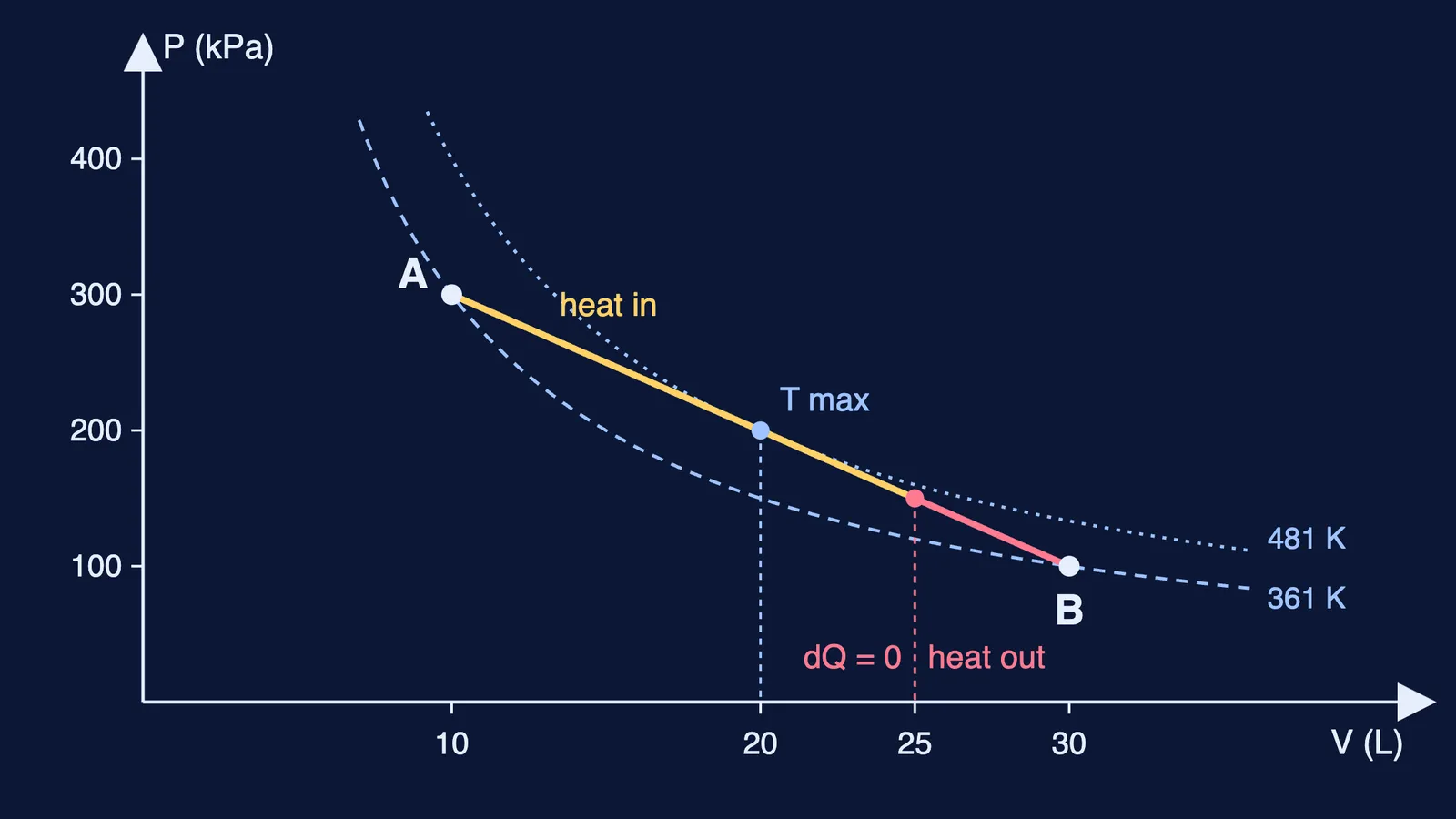
Q6 (hard, one or more correct). One mole of monatomic ideal gas goes from A (10 L, 300 kPa) to B (30 L, 100 kPa) along a straight P–V line (figure above). Which are correct?
(A) The temperature is highest at V = 25 L. (B) Heat flows in from 10 L to 25 L and out from 25 L to 30 L. (C) The net heat absorbed from A to B is 4.0 kJ. (D) The heat absorbed between 10 L and 25 L is 4.0 kJ.
Answer: (B), (C). With P = 400 − 10V (kPa, L), PV peaks at 20 L (about 481 K). dQ = (3/2)d(PV) + P dV = (1000 − 40V) dV changes sign at 25 L. T_A = T_B, so net Q = area = 4.0 kJ; heat in up to 25 L is 4.5 kJ.
Trap: (A) puts the peak where dQ = 0.
Q7 (hard, numerical). A diatomic ideal gas at 300 K is under a light piston in an insulated cylinder. The outside pressure is suddenly tripled and held. Find the final temperature in kelvin (nearest integer).
Answer: 471. Q = 0 against a constant 3P₁: (5/2)R(T − 300) = −3P₁(V₂ − V₁) = −RT + 900R, so T = 1650/3.5 ≈ 471 K.
Trap: 411, the reversible adiabat; a sudden push is irreversible.
Q8 (hard, one or more correct). Insulated bodies A (600 J/K, 100 °C) and B (1200 J/K, 10 °C) are joined only by a copper rod (0.50 m long, 2.0 cm², k = 400 W m⁻¹ K⁻¹) of negligible heat capacity. Which are correct?
(A) The final common temperature is 55 °C. (B) The initial heat current is 14.4 W. (C) The temperature difference halves in about 29 minutes. (D) In all, 54 kJ flows through the rod.
Answer: (B), (C). Rod resistance L/(kA) = 6.25 K/W; initial current 90/6.25 = 14.4 W. The gap decays as e^(−t/τ), τ = 6.25 × 600 × 1200/1800 = 2500 s, halving in 2500 ln 2 ≈ 29 min. Final temperature 40 °C, so 36 kJ flows.
Trap: (A), the plain average; B's larger heat capacity wins.
What should you do after this set?
6 or more right: move to timed mixed papers.
Fewer: redo misses two days later, and warm up with our JEE Main thermodynamics practice questions; see also JEE Advanced question types.
If one step keeps failing, the Fermi Problem Library has worked problems with a step-by-step solver that explains the reasoning rather than printing an answer.