On this page
Every statement below was checked against NCERT Class 12 Physics Part II, Chapter 9: Ray Optics and Optical Instruments (Reprint 2026-27), Chapter 9 of Unit VI in the CBSE 2026-27 Class 12 Physics syllabus. For the full chapter, see our ray optics Class 12 board exam guide.
How do you answer assertion-reason questions in Class 12 Physics?
The CBSE Class 12 Physics sample question paper for 2026-27 has four assertion-reasoning questions, Q13 to Q16, in Section A at 1 mark each. Check in order: is A true, is R true, and only then, is R the textbook's own cause of A? Our three-check method for assertion-reason questions explains it.
Keys for Q1 to Q6:
(A) Both A and R are true and R is the correct explanation of A.
(B) Both A and R are true but R is NOT the correct explanation of A.
(C) A is true but R is false.
(D) A is false but R is true.
Keys for Q7 to Q10:
(A) Both statements are correct.
(B) Both statements are incorrect.
(C) Statement I is correct, Statement II is incorrect.
(D) Statement I is incorrect, Statement II is correct.
Assertion-reason questions on ray optics
Q1 (easy). Assertion (A): Turpentine is optically denser than water. Reason (R): Turpentine has a greater mass density than water.
Answer: (C). A is true: NCERT names turpentine as optically denser than water. R is false: its mass density is lower.
Trap: assuming "denser" means the same in optics and mechanics.
Q2 (easy). Assertion (A): The critical angle at a diamond-air surface (about 24.4°) is much smaller than at a water-air surface (about 48.8°). Reason (R): sin ic = 1/n, and diamond's refractive index (2.42) is much larger than water's (1.33).
Answer: (A). Both are true (NCERT Table 9.1), and R is the direct cause: larger n, smaller sin ic.
Trap: thinking a larger n gives a larger critical angle.
Q3 (medium). Assertion (A): A ray going from water into crown glass is totally internally reflected at a large enough angle of incidence. Reason (R): Crown glass (n = 1.52) is optically denser than water (n = 1.33).
Answer: (D). A is false: total internal reflection needs light going from a denser to a rarer medium. R is true and is why A fails: the ray bends towards the normal and always enters the glass.
Trap: thinking any large angle gives total internal reflection.
Q4 (medium). Assertion (A): A telescope with a larger-diameter objective lets you observe fainter stars. Reason (R): In normal adjustment, the magnifying power of a telescope is fo/fe.
Answer: (B). Both are true, but NCERT ties light-gathering power to the objective's area; fo/fe contains no diameter.
Trap: equating magnification with brightness.
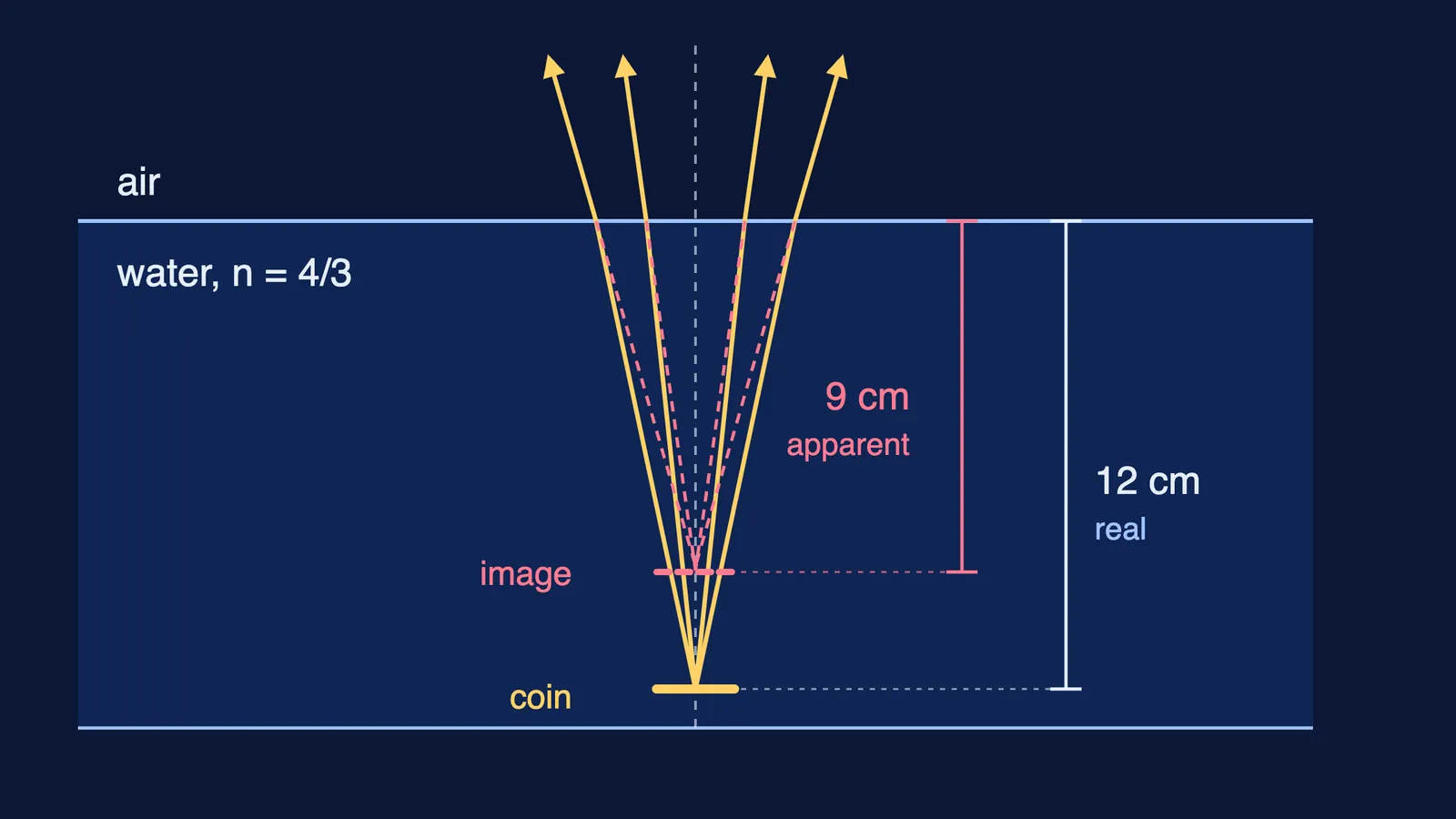
Q5 (medium). Assertion (A): A coin under 12 cm of water (n = 4/3), seen from directly above, appears raised, to about 9 cm below the surface. Reason (R): Rays from the coin bend away from the normal as they pass from water into air.
Answer: (A). Both are true. Apparent depth = 12/(4/3) = 9 cm; the emerging rays bend away from the normal and, traced back, meet above the coin (diagram at the top).
Trap: multiplying by n.
Q6 (hard). Assertion (A): Thin lenses of power +5 D and −3 D in contact act as a converging lens of focal length 50 cm. Reason (R): The focal length of thin lenses in contact is the sum of their focal lengths.
Answer: (C). A is true: P = 5 − 3 = +2 D, so f = 50 cm. R is false: 1/f = 1/f1 + 1/f2.
Trap: adding focal lengths instead of powers.
Statement I and II questions on instruments and prisms
Q7 (medium). Statement I: With the object at the focus of a simple microscope, the image is at infinity and the angular magnification is D/f. Statement II: For magnification 6 with the image at the near point (D = 25 cm), the lens needs f = 25/6 cm.
Answer: (C). Statement I matches NCERT. Statement II is wrong: at the near point m = 1 + D/f, so 6 = 1 + 25/f gives f = 5 cm.
Trap: mixing up the near-point and infinity formulas.
Q8 (medium). Statement I: As the angle of incidence on a prism increases from small values, the deviation keeps decreasing. Statement II: At minimum deviation, the angle of incidence equals the angle of emergence and the ray inside the prism runs parallel to its base.
Answer: (D). Statement I is incorrect: deviation falls to a minimum, then rises (NCERT Fig. 9.22). Statement II is correct as NCERT states it.
Trap: remembering only half the curve.
Q9 (hard). Statement I: A compound microscope with tube length 16 cm, fo = 0.8 cm and fe = 2.5 cm has magnifying power 200 (final image at infinity). Statement II: An astronomical telescope with fo = 120 cm and fe = 4 cm has magnifying power 30 and tube length 124 cm in normal adjustment.
Answer: (A). I: (L/fo)(D/fe) = 20 × 10 = 200. II: fo/fe = 30; tube length fo + fe = 124 cm.
Trap: writing the telescope length as fo − fe.
Q10 (hard). Statement I: An equiconvex lens of refractive index 1.5 with each radius 20 cm has a focal length of 10 cm. Statement II: A thin prism of angle 5° and refractive index 1.5 deviates a ray by 7.5°.
Answer: (B). Statement I is wrong: with NCERT's sign convention R1 = +20 cm and R2 = −20 cm, so 1/f = 0.5 × (1/20 − 1/(−20)) = 1/20 and f = 20 cm. Statement II is wrong: δ = (n − 1)A = 2.5°; 7.5° comes from nA.
Trap: dropping the "− 1" in (n − 1).
How should you use this set?
Mark all ten in 10 minutes.
For each miss, note which check failed: A, R, or the link.
Redo the numeric items unaided.
The deviation curve in Q8 is easier to see than to read; the Fermi Simulation Lab has interactive simulations for ideas like that. Then try our ray optics case study questions for CBSE Class 12.