On this page
Ten original questions on Principles of Inheritance and Variation, aimed at dominance types, sex determination, genetic disorders and polygenic traits.
How do you answer assertion-reason questions in this chapter?
The CBSE Class XII Biology sample paper for 2026-27 has four assertion-reason questions, Q13 to Q16, of 1 mark each in Section A. Every item below stays inside the Chapter 4 topics of the CBSE Biology curriculum for 2026-27 and follows the NCERT chapter, Reprint 2026-27.
Keys for Q1 to Q6:
(A) Both A and R are true and R is the correct explanation of A.
(B) Both A and R are true but R is not the correct explanation of A.
(C) A is true but R is false.
(D) A is false but R is true.
Keys for Q7 to Q10:
(A) Both statements are correct.
(B) Both statements are incorrect.
(C) Statement I is correct, Statement II is incorrect.
(D) Statement I is incorrect, Statement II is correct.
Judge each statement alone, then ask whether R causes A. Our three-check method for assertion-reason questions explains more.
Assertion-reason questions with answers
Q1 (easy). Assertion (A): A person with genotype I^A I^B has blood group AB. Reason (R): I^A and I^B are co-dominant, so the red blood cells carry both A and B types of sugar.
Answer: (A). NCERT says that when I^A and I^B are together, both express their own sugars because of co-dominance. That is why the blood group is AB.
Trap: calling AB incomplete dominance.
Q2 (easy). Assertion (A): In the F2 of a red (RR) × white (rr) snapdragon cross, the phenotypic ratio is the same as the genotypic ratio. Reason (R): Flower colour in snapdragon shows co-dominance.
Answer: (C). F2 is 1 RR red : 2 Rr pink : 1 rr white, so both ratios are 1:2:1 and A is true. R is false: NCERT uses snapdragon as its example of incomplete dominance, where Rr is in between, not showing both colours.
Trap: mixing up "in between" (incomplete dominance) with "both at once" (co-dominance).
Q3 (medium). Assertion (A): A drone (male honey bee) cannot have sons. Reason (R): Drones produce sperm by mitosis.
Answer: (B). Both are NCERT facts, but a drone has no sons because males develop from unfertilised eggs, so a drone's sperm only ever gives rise to females. How the sperm is made does not decide this.
Trap: picking (A) because both facts sit in one paragraph.
Q4 (medium). Assertion (A): In birds, the egg, not the sperm, decides whether a chick is male or female. Reason (R): Female birds have ZW sex chromosomes and make two kinds of eggs, while males are ZZ.
Answer: (A). NCERT calls this female heterogamety. Since every sperm carries Z, the egg (Z or W) settles the chick's sex.
Trap: carrying the human rule ("the sperm decides") over to birds.
Q5 (medium). Assertion (A): Red-green colour blindness is much more common in human males than in females. Reason (R): The genes for it lie on the Y chromosome.
Answer: (C). The NCERT chapter gives about 8 per cent of males and 0.4 per cent of females, so A is true. R is false: the genes are on the X chromosome, and males have only one X, so one recessive allele is enough.
Trap: assuming "affects males more" means "Y-linked".
Q6 (hard). Assertion (A): A person with Klinefelter's syndrome has overall female development. Reason (R): Klinefelter's syndrome is caused by an additional copy of the X chromosome, giving the karyotype 47, XXY.
Answer: (D). R is NCERT's account of the cause. A is false: NCERT describes overall masculine development with some feminine features such as gynaecomastia. In humans the Y chromosome, not the number of X chromosomes, sets maleness.
Trap: thinking two X chromosomes make a person female even when a Y is present.
Statement I and Statement II questions with answers
Q7 (medium). Statement I: Turner's syndrome (45, X0) is an example of aneuploidy. Statement II: Polyploidy results from failure of cytokinesis after telophase and is often seen in plants.
Answer: (A). NCERT lists loss of an X in Turner's syndrome as aneuploidy, the gain or loss of chromosomes. Statement II is NCERT's description of polyploidy.
Trap: calling any change in chromosome number "polyploidy".
Q8 (medium). Statement I: Thalassemia is a qualitative problem of haemoglobin, while sickle-cell anaemia is a quantitative one. Statement II: β thalassemia is controlled by a single gene, HBB, on chromosome 11.
Answer: (D). Statement I is reversed. In thalassemia too few globin molecules are made (quantitative); in sickle-cell anaemia the globin is faulty (qualitative). Statement II matches NCERT.
Trap: swapping the two words.
Q9 (hard). Assume all genes assort independently. Statement I: A diploid organism heterozygous at 4 loci can make 8 kinds of gametes. Statement II: In a cross AaBb × Aabb, one-quarter of the offspring are aabb.
Answer: (B). Gamete types are 2^4 = 16, not 8. For aabb you need aa (1/4) and bb (1/2 from Bb × bb), so 1/4 × 1/2 = 1/8.
Trap: using 2n instead of 2^n, and treating Aabb as if it were a full test-cross parent.
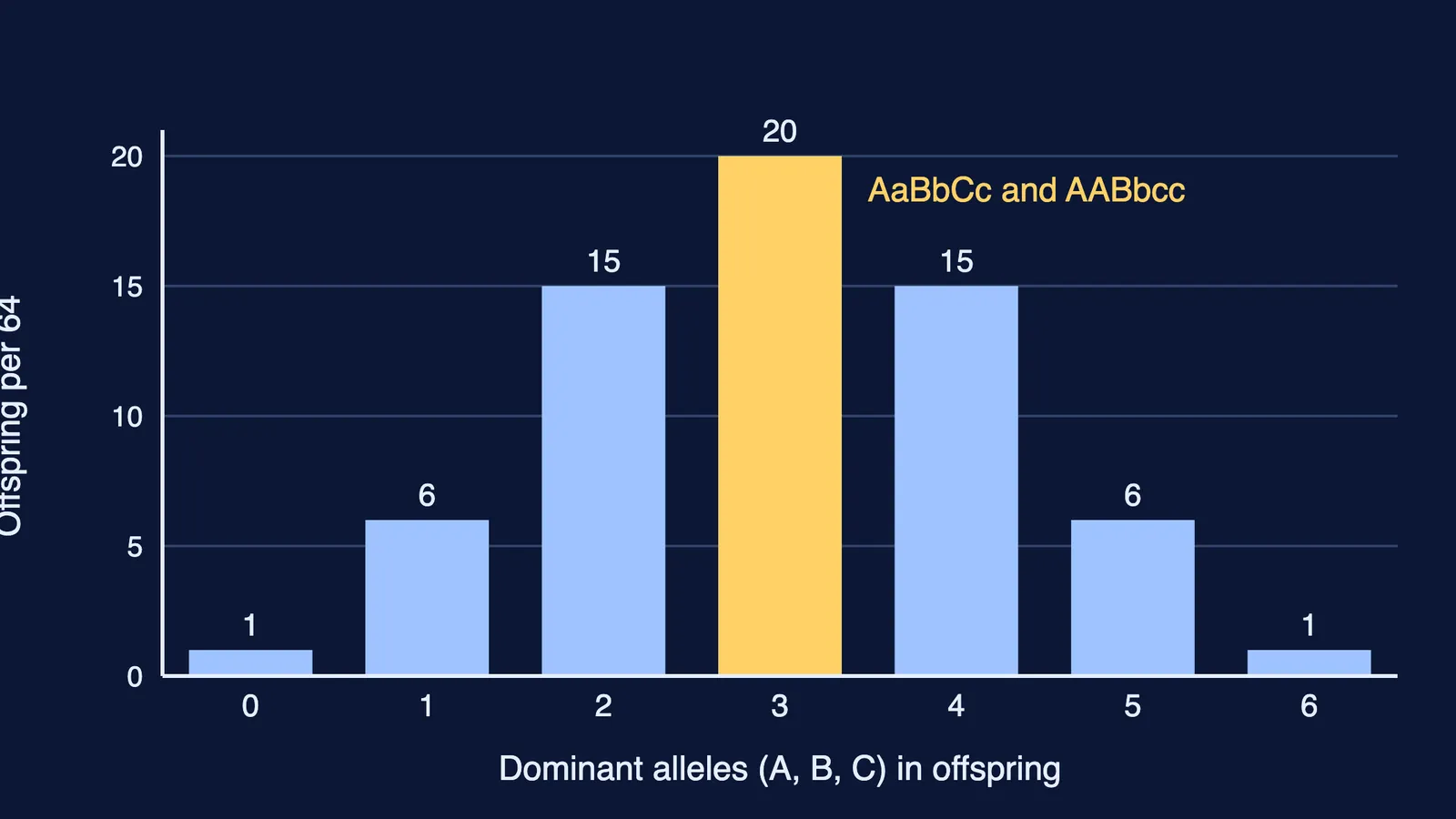
Q10 (hard). Statement I: Phenylketonuria is an example of pleiotropy. Statement II: In NCERT's three-gene model of skin colour, AaBbCc and AABbcc have different skin colours.
Answer: (C). One mutated gene in phenylketonuria causes mental retardation and reduced hair and skin pigmentation, so Statement I is true. In polygenic inheritance each dominant allele adds the same effect; both genotypes carry three dominant alleles, so they have the same intermediate colour.
Trap: judging a polygenic genotype by which genes are dominant instead of how many dominant alleles there are.
How should you use this set?
Cover the answers and mark every statement true or false first.
For each (A) or (B), write the NCERT line that links R to A, or "no link".
For each false statement, write the corrected version in one line.
Redo misses two days later.
For the full chapter plan, read our Principles of inheritance guide for the Class 12 board exam. To practise the 4-mark format, try our Principles of inheritance case study questions for Class 12.
If co-dominance, pleiotropy or polygenic inheritance still blur together, the Fermi Concept Library gives every concept in biology its own lesson and its place in the map.