On this page
Case-study questions on Principles of Inheritance and Variation test whether you can turn a short passage into genotypes, gametes and ratios. Here are three original cases, from easy to hard, each laid out like a 4-mark board question with worked answers.
What do case-study questions look like in the 2026-27 board paper?
The CBSE Class XII Biology sample paper for 2026-27 has Section D with two case-based questions of 4 marks each. Each has parts of 1 and 2 marks, then a choice between two 1-mark parts (C or D). The cases below follow that layout. The chapter topics, from Mendelian inheritance to linkage, sex-linked inheritance and chromosomal disorders, are listed in the CBSE Biology curriculum for 2026-27. Every fact in the answers below follows the NCERT chapter, Reprint 2026-27; the scenarios and numbers are our own.
For the full chapter plan, read our principles of inheritance guide for the Class 12 board exam. For a general method across subjects, see how to answer case-based questions in board exams.
Case 1: Round peas with two kinds of starch grain
Tanvi, a Class 12 student in Nashik, grows pea plants for a school project. Every parent plant comes from round seeds and is heterozygous (Bb) for the gene that controls starch synthesis. She crosses two of them and harvests 240 seeds: 178 are round and 62 are wrinkled. Under the school microscope she looks at stained starch grains. In some round seeds the grains are large; in others they are clearly middle-sized. In wrinkled seeds they are small. Tanvi writes in her notebook: "The B allele is dominant, so why are some round seeds different inside?"
A. For seed shape, which allele is dominant? (a) b (b) B (c) neither (d) both equally (1 mark)
B. Explain, in two points, how the same gene shows complete dominance for one trait and incomplete dominance for another. (2 marks)
Attempt either C or D.
C. How many wrinkled seeds would Mendel's ratio predict out of 240? (1 mark)
OR
D. Which genotype gives round seeds with middle-sized starch grains? (1 mark)
Answers.
A. (b) B. Bb seeds are round, so B masks b for seed shape.
B. For seed shape, Bb seeds are round like BB seeds: complete dominance. For grain size, Bb sits between BB (large) and bb (small): incomplete dominance. So dominance depends on which phenotype you examine, not on the gene alone.
C. Bb × Bb gives 1 BB : 2 Bb : 1 bb, so wrinkled (bb) = 240 × 1/4 = 60. Tanvi's 62 is close.
D. Bb. NCERT notes that heterozygotes make starch grains of intermediate size.
Case 2: A family history of haemophilia
Kavya, 22, lives in Lucknow. Her brother Ravi has haemophilia. Their parents do not have the disease, and nor does Kavya. Kavya is planning to marry Arjun, who does not have haemophilia and has no family history of it. A genetic counsellor draws a pedigree with Ravi as a shaded square and explains that the faulty gene affects one protein in the chain of proteins that make blood clot.
A. Haemophilia is inherited as: (a) autosomal dominant (b) autosomal recessive (c) X-linked recessive (d) Y-linked (1 mark)
B. If Kavya and Arjun have a son, what is the probability that he has haemophilia? Can their daughter have the disease? Give reasons. (2 marks)
Attempt either C or D.
C. From which parent did Ravi receive the haemophilia allele? (1 mark)
OR
D. What is the probability that Kavya is a carrier? (1 mark)
Answers.
A. (c) X-linked recessive, as NCERT describes it.
B. Ravi's unaffected mother must be a carrier, so Kavya is a carrier with probability 1/2, and a carrier passes X^h to a son with probability 1/2: 1/2 × 1/2 = 1/4. A daughter cannot be affected: she always gets Arjun's X^H.
C. His mother. A son gets his X chromosome from his mother and his Y from his father, so the mother is a carrier (X^H X^h).
D. 1/2. Kavya gets X^H from her father and either X^H or X^h from her carrier mother.
Case 3: A fly lab that breaks the 9:3:3:1 rule
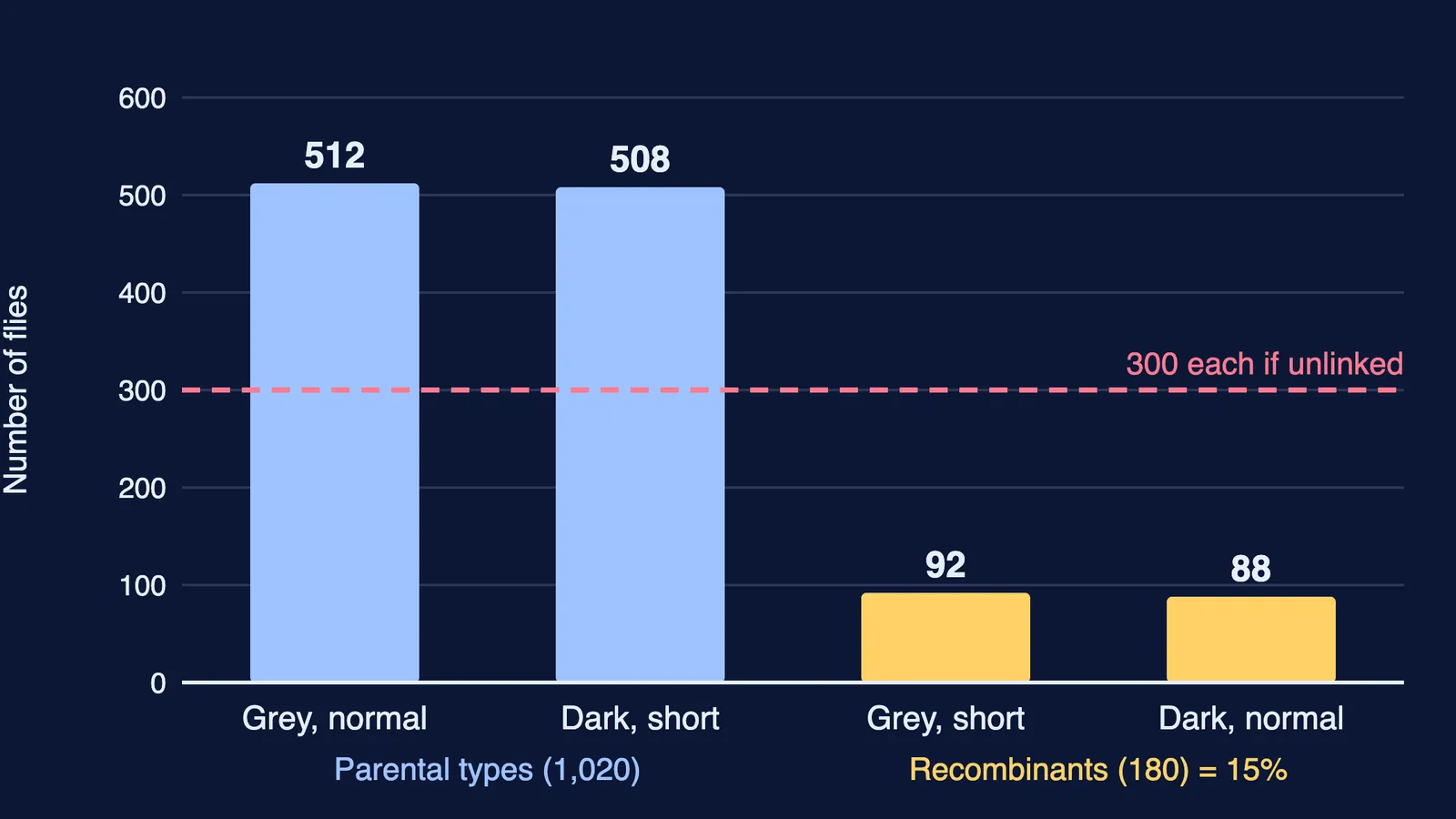
A college genetics lab in Bengaluru keeps two lines of Drosophila. One has grey bodies and normal wings (AAWW); the other has dark bodies and short wings (aaww). Grey is dominant to dark, and normal wings to short. The F1 females (AaWw) are test crossed with aaww males. Students sort 1,200 offspring: 512 grey normal, 508 dark short, 92 grey short and 88 dark normal. A student says, "With independent assortment I expected about 300 of each."
A. Far more parental than non-parental types show that the two genes are: (a) on different chromosomes (b) linked on the same chromosome (c) multiple alleles (d) co-dominant (1 mark)
B. Explain why the student expected 300 of each class, and how a recombination frequency is used to map genes. (2 marks)
Attempt either C or D.
C. Calculate the recombination frequency between the two genes. (1 mark)
OR
D. What term did Morgan use for the generation of non-parental gene combinations? (1 mark)
Answers.
A. (b) Linked. Parental types are 1,020 of 1,200, or 85 per cent.
B. If the genes were on different chromosomes, AaWw would make four gamete types in equal numbers, giving 1,200 / 4 = 300 of each class. Sturtevant used recombination frequency as a measure of the distance between genes; the higher the recombination, the farther apart the genes lie.
C. Recombinants = 92 + 88 = 180. Recombination frequency = 180 / 1,200 × 100 = 15 per cent.
D. Recombination.
How do you attack case-study questions in this chapter?
Underline the data first. Circle every count, ratio and family member first.
Write genotypes and gametes. One line of working protects even a 1-mark answer.
Check your ratio against the data. If counts are near 3:1, 1:1 or 1:1:1:1, say so; if parental types dominate, think linkage.
Name the NCERT term. Co-dominance, incomplete dominance, carrier, recombination: the term often carries the mark.
Use the product rule for probabilities. Multiply the chance of each step, as in Case 2.
If a step in these answers still feels unclear, the Fermi Problem Library has worked problems with a step-by-step solver that explains the reasoning rather than printing an answer.