On this page
Here are six original assertion-reason items and four Statement I / Statement II pairs on Chapter 13, Nuclei, of NCERT Class 12 Physics Part II (Reprint 2026-27). Each block runs easy to hard. Radioactivity is not in the chapter's topic list in the CBSE Class XII Physics syllabus for 2026-27, so no item here tests decay.
How do you answer assertion-reason questions on Nuclei?
The CBSE Class XII Physics sample paper for 2026-27 puts four assertion-reason questions of 1 mark each in Section A. Its option D reads "both Assertion and Reason are false", unlike the key below, so read the options in your own paper.
Use these keys throughout this set.
Assertion-reason:
(A) Both A and R are true and R is the correct explanation of A.
(B) Both A and R are true but R is NOT the correct explanation of A.
(C) A is true but R is false.
(D) A is false but R is true.
Statement pairs:
(A) Both statements are correct.
(B) Both statements are incorrect.
(C) Statement I is correct, Statement II is incorrect.
(D) Statement I is incorrect, Statement II is correct.
Judge A alone, then R alone. False lines here usually swap one detail: A for A^(1/3), higher for lower, isobar for isotone.
Need the facts first? Read our Nuclei Class 12 board exam guide, with answers and traps.
Assertion-reason questions on Nuclei
Q1 (easy). Assertion (A): Deuterium and ordinary hydrogen have identical chemical behaviour. Reason (R): Isotopes have the same number of protons, so their atoms have the same electronic structure.
Answer: (A). Both are true, and R is the reason NCERT gives: identical electronic structure means identical chemical behaviour. Trap: thinking the extra neutron must change the chemistry.
Q2 (easy). Assertion (A): Nuclear matter has roughly the same density, about 2.3 × 10^17 kg/m³, in every nucleus. Reason (R): The radius of a nucleus is directly proportional to its mass number A.
Answer: (C). A is true. R is false: NCERT gives R = R0A^(1/3), so it is the volume, not the radius, that grows in proportion to A. Trap: dropping the cube root.
Q3 (medium). Assertion (A): The mass of a nucleus is less than the total mass of its protons and neutrons when they are free. Reason (R): The nuclear force between two neutrons is about the same as between two protons.
Answer: (B). Both are true, but R does not explain A. The mass defect exists because energy Eb = ΔMc² is released when nucleons bind. Trap: picking (A) because both lines sound related.
Q4 (medium). Assertion (A): Binding energy per nucleon is nearly constant for nuclei with 30 < A < 170. Reason (R): The nuclear force is short-ranged, so a nucleon deep inside a large nucleus feels only its near neighbours.
Answer: (A). Both are true; NCERT names this saturation as the cause of the flat middle of the curve. Trap: answering (B) because "short range" sounds unrelated to energy.
Q5 (medium). Assertion (A): Light nuclei in a gas at room temperature fuse readily. Reason (R): Two nuclei must overcome their Coulomb repulsion before the short-range nuclear force can pull them together.
Answer: (D). A is false: NCERT puts the barrier for two protons near 400 keV, needing about 3 × 10^9 K on average. R is true. Trap: thinking attraction alone makes fusion easy.
Q6 (hard). Assertion (A): Two nucleons pushed closer than about 0.8 fm repel each other strongly. Reason (R): The nuclear force depends on charge, so it is weaker between two neutrons than between two protons.
Answer: (C). A is true: NCERT's potential energy curve has its minimum near r0 = 0.8 fm, with strong repulsion inside it. R is false, because the nuclear force is charge-independent. Trap: blaming the short-range repulsion on Coulomb's law.
Statement I and Statement II questions on Nuclei
Q7 (medium). Statement I: One atomic mass unit is one-twelfth of the mass of a carbon-12 atom, and its energy equivalent is about 931.5 MeV. Statement II: The mass of a proton, 1.00727 u, equals the mass of a hydrogen atom.
Answer: (C). Statement II is wrong: the hydrogen atom is 1.00783 u, one electron (0.00055 u) heavier than the proton. Trap: treating atomic and nuclear masses as the same.
Q8 (medium). Statement I: Mercury-198 (Z = 80) and gold-197 (Z = 79) are isobars. Statement II: Tritium and helium-3 are isobars.
Answer: (D). Statement I is wrong: both have 118 neutrons, which makes them isotones. Statement II is right, since both have A = 3. Trap: mixing up "same A" with "same N".
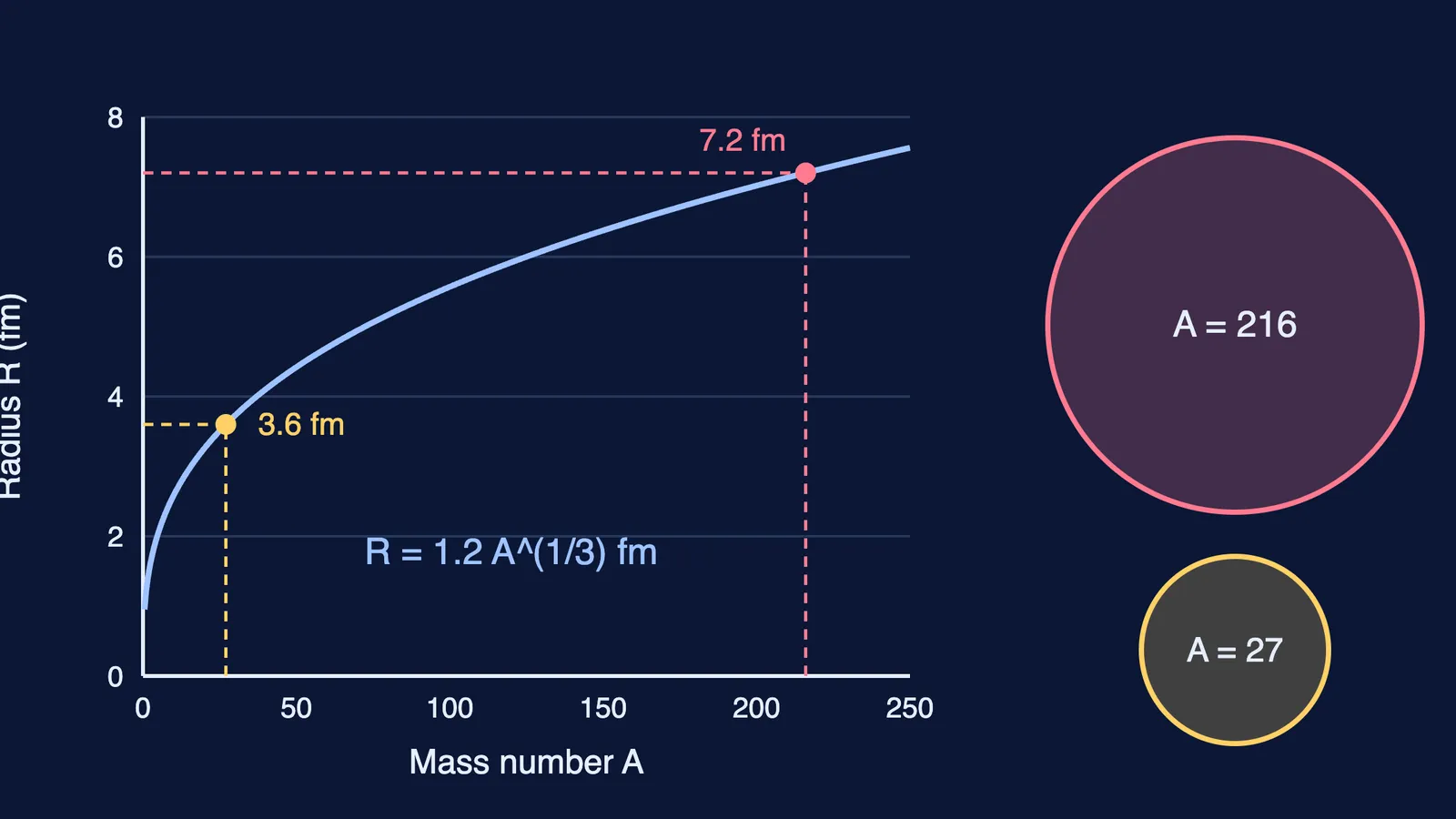
Q9 (hard). Statement I: Mass-energy conversion also happens in chemical reactions, but the mass changes are about a million times smaller than in nuclear reactions. Statement II: A nucleus with A = 216 has twice the radius of an aluminium-27 nucleus but the same density.
Answer: (A). Statement I is NCERT's Example 13.4(c). Statement II follows from R = 1.2A^(1/3) fm: 3.6 fm and 7.2 fm, with mass and volume both eight times larger (checked in Python). Trap: expecting eight times the radius.
Q10 (hard). Statement I: Fusion of light nuclei releases energy because the product has a lower binding energy per nucleon than the nuclei that formed it. Statement II: Like a chemical equation, a nuclear reaction keeps the number of atoms of each element the same on both sides.
Answer: (B). Both are incorrect. The product of fusion is more tightly bound, with a higher binding energy per nucleon. Elements can change in a nuclear reaction; only the numbers of protons and of neutrons stay the same. Trap: linking "energy released" with "less binding".
How should you use this set?
Do all ten in 12 minutes, book closed, marking T or F above each line first.
Sort each miss: wrong fact (reread NCERT) or wrong link (rerun the because test).
For each false line, write the one change that makes it true.
Two days later, redo only your misses.
If a miss comes from a concept gap, the Fermi Concept Library has a lesson for every concept in physics. For the method itself, read our three-check assertion-reason strategy, and keep the Atoms and Nuclei Class 12 formulas with worked examples beside you for the numericals.