On this page
These 10 practice items cover Chapter 8 of NCERT Class 11 Physics Part II, Mechanical Properties of Solids (Reprint 2026-27). All stay inside the CBSE Physics curriculum 2026-27. New to the chapter? Start with our Mechanical Properties of Solids Class 11 guide.
How do you read assertion-reason questions on solids?
Check in order:
Is the Assertion (A) true? Test it with a formula, not a feeling.
Is the Reason (R) true? Check words like "only" and "doubles".
If both are true, read "A, because R". Choose (A) only if R is NCERT's direct cause.
Assertion-reason key (Q1 to Q6): (A) Both A and R are true and R is the correct explanation of A. (B) Both A and R are true but R is NOT the correct explanation of A. (C) A is true but R is false. (D) A is false but R is true.
Statement pair key (Q7 to Q10): (A) Both statements are correct. (B) Both statements are incorrect. (C) Statement I is correct, Statement II is incorrect. (D) Statement I is incorrect, Statement II is correct.
More method: how to solve assertion-reason questions with a three-check method.
Assertion-reason questions with answers
Q1 (easy). Assertion (A): Under the same load, a steel wire stretches less than a copper wire of the same length and cross-section. Reason (R): Steel has a larger Young's modulus than copper.
Answer: (A). ΔL = FL/(AY), so with F, L and A equal, the larger Y (steel about 2.0 × 10¹¹ N m⁻², copper about 1.1 × 10¹¹ N m⁻², NCERT Table 8.1) gives the smaller extension.
Trap: thinking the wire that stretches more is "more elastic".
Q2 (easy). Assertion (A): Doubling the length of a wire doubles its Young's modulus. Reason (R): Young's modulus is a property of the material, not of the wire's dimensions.
Answer: (D). Doubling L doubles the extension ΔL under the same load, so Y = FL/(AΔL) is unchanged. A is false; R is true.
Trap: forgetting that ΔL grows with L too.
Q3 (medium). Assertion (A): A light wire hanging from a ceiling with a load W at its lower end has a tensile stress W/A, not 2W/A. Reason (R): The ceiling pulls up on the wire with a force equal to W.
Answer: (B). Both are true. NCERT's Points to Ponder explain A: the tension at any cross-section is W. The ceiling's pull only balances the load; it does not add to the tension, so R does not explain A.
Trap: adding the two end forces to get 2W.
Q4 (medium). Assertion (A): A metal wire loaded past its yield point, but short of its ultimate tensile strength, does not return to its original length when the load is removed. Reason (R): Between the yield point and the ultimate tensile strength, stress is proportional to strain.
Answer: (C). A is NCERT's permanent set: beyond the yield point, the strain is not zero even when the stress is removed. R is false: stress and strain are proportional only in the linear region O to A.
Trap: assuming the whole stress-strain curve is a straight line.
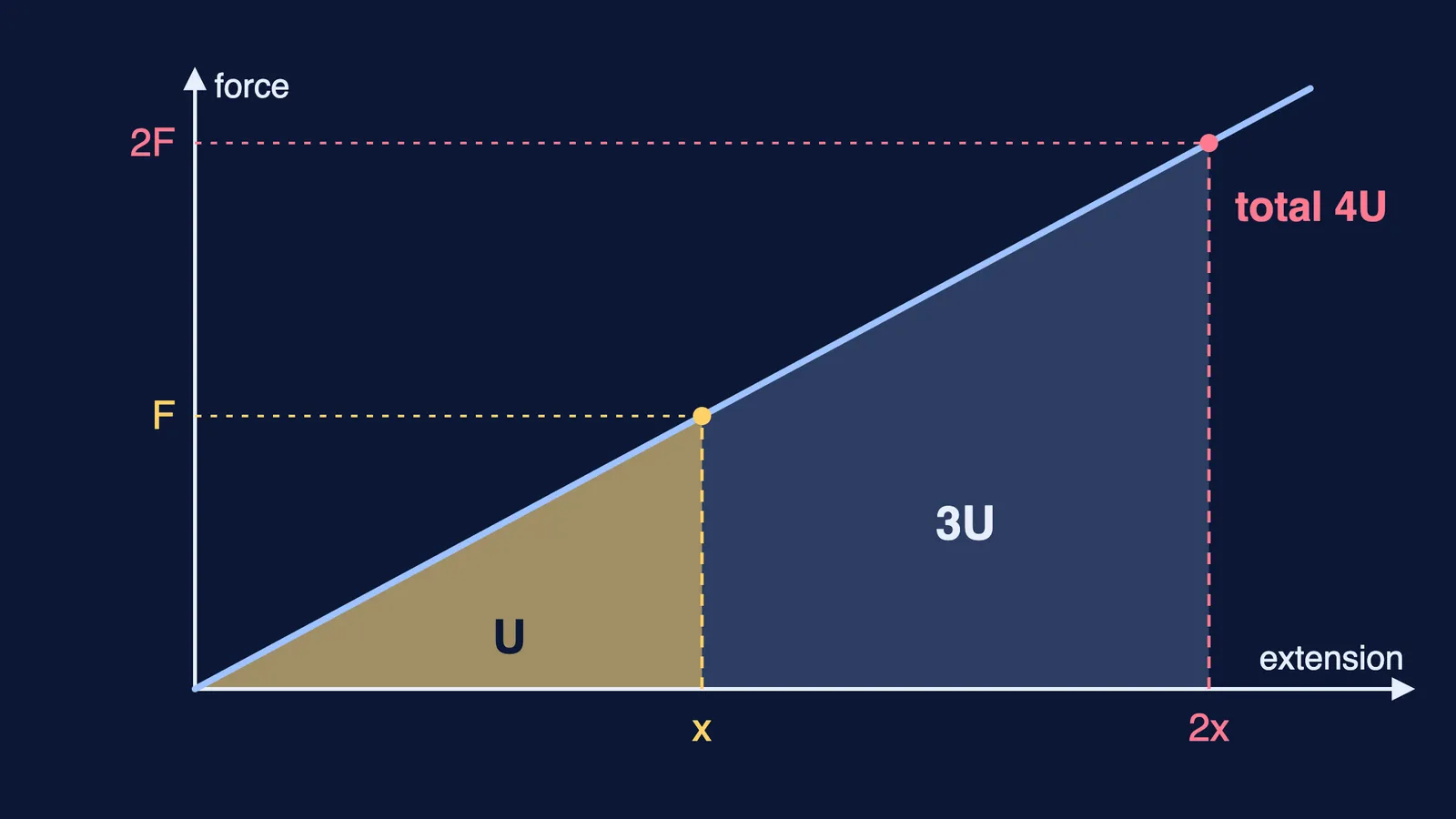
Q5 (hard). Assertion (A): If the extension of a wire is doubled within its elastic limit, the elastic potential energy stored in it doubles. Reason (R): Within the elastic limit, the stored energy is U = ½FΔL, and F is proportional to ΔL.
Answer: (D). R is true, and it makes A false. Doubling ΔL also doubles F, so U becomes four times as large (diagram above).
Trap: treating F as fixed while ΔL changes.
Q6 (hard). Assertion (A): Elastic properties of rock limit mountains on Earth to a height of about 10 km. Reason (R): The shear stress at a mountain's base, about hρg, must stay below the elastic limit of rock, about 30 × 10⁷ N m⁻².
Answer: (A). This is NCERT's own argument in Section 8.6. With ρ = 3 × 10³ kg m⁻³ and g = 10 m s⁻², h = 30 × 10⁷/(3 × 10³ × 10) = 10⁴ m, or 10 km.
Trap: treating the base as under bulk compression; its sides are free.
Statement I/II questions with answers
Q7 (easy). Statement I: Young's modulus and shear modulus are relevant only for solids. Statement II: Bulk modulus is relevant only for solids and liquids.
Answer: (C). Only solids have lengths and shapes, so I is correct. Bulk modulus applies to gases too.
Trap: forgetting that air has a bulk modulus.
Q8 (medium). Statement I: Stress is a vector because the force that causes it is a vector. Statement II: Hooke's law holds right up to the yield point of a metal.
Answer: (B). NCERT says stress cannot be given a specific direction, so it is not a vector. Between A and B on NCERT's stress-strain curve (Fig. 8.2), the body is still elastic but stress and strain are no longer proportional.
Trap: equating "elastic" with "obeys Hooke's law".
Q9 (medium). Statement I: Raising the pressure on water (B = 2.2 × 10⁹ N m⁻²) by 1.1 × 10⁷ Pa reduces its volume by 0.5%. Statement II: Under the same pressure increase, glass (B = 37 × 10⁹ N m⁻²) has a smaller volume strain than water.
Answer: (A). Volume strain is p/B: 1.1 × 10⁷/2.2 × 10⁹ = 5 × 10⁻³, or 0.5%. For glass (NCERT Table 8.3) it is about 3 × 10⁻⁴, smaller because B is larger.
Trap: thinking a bigger modulus means a bigger change.
Q10 (hard). Statement I: For a beam supported at its ends and loaded at the centre, doubling its breadth cuts the sag more than doubling its depth. Statement II: A pillar with rounded ends supports more load than a pillar with distributed ends.
Answer: (B). NCERT gives the sag as δ = Wl³/(4bd³Y): doubling the depth cuts it to one-eighth, doubling the breadth only to one-half. NCERT also states that a rounded-end pillar supports less load.
Trap: missing the cube on d.
How should you use this set?
Cover each answer, mark your key, then check.
For every miss, note which check failed.
Redo missed items two days later.
Revise the relations you used from our Class 11 formula sheet for solids and fluids.
If one idea keeps tripping you up, the Fermi Concept Library has every concept in physics with its own lesson, so you can fix the gap before your next attempt.