On this page
These ten original items cover Chapter 9, Mechanical Properties of Fluids, of NCERT Class 11 Physics Part II (Reprint 2026-27), the chapter listed in Unit VII of the CBSE Class XI Physics syllabus for 2026-27. Every statement was checked against that text and every number recomputed. New to the chapter? Start with our Mechanical Properties of Fluids Class 11 guide.
How do you read assertion-reason questions on fluids?
Make three checks, in order:
Is the Assertion (A) true? Write its formula.
Is the Reason (R) true? Check every factor, square and sign.
If both are true, read "A, because R". Choose (A) only if R is the direct cause NCERT gives.
More detail: our three-check method for assertion-reason questions.
Assertion-reason key, for Q1 to Q6:
(A) Both A and R are true and R is the correct explanation of A.
(B) Both A and R are true but R is NOT the correct explanation of A.
(C) A is true but R is false.
(D) A is false but R is true.
Statement pair key, for Q7 to Q10:
(A) Both statements are correct.
(B) Both statements are incorrect.
(C) Statement I is correct, Statement II is incorrect.
(D) Statement I is incorrect, Statement II is correct.
Assertion-reason questions with answers
Q1 (easy). Assertion (A): In a hydraulic lift, a small force on the narrow piston can hold up a car resting on the wide piston. Reason (R): A pressure change applied to an enclosed liquid is transmitted undiminished throughout it, so F₂ = F₁ × A₂/A₁.
Answer: (A). R is Pascal's law, the principle NCERT gives for the hydraulic lift. Trap: thinking the liquid creates energy; the wide piston moves less.
Q2 (easy). Assertion (A): The coefficient of viscosity of a liquid falls as its temperature rises. Reason (R): Like that of a liquid, the viscosity of a gas also falls as its temperature rises.
Answer: (C). A is true. R is false: NCERT says gas viscosity increases with temperature. Trap: assuming gases follow the same rule as liquids.
Q3 (medium). Assertion (A): In steady flow of water through a horizontal pipe, the water moves faster in the narrow section than in the wide section. Reason (R): Along a horizontal streamline, the pressure is lower where the speed is higher.
Answer: (B). Both are true, but the speed-up comes from continuity, Av = constant (conservation of mass). R, Bernoulli, explains the pressure drop, not the speed-up. Trap: quoting Bernoulli for every fact about a narrowing pipe.
Q4 (medium). Assertion (A): In steady flow, two streamlines can cross at a point where the pipe bends sharply. Reason (R): In steady flow, the velocity of the fluid at any fixed point does not change with time.
Answer: (D). R defines steady flow and is true. It makes A false: a crossing would give two velocities at one point. Trap: picturing mixing at a bend, which is turbulence.
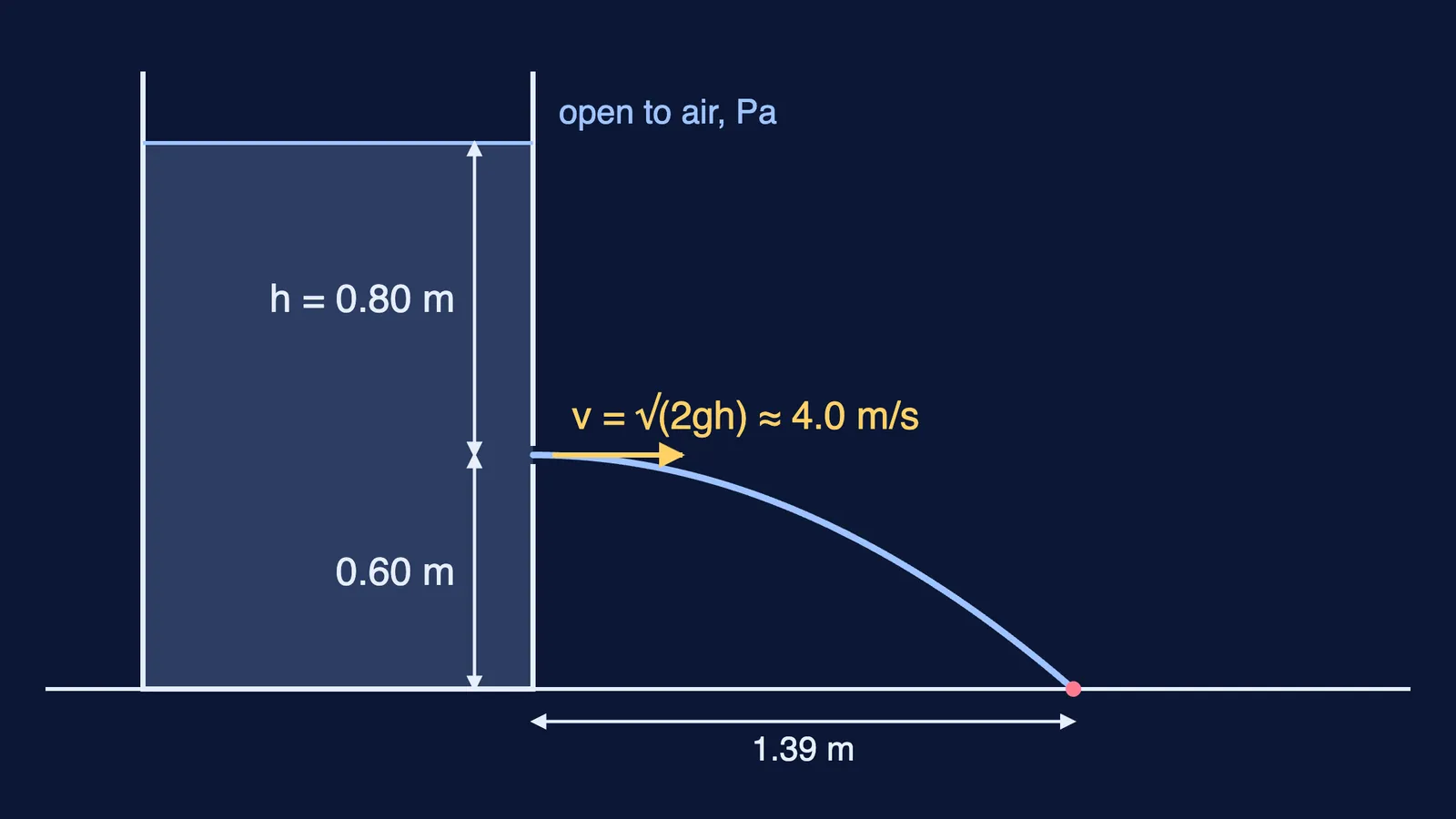
Q5 (hard). Assertion (A): Water leaving a small hole 0.80 m below the open surface of a wide tank comes out at about 4.0 m/s (take g = 9.8 m/s²). Reason (R): For an open tank much wider than the hole, the speed of efflux is √(2gh), the speed of a body falling freely through height h.
Answer: (A). R is Torricelli's law: √(2 × 9.8 × 0.80) ≈ 3.96 m/s, about 4.0 m/s (diagram above). Trap: measuring h from the tank's bottom, not the water surface.
Q6 (hard). Assertion (A): A steel ball falling through glycerine at terminal velocity feels a viscous drag smaller than its weight. Reason (R): The viscous drag on a small sphere is proportional to its speed, F = 6πηav.
Answer: (B). Both are true. At terminal velocity, drag plus buoyant force equals the weight, so drag alone is less. R is Stokes' law, true, but the buoyant force, not R, is why drag falls short of the weight. Trap: writing "drag = weight" and forgetting buoyancy.
Statement I and II questions with answers
Q7 (easy). Statement I: Gauge pressure is actual pressure minus atmospheric pressure; a blood pressure gauge reads gauge pressure. Statement II: One torr, the pressure of a 1 mm column of mercury, is about 1.33 × 10⁵ Pa.
Answer: (C). Statement II is wrong: 1 torr is about 133 Pa; 1.01 × 10⁵ Pa is 1 atm. Trap: mixing up torr with atm.
Q8 (medium). Statement I: The excess pressure inside a small liquid drop of radius r is 4S/r, because the drop has two surfaces. Statement II: A soap bubble of radius r in air has an excess pressure of 4S/r, twice that inside an air bubble of the same radius in the same soap solution.
Answer: (D). A drop has one surface, so its excess pressure is 2S/r. A soap film has two surfaces (4S/r); an air bubble in the liquid has one (2S/r). Trap: counting surfaces wrongly.
Q9 (hard). Statement I: If a barometer at sea level used water (density 1000 kg/m³) instead of mercury, the column would be about 10.3 m tall. Statement II: The space above the mercury column in a barometer holds only mercury vapour, whose pressure is small enough to neglect.
Answer: (A). From Pₐ = ρgh, h = 1.013 × 10⁵ / (1000 × 9.8) ≈ 10.3 m. Statement II matches NCERT's barometer description. Trap: assuming 76 cm for any liquid.
Q10 (hard). Statement I: Taking the angle of contact as zero and S = 0.073 N/m, water rises about 6 cm in a glass capillary of diameter 0.25 mm. Statement II: When water in steady flow passes from a pipe section of diameter 4.0 cm into one of diameter 2.0 cm, its speed doubles.
Answer: (B). With radius 0.125 mm, h = 2S/(ρga) ≈ 11.9 cm; 6 cm needs radius 0.25 mm. Halving the diameter quarters the area, so the speed becomes four times larger. Trap: using diameter for radius, and not squaring.
How should you use this set?
Cover the answers, mark a key for all ten, then check.
For each miss, note which check failed.
Redo the misses two days later.
For longer items, try our mechanical properties of fluids case study questions.
If streamlines still feel abstract, the Fermi Simulation Lab has interactive simulations for the ideas that are easier to see than to read.