On this page
These 10 original questions, easy to hard, stay inside NCERT Physics Part II, Chapter 11 (Reprint 2026-27). For the full chapter plan, start with our Class 12 board exam guide to dual nature of radiation and matter.
How do you read assertion-reason and statement questions?
Judge each statement on its own first. Only when both are true, ask whether R is the direct reason NCERT gives for A. Our three-check method for assertion-reason questions explains this.
Use these keys for every question below.
Assertion-reason: (A) Both A and R are true and R is the correct explanation of A. (B) Both A and R are true but R is not the correct explanation of A. (C) A is true but R is false. (D) A is false but R is true.
Statement pairs: (A) Both statements are correct. (B) Both statements are incorrect. (C) Statement I is correct, Statement II is incorrect. (D) Statement I is incorrect, Statement II is correct.
The CBSE Class 12 Physics sample question paper for 2026-27 has four assertion-reason questions of 1 mark each in Section A. Its option D reads "both Assertion and Reason are false", unlike ours, so read the key printed on your paper.
Assertion-reason questions on dual nature, with answers
All facts and values here follow NCERT Chapter 11.
Q1 (easy). Assertion (A): Photoelectrons are emitted without any noticeable delay, even when the incident light above threshold is very dim. Reason (R): Emission happens when a single electron absorbs a single photon, and that absorption is instantaneous.
Answer: (A). NCERT gives the delay as of the order of 10⁻⁹ s or less, and explains it by one-photon, one-electron absorption.
Trap: the wave-picture idea that dim light needs time to build up energy.
Q2 (easy). Assertion (A): Caesium and sodium emit photoelectrons under visible light, while zinc needs ultraviolet light. Reason (R): The energy of a photon increases as its wavelength increases.
Answer: (C). A is stated in NCERT. R is false: E = hc/λ, so longer wavelength means lower photon energy.
Trap: mixing up wavelength and frequency in E = hν.
Q3 (medium). Assertion (A): A beam of photons is not deflected by an electric or a magnetic field. Reason (R): Each photon carries momentum p = hν/c.
Answer: (B). Both are true. Photons pass undeflected because they are electrically neutral; momentum does not explain it.
Trap: accepting R because it is a correct formula.
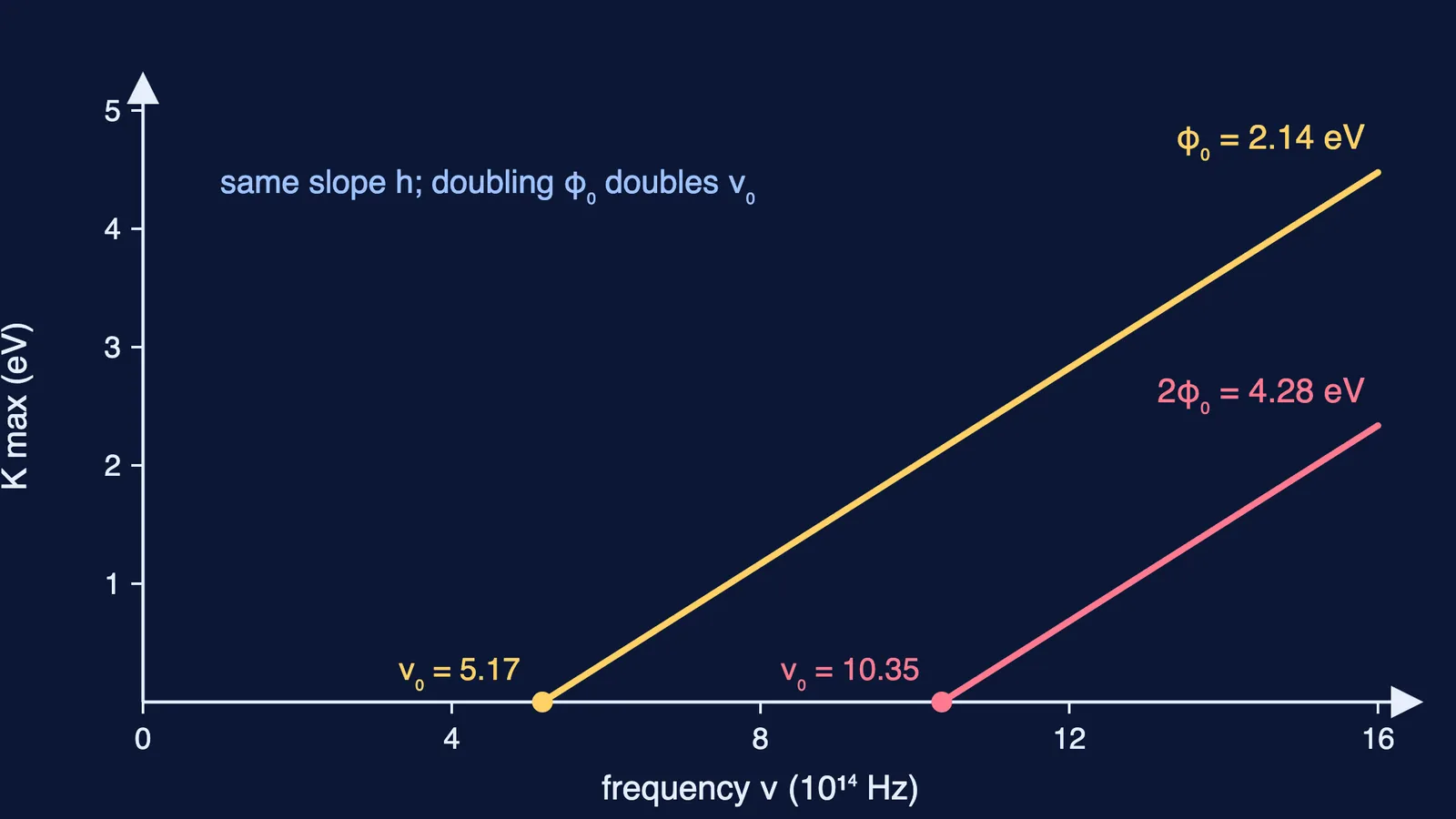
Q4 (medium). Assertion (A): If the work function of a metal were doubled, its threshold wavelength would also double. Reason (R): The threshold frequency of a metal is ν₀ = φ₀/h.
Answer: (D). R is true, so doubling φ₀ doubles ν₀. But λ₀ = c/ν₀ = hc/φ₀, so the threshold wavelength halves.
Trap: carrying "doubles" from frequency over to wavelength.
Q5 (hard). Assertion (A): An electron and a proton moving with the same speed have the same de Broglie wavelength. Reason (R): The de Broglie wavelength of a particle does not depend on its charge.
Answer: (D). R is true per NCERT. A is false because λ = h/mv: the much heavier proton has a far shorter wavelength.
Trap: letting a true R rescue a false A.
Q6 (hard). Assertion (A): A photon and an electron with the same de Broglie wavelength have the same momentum. Reason (R): A photon and an electron with the same wavelength also have the same kinetic energy.
Answer: (C). A is true, since p = h/λ for both. R is false: the photon's energy is E = pc, while the electron's is p²/2m, far smaller at equal momentum.
Trap: assuming equal momentum means equal energy.
Statement I and Statement II questions on photons and matter waves
Values follow NCERT Chapter 11.
Q7 (medium). Statement I: Raising the positive potential of the collector beyond a certain value does not increase the photocurrent. Statement II: At saturation, all photoelectrons emitted by the emitter reach the collector.
Answer: (A). Both are correct: once every emitted electron is collected, more potential adds nothing.
Trap: expecting current to keep rising with voltage as in Ohm's law.
Q8 (medium). Statement I: Thermionic emission supplies the escape energy by heating, and field emission uses a very strong electric field, of the order of 10⁸ V m⁻¹. Statement II: The work function of a metal depends only on the metal, not on the condition of its surface.
Answer: (C). Statement I matches NCERT Section 11.2. Statement II is wrong: NCERT says the work function depends on the metal and the nature of its surface.
Trap: treating φ₀ as a fixed property of the element.
Q9 (hard). Statement I: A source emitting 3.0 mW of 600 nm light emits about 9 × 10¹² photons per second. Statement II: Halving the wavelength of light falling on a metal exactly doubles the maximum kinetic energy of the photoelectrons.
Answer: (B). Each photon carries hc/λ ≈ 3.31 × 10⁻¹⁹ J, so N = P/E ≈ 9.1 × 10¹⁵ per second, not 10¹². For II, Kmax = hc/λ − φ₀; halving λ gives 2hc/λ − φ₀ = 2Kmax + φ₀, more than double.
Trap: forgetting that φ₀ is subtracted, not scaled.
Q10 (hard). Statement I: A proton moving at 2.0 × 10⁵ m s⁻¹ has a de Broglie wavelength of about 2.0 nm. Statement II: For a photon, λ = h/p gives exactly the wavelength of its electromagnetic wave.
Answer: (D). λ = h/mv = (6.63 × 10⁻³⁴)/(1.67 × 10⁻²⁷ × 2.0 × 10⁵) ≈ 2.0 × 10⁻¹² m, about 0.0020 nm, a thousand times smaller. Statement II is NCERT Eq. 11.7: with p = hν/c, h/p = c/ν = λ.
Trap: confusing 10⁻⁹ m (nm) with 10⁻¹² m (pm).
How should you use this set before the board exam?
Attempt all 10 in one 12-minute sitting, writing T or F beside each statement first.
Mark each miss as a fact error or a link error (wrong call on "is R the reason?").
For fact errors, reread that NCERT section and redo the question next day.
Then try longer data questions in our dual nature case study questions for Class 12.
If threshold frequency still feels abstract, the Fermi Simulation Lab has interactive simulations for the ideas that are easier to see than to read.