On this page
In Atoms, most assertion-reason lines are true facts. The mark goes to whoever can tell a true reason from the right one.
What do these Atoms questions cover?
Every item stays inside Chapter 12, Atoms, of the CBSE Class XII Physics syllabus for 2026-27 and was checked against NCERT Class 12 Physics Part II, Chapter 12 (Reprint 2026-27).
The CBSE 2026-27 Physics sample paper has four 1-mark assertion-reason questions in Section A. Its option D reads "both Assertion and Reason are false", unlike our (D), so check your paper's options. For the whole chapter, see our Atoms Class 12 board exam guide.
How do you answer assertion-reason questions?
Judge each statement alone. If both are true, check that R is the direct cause NCERT gives for A.
Assertion-reason keys (Q1 to Q6):
(A) Both A and R are true and R is the correct explanation of A.
(B) Both A and R are true but R is NOT the correct explanation of A.
(C) A is true but R is false.
(D) A is false but R is true.
Statement keys (Q7 to Q10):
(A) Both statements are correct.
(B) Both statements are incorrect.
(C) Statement I is correct, Statement II is incorrect.
(D) Statement I is incorrect, Statement II is correct.
Assertion-reason questions on Atoms
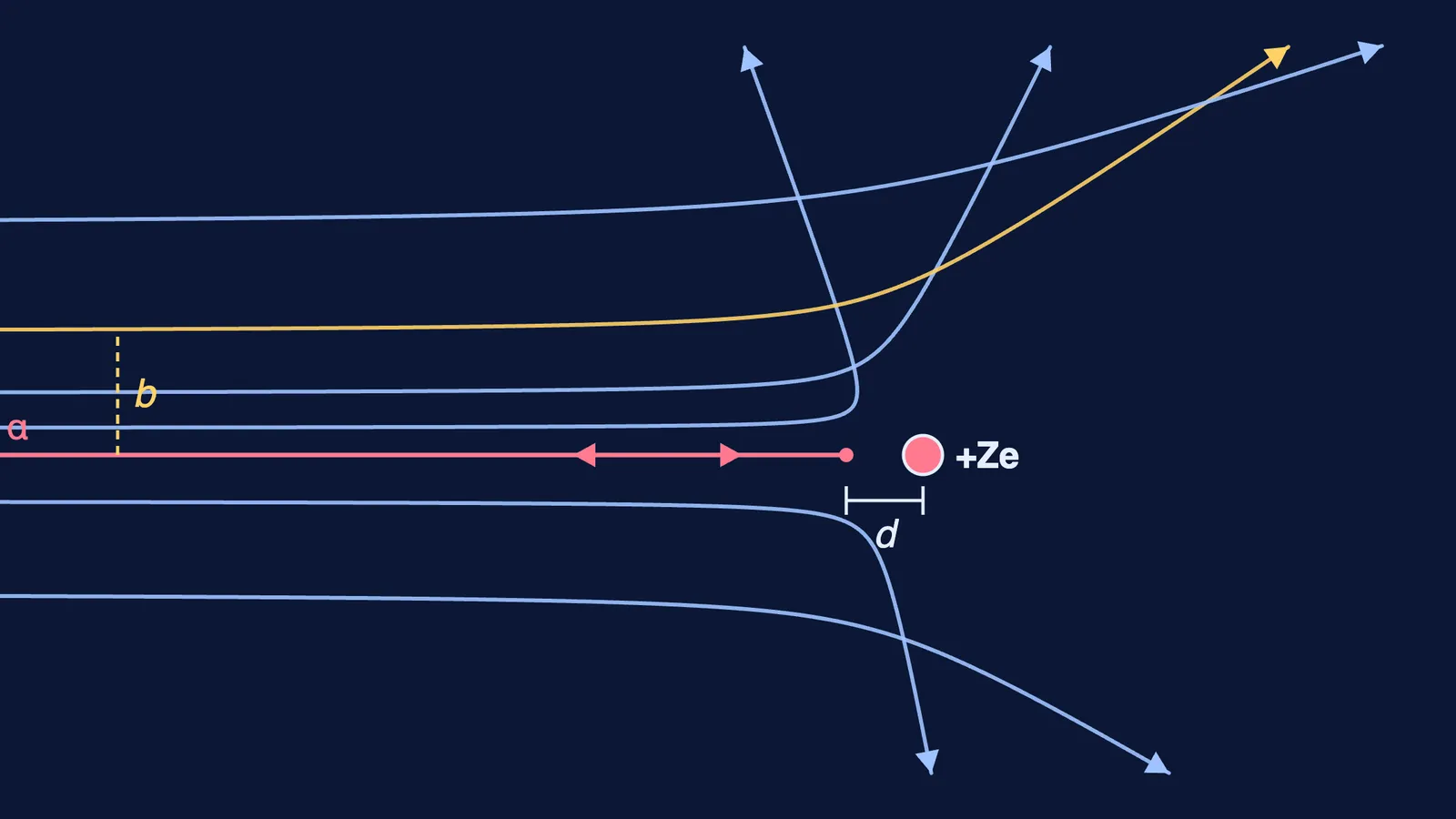
Q1 (easy). Assertion (A): In the Geiger-Marsden gold-foil experiment, alpha particles that came straight back towards the source were rare. Reason (R): The nucleus occupies a tiny part of the atom's volume, so very few alpha particles meet it nearly head-on.
Answer: (A). Both are true. Only a near head-on encounter turns an alpha particle back; a tiny nucleus makes those rare.
Trap: picking (B) because R sounds like a conclusion.
Q2 (easy). Assertion (A): Hydrogen at low pressure, excited by an electric discharge, emits light of only certain discrete wavelengths. Reason (R): In a rarefied gas, the light comes mainly from each atom's interaction with its neighbours.
Answer: (C). A is true. R is false: the atoms are far apart and emit on their own. Neighbour interactions give solids and liquids their continuous spectrum.
Trap: mixing up the sources of line and continuous spectra.
Q3 (medium). Assertion (A): In alpha scattering from gold, the nucleus can be treated as stationary. Reason (R): The alpha particle and the gold nucleus both carry positive charge.
Answer: (B). Both are true. A holds because a gold nucleus is about 50 times heavier than an alpha particle. R explains why the alpha particle is repelled, not why the nucleus barely recoils.
Trap: accepting a true fact about the collision as the reason.
Q4 (medium). Assertion (A): In the Bohr model of hydrogen, the electron moves faster in higher orbits. Reason (R): The electron's angular momentum in the nth orbit is nh/2π.
Answer: (D). R is true and shows A is false. With mvr = nh/2π and r ∝ n², v ∝ 1/n: about 2.19 × 10⁶ m/s for n = 1, half that for n = 2.
Trap: "more angular momentum, so more speed", ignoring how fast r grows.
Q5 (medium). Assertion (A): Rutherford's model, treated classically, predicts that a hydrogen atom cannot be stable. Reason (R): By classical electromagnetic theory, an accelerating charge radiates electromagnetic energy.
Answer: (A). Both are true. An orbiting electron is always accelerating, so it should radiate, lose energy and spiral into the nucleus.
Trap: choosing (B) because R never mentions atoms.
Q6 (hard). Assertion (A): In the Bohr model, light emitted when a hydrogen electron drops from n = 3 to n = 2 does not have the electron's frequency of revolution in the n = 3 orbit. Reason (R): In the Bohr model, the photon's frequency equals the electron's frequency of revolution in its initial orbit.
Answer: (C). A is true: (E₃ − E₂)/h ≈ 4.57 × 10¹⁴ Hz, while the electron revolves about 2.44 × 10¹⁴ times a second in n = 3. R is false: it is the classical idea Bohr dropped, and the two match only for very large n.
Trap: carrying "orbit frequency = light frequency" into Bohr's model.
Statement I and Statement II questions on Atoms
Q7 (easy). Statement I: The ground-state energy of hydrogen is −13.6 eV, so ionising it from there needs 13.6 eV. Statement II: Exciting a hydrogen atom from n = 1 to n = 2 needs about 10.2 eV.
Answer: (A). Both are correct. E₂ = −13.6/4 = −3.4 eV, and −3.4 − (−13.6) = 10.2 eV.
Trap: taking E₂ as −13.6/2 instead of −13.6/2².
Q8 (medium). Statement I: In hydrogen's ground state, the electron's kinetic energy is +13.6 eV and its potential energy is −13.6 eV. Statement II: In any Bohr orbit, the potential energy is twice the total energy.
Answer: (D). I is incorrect: K = +13.6 eV, U = −27.2 eV, total −13.6 eV. II is correct: U = −e²/(4πε₀r) and E = −e²/(8πε₀r), so U = 2E.
Trap: equal and opposite halves would make the total zero.
Q9 (hard). Statement I: The radius of hydrogen's n = 3 orbit is three times the Bohr radius. Statement II: In the n = 2 orbit, the electron's de Broglie wavelength equals the orbit's circumference.
Answer: (B). Both are incorrect. Radius grows as n², so r₃ = 9a₀. With 2πr = nλ, the n = 2 orbit holds two wavelengths, so λ is half the circumference.
Trap: mixing up n² (radius) with n (wavelengths per orbit).
Q10 (hard). Statement I: For alpha particles of equal kinetic energy, the head-on distance of closest approach is smaller for a nucleus of lower atomic number. Statement II: Doubling the alpha particles' kinetic energy doubles the distance of closest approach.
Answer: (C). At closest approach all of K is potential energy: d = 2Ze²/(4πε₀K). I is correct: d ∝ Z. II is incorrect: d ∝ 1/K, so doubling K halves d.
Trap: reading "more energy" as "stops farther away".
How should you use this set?
Sort every miss: wrong on A, on R, or on the link.
For each link miss, write the real reason in one line from NCERT.
If the scattering in Q1 and Q10 is hard to picture, the Fermi Simulation Lab has interactive simulations for ideas that are easier to see than to read.
For the Bohr results step by step, see our Atoms Class 12 derivations. For a method for any chapter, read our strategy for assertion-reason questions.