On this page
Chapter 2 of NCERT's *An Introduction to Indian Art* Part I (chapter PDF, reprint 2026-27) looks at what Indus Valley craftspeople made in stone, metal, clay, steatite and gemstones. The book dates these arts to the third millennium BCE's second half.
How many marks is Arts of the Indus Valley in Class 11?
The CBSE 2026-27 Fine Arts curriculum sets one theory paper, "History of Indian Art", of 30 marks and 2 hours for Class 11. Painting, Graphics, Sculpture and Applied Art-Commercial Art (codes 049 to 052) each print the same theory syllabus.
Unit 1 carries 15 marks, and those 15 marks cover prehistoric rock paintings, Indus art (the curriculum's wording is "Indus / Sindhu Saraswati Civilization (Indus valley Civilization)"), and Buddhist, Jain and Hindu art together. CBSE prints no separate Indus figure. The curriculum does not name a textbook; this guide follows the NCERT chapter and maps it to the Unit 1 list.
The curriculum names five works for study and appreciation: the Dancing Girl, the Male Torso, the Mother Goddess, a Bull seal and a painted earthenware jar. Its site list adds Rangpur, Alamgirpur and Banawali, which the chapter does not name; the chapter names Rakhigarhi, which the curriculum list omits.
What does the chapter cover?
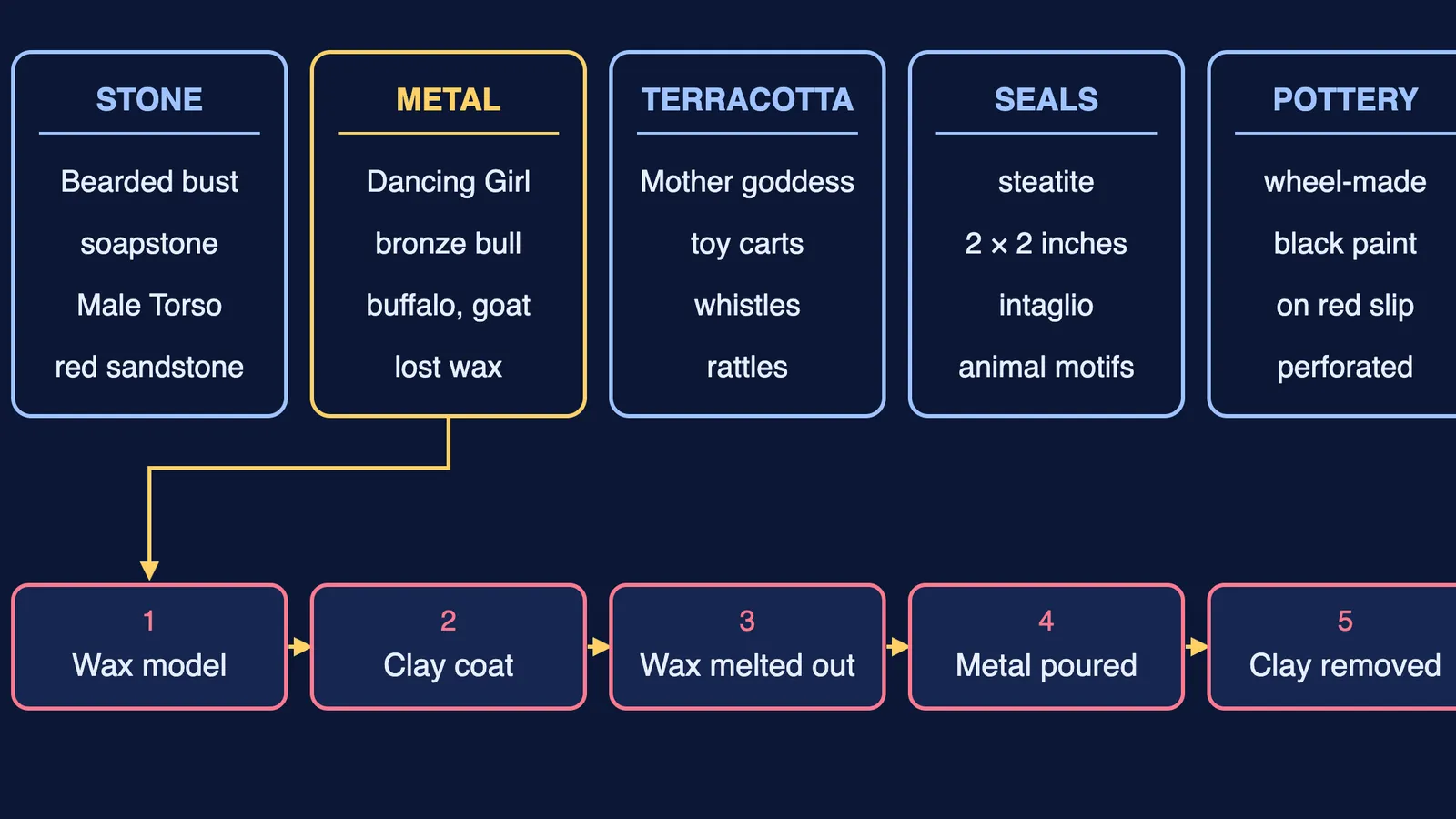
The NCERT chapter opens with two big cities on the Indus, northern Harappa and southern Mohenjodaro, both now in Pakistan. Sites in India it names are Lothal and Dholavira (Gujarat), Rakhigarhi (Haryana), Ropar (Punjab) and Kalibangan (Rajasthan). By material:
Stone: a soapstone bust of a bearded man, read as a priest; and a red sandstone torso with sockets at the neck and shoulders where a head and arms were once fixed.
Metal: bronze figures made by the lost-wax method, including the Dancing Girl, a buffalo and a goat, plus a copper dog and bird from Lothal and a bronze bull from Kalibangan.
Terracotta: the book calls Indus clay human figures cruder than stone or bronze ones, but more realistic at Gujarat sites and Kalibangan. Mother goddess figures are the key type; toy carts, whistles and rattles too.
Seals: mostly steatite, sometimes agate, chert, copper, faience or terracotta. The standard seal is a 2×2 square inch plaque carved in intaglio, with a script still undeciphered. One seal shows a cross-legged figure ringed by animals; the book says some scholars call it the Pashupati seal and others a female deity.
Pottery: mostly wheel-made, with plain pottery (usually red clay) more common than painted ware. Black designs sit on a red slip; polychrome and incised wares are rare.
How did the lost-wax method work?
The book describes the bronze process in five moves:
Shape the figure in wax.
Cover it in clay and let it dry.
Heat it so the wax melts and runs out through a small hole, leaving a hollow mould.
Pour molten metal into the hollow.
Once the metal cools, break the clay away.
Where do the book and the curriculum differ?
The two documents do not describe every work the same way. Compare the NCERT chapter with the curriculum list:
Dancing Girl: the curriculum lists it as bronze, dated circa 2500 B.C., measuring 10.5 by 5 by 2.5 cm. The book's feature box calls it a copper figure about four inches high (the curriculum's largest measurement, 10.5 cm, is about 4.1 inches, close to the book's figure).
Male Torso: the book says red sandstone; the curriculum prints "Red lime Stone" (size 9.2 x 5.8 x 3 cm).
Bull: the curriculum's Bull is a steatite seal measuring 2.5 by 2.5 by 1.4 cm. The book's Bull feature is a bronze figure from Mohenjodaro with its head turned right and a cord round its neck. For the seal, use the book's general seal facts.
Mother Goddess: the curriculum gives terracotta, Mohenjo-daro, 22 x 8 x 5 cm. The book points to the fan-shaped headdress, pellet eyes, girdle and loin cloth.
Painted jar: thrown on a wheel, painted black after baking, then polished, with plant and geometric motifs.
The curriculum lists all five at the National Museum, New Delhi.
Practice questions for Unit 1
Marks in brackets are our suggestion, not a CBSE pattern.
Name four materials other than steatite that the Indus people used for seals. (2)
The book gives two readings of the seal with a seated figure. State both and list the animals around the figure. (3)
Explain the lost-wax method in five steps and name one metal figure from Lothal or Kalibangan. (4)
Compare the bearded bust and the Male Torso by material, pose and surface detail. (6)
Write an appreciation of the painted earthen jar: how it was made, its colour, finish and motifs. (6)
Stuck on which Unit 1 topic to revise first? Fermi's AI tutor works out what you already know and builds a plan for the session.
For the same finds seen as history, read how Harappan finds are read in Class 12 History. For the basics of art history, see the Class 9 introduction to the history of arts. Planning ahead? See what BFA admission after Class 12 involves.