On this page
Application of Integrals is Chapter 8 of the NCERT Class 12 Mathematics Part II textbook (2026-27 reprint). The CBSE Mathematics syllabus for 2026-27 covers the area under simple curves, especially lines, circles, parabolas and ellipses (in standard form only). Below are 26 key terms in five groups. For the exam plan, see our Application of integrals Class 12 board exam guide.
Not covered: the separate section on the area between two curves found in older editions; the current chapter has only sections 8.1 and 8.2.
What does "area under a curve" mean?
These terms come from section 8.2 of the NCERT chapter.
Region bounded by a curve: the part of the plane fenced in on every side by the curve and the given lines. Example: y = x², the x-axis, x = 1 and x = 2.
Ordinate (the line x = a): here, a vertical line x = a marking one side of the region. Don't confuse with: the ordinate of a point, which is its y-coordinate.
Elementary strip: a very thin rectangle cut from the region at any position; adding up many strips gives the whole area.
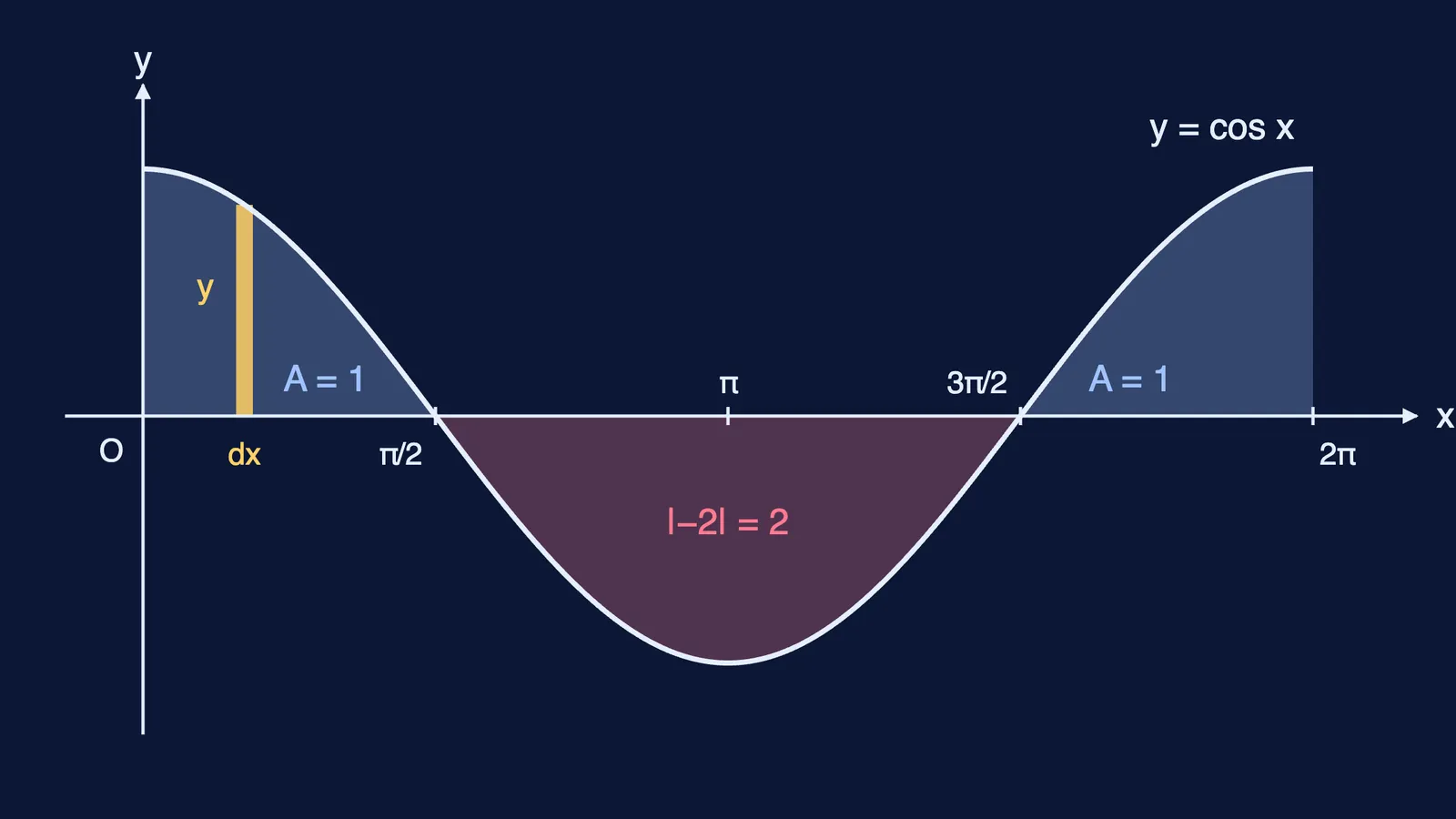
Elementary area (dA): the area of one strip; for a vertical strip of height y and width dx, dA = y dx.
Vertical strip: a strip standing on the x-axis, of height y = f(x) and width dx. Use it when y is given in terms of x.
Horizontal strip: a strip lying against the y-axis, of length x = g(y) and width dy. Don't confuse with: a vertical strip; pick whichever keeps one formula across the region.
Limits of integration: the start and end values, a and b for x or c and d for y, that mark the region's edges.
Which formulas give the area under a curve?
Area with respect to the x-axis: for y = f(x), the x-axis and the lines x = a and x = b (b > a), Area = ∫ y dx = ∫ f(x) dx, integrated from x = a to x = b. Example: y = x² from 1 to 2 gives 8/3 − 1/3 = 7/3.
Area with respect to the y-axis: for x = g(y), the y-axis and the lines y = c and y = d, Area = ∫ x dy = ∫ g(y) dy, integrated from y = c to y = d. Example: y² = 4x, the y-axis and y = 3 give x = y²/4 and area 27/12 = 9/4.
Definite integral: the number ∫ f(x) dx from a to b, which can be positive, negative or zero. Don't confuse with: area, which can never be negative.
Fundamental Theorem of Calculus: if f is continuous on [a, b] and F is an antiderivative of f, the integral of f from a to b equals F(b) − F(a); every area here is worked out this way.
Antiderivative: a function F whose derivative is f. Example: x³/3 is an antiderivative of x².
What happens when the curve goes below the x-axis?
Negative integral and absolute value: where f(x) < 0 between a and b, the integral comes out negative, so NCERT takes its absolute value as the area.
Crossing point: the x-value where the curve meets the x-axis, so f(x) = 0. Split there. Example: y = 3x + 2 crosses at x = −2/3.
A = |A₁| + A₂: the total area when one part, A₁, lies below the axis and the other, A₂, above it. Example: for y = 3x + 2 from x = −1 to 1, the area is 1/6 + 25/6 = 13/3, but the plain integral gives 4.
Net integral versus total area: for y = cos x from 0 to 2π, ∫ cos x dx = 0, yet the area is 1 + 2 + 1 = 4.
Circles, parabolas and ellipses: key terms
Standard form: a curve with its centre or vertex at the origin and its axes along the coordinate axes, such as x² + y² = a².
Line: the simplest boundary, y = mx + c; a region under it on one side of the axis is a triangle or trapezium, so geometry checks the integral.
Circle x² + y² = a²: radius a, centre at the origin; the area enclosed is πa². Example: x² + y² = 4 has area 4π, and its first-quadrant quarter has area π.
Ellipse x²/a² + y²/b² = 1: semi-axes a along x and b along y; the area enclosed is πab. Don't confuse with: the circle's πa², which is the case a = b.
Parabola y² = 4ax: opens to the right, symmetric about the x-axis. Don't confuse with: x² = 4ay, which opens upwards and is symmetric about the y-axis.
Symmetry: a curve unchanged when reflected in an axis. Example: a circle or an ellipse is symmetric about both axes, so its area is 4 times the first-quadrant part.
First quadrant: where x ≥ 0 and y ≥ 0. From x² + y² = a², y = ±√(a² − x²); take the positive root there.
Key integral: ∫√(a² − x²) dx = (x/2)√(a² − x²) + (a²/2) sin⁻¹(x/a) + C, used for both the circle and the ellipse.
Words from the chapter's history
Method of exhaustion: the ancient Greek way of finding areas by filling a shape with ever smaller pieces, developed by Eudoxus and Archimedes.
Integral sign ∫: the symbol Leibniz used for a sum of infinitely small areas, which is what adding elementary strips does.
How to learn these terms
Draw every region before you write an integral, and shade the strip you chose.
Learn the pairs together: vertical and horizontal strip, integral and area, πa² and πab, y² = 4ax and x² = 4ay.
Check each answer against geometry: a line gives a triangle or trapezium, a circle gives πa².
For a curve that crosses the axis, find the crossing points first; they become extra limits.
Test yourself with our Application of integrals assertion-reason questions, then revise the Application of integrals Class 12 formulas.
If antiderivatives still feel shaky, the Fermi Concept Library gives every mathematics concept its own lesson and shows where it sits in the map.