On this page
These are the key terms of Chapter 6, Application of Derivatives, in the NCERT Class 12 Mathematics Part I textbook (Reprint 2026-27). For answers, see our Application of derivatives Class 12 board answer guide.
The CBSE Mathematics curriculum for 2026-27 lists rate of change, increasing and decreasing functions, and maxima and minima; tangents, normals and approximations are not listed, so they are left out.
What does rate of change mean in Class 12?
Rate of change: for y = f(x), dy/dx (or f′(x)) says how fast y changes with x. Example: a square's area A = a² gives dA/da = 2a.
Rate at a point: f′(x₀), the value of dy/dx at x = x₀. Example: for x², f′(3) = 6. Don't confuse with: f′(x), a formula for every x.
Rate with respect to time: a derivative with respect to t. Example: a square's side growing at da/dt = 3 cm/s gives dA/dt = 2a · da/dt = 30 cm²/s at a = 5 cm.
Sign of a rate: positive when y rises as x rises, negative when y falls. Example: a level falling 2 cm/min has dh/dt = −2 cm/min.
Chain rule for rates: if x = f(t) and y = g(t), then dy/dx = (dy/dt) ÷ (dx/dt), provided dx/dt ≠ 0. Example: x = t², y = t³ gives dy/dx = 3t/2.
Marginal cost (MC): dC/dx, the rate of change of total cost C(x) with units produced x. Example: C(x) = x² + 10x + 500 gives MC = ₹50 at x = 20.
Marginal revenue (MR): dR/dx, the rate of change of total revenue R(x). Example: R(x) = 50x − x² gives MR = 50 − 2x = ₹30 at x = 10. Don't confuse with: total revenue R(10) = ₹400.
When is a function increasing or decreasing?
For an interval I in the domain of f and any x₁ < x₂ in I:
Increasing: f(x₁) ≤ f(x₂); never drops. Example: any constant function.
Strictly increasing: f(x₁) < f(x₂); always rises. Example: 2x + 1 on R. Don't confuse with: increasing, which allows flat stretches.
Decreasing and strictly decreasing: f(x₁) ≥ f(x₂) and f(x₁) > f(x₂). Example: 5 − 3x is strictly decreasing on R.
Constant: f(x) = c for every x in I.
Increasing at a point: f is increasing on some open interval containing x₀. Example: x² at x = 1.
Monotonic: either increasing on I or decreasing on I. Example: x³ is monotonic on R; x² is not.
Derivative test (Theorem 1): if f is continuous on [a, b] and differentiable on (a, b), then f′ > 0 on (a, b) means increasing on [a, b], f′ < 0 decreasing, f′ = 0 constant. Example: x³ − 3x has f′(x) = 3(x − 1)(x + 1), so it decreases on [−1, 1].
What are local maxima, minima and critical points?
Maximum and minimum value: f(c) is the maximum value on I if f(c) ≥ f(x) for all x in I (minimum: ≤). Example: x² on [−1, 3] has maximum 9 (x = 3) and minimum 0 (x = 0). Counter-example: f(x) = x on (0, 1) has neither.
Extreme value and extreme point: a maximum or minimum value, and where it occurs.
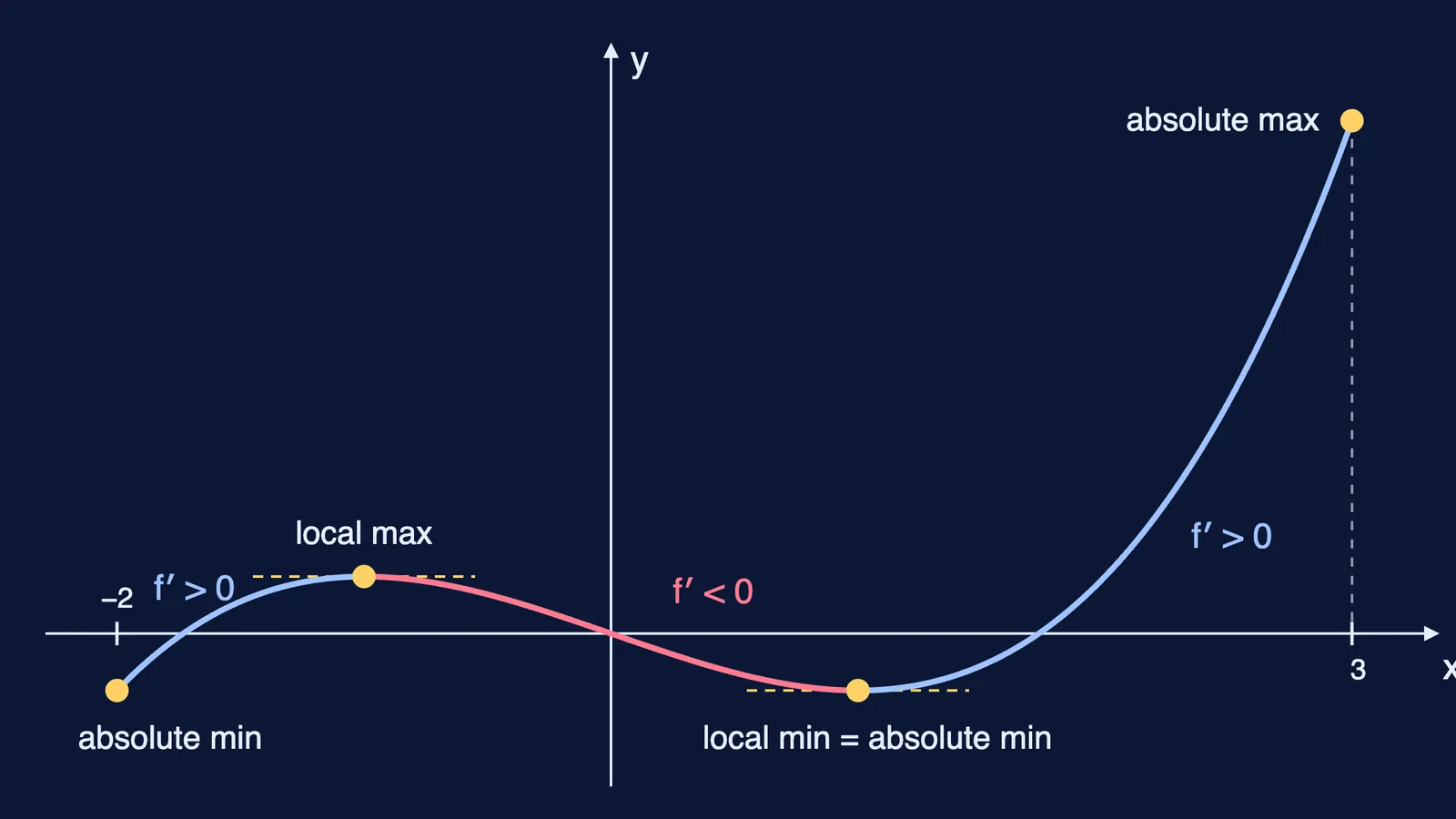
Turning point: where the graph switches between rising and falling. Example: x = ±1 for x³ − 3x.
Interior point: a point with an open interval around it inside the domain. Example: in [0, 5], 2 is interior; 0 and 5 are not.
Point of local maxima: an interior point c with f(c) ≥ f(x) for all x in some (c − h, c + h), h > 0; f(c) is the local maximum value. Example: x³ − 3x has local maximum value f(−1) = 2.
Point of local minima: the same with f(c) ≤ f(x) near c. Example: f(1) = −2 for x³ − 3x.
Critical point: a point c in the domain where f′(c) = 0 or f is not differentiable. Example: x = ±1 for x³ − 3x; x = 0 for |x|. Don't confuse with: a local extreme; every local extreme on an open interval is a critical point (Theorem 2), not the reverse.
Point of inflexion (NCERT's usage): a critical point where f′ does not change sign, so it is not a local extreme. Example: x³ at x = 0.
How do the derivative tests and absolute maxima work?
First derivative test: at a critical point c where f is continuous, f′ changing + to − means local maxima, − to + local minima, no change neither. Example: x³ − 3x has + to − at x = −1.
Second derivative test: for f twice differentiable at c, f′(c) = 0 with f″(c) < 0 gives local maxima; with f″(c) > 0, local minima. Example: x³ − 3x has f″(1) = 6, so x = 1 is a point of local minima.
Test fails: if f′(c) = 0 and f″(c) = 0, go back to the first derivative test. Example: x⁴ and x³ both have f′(0) = f″(0) = 0; only x⁴ has a local minimum there.
Absolute maximum and minimum: the greatest and least values on the whole interval. Example: on [−2, 3], x³ − 3x has absolute maximum 18 (x = 3) and absolute minimum −2 (x = −2 and x = 1). Don't confuse with: the local maximum value 2.
Theorem 5: a function continuous on [a, b] has an absolute maximum and minimum, each reached at least once.
Working rule: find the critical points in [a, b], add a and b, evaluate f at all of them, pick the largest and smallest. Example: f(−2) = −2, f(−1) = 2, f(1) = −2, f(3) = 18.
How to learn these terms
Write a counter-example for each "Don't confuse with" pair.
Draw x³ − 3x on [−2, 3] and label every term on it.
Say each test's conditions before using it.
Differentiate before substituting, and keep units with every rate.
Revise the Application of derivatives Class 12 formulas, then test yourself with the application of derivatives assertion-reason questions. If a definition feels slippery, the Fermi Concept Library gives every concept in mathematics its own lesson and its place in the map.