On this page
Here is every formula and test in Chapter 6 of the NCERT Class 12 Mathematics Part I textbook (Reprint 2026-27), grouped by topic, with one worked example per group. For full board answers, read our Application of derivatives Class 12 board answer guide.
The CBSE Mathematics curriculum for 2026-27 covers rate of change, increasing and decreasing functions, and maxima and minima with the first and second derivative tests. Tangents, normals and approximations are not in this syllabus or in the chapter's sections 6.1 to 6.4, so they are left out.
What are the rate of change formulas in Class 12?
Here y = f(x), t is time and f′(x) = dy/dx.
Rate of change of y with respect to x: dy/dx = f′(x)
Rate of change at a point: f′(x₀), the value of dy/dx at x = x₀
Chain rule when x = f(t) and y = g(t): dy/dx = (dy/dt) ÷ (dx/dt), valid only if dx/dt ≠ 0
Marginal cost: MC = dC/dx, where C(x) is the total cost of x units
Marginal revenue: MR = dR/dx, where R(x) is the total revenue from x units
Shape results, differentiated with respect to t (r is a radius, a a cube's edge):
Circle: A = πr², so dA/dt = 2πr · dr/dt
Sphere: V = (4/3)πr³, so dV/dt = 4πr² · dr/dt; S = 4πr², so dS/dt = 8πr · dr/dt
Cube: V = a³, so dV/dt = 3a² · da/dt; S = 6a², so dS/dt = 12a · da/dt
Worked example: a balloon's radius grows at 0.5 cm/s. At r = 6 cm, dV/dt = 4π(6²)(0.5) = 72π ≈ 226.2 cm³/s, and dS/dt = 8π(6)(0.5) = 24π cm²/s. For costs, if C(x) = 0.02x² + 40x + 1500 rupees, then MC = 0.04x + 40, which is ₹42 per unit at x = 50.
Watch for: putting r = 6 in before differentiating. Differentiate first, then substitute, and keep the units (cm³/s).
How do you find where a function is increasing or decreasing?
For an interval I in the domain of f and any x₁ < x₂ in I:
Strictly increasing on I: f(x₁) < f(x₂)
Strictly decreasing on I: f(x₁) > f(x₂)
Constant on I: f(x) = c for all x in I
The derivative test (Theorem 1) needs f continuous on [a, b] and differentiable on (a, b):
f′(x) > 0 for every x in (a, b) ⇒ f is increasing on [a, b]
f′(x) < 0 for every x in (a, b) ⇒ f is decreasing on [a, b]
f′(x) = 0 for every x in (a, b) ⇒ f is constant on [a, b]
Worked example: f(x) = x³ − 12x + 5 gives f′(x) = 3(x − 2)(x + 2), which is zero at x = ±2. Split the number line there: f′ is positive on (−∞, −2) and (2, ∞), so f is strictly increasing there, and negative on (−2, 2), so f is strictly decreasing there.
Watch for: ignoring the domain (for log x, only x > 0 counts).
Critical points and the local maxima and minima tests
A critical point of f is a point c in its domain where f′(c) = 0 or f is not differentiable. Every local maximum or minimum on an open interval is at a critical point, but not the reverse: x³ has f′(0) = 0 and no extremum at 0.
First derivative test (f continuous at the critical point c):
f′ changes from + to − as x increases through c ⇒ local maximum at c, value f(c)
f′ changes from − to + ⇒ local minimum at c
f′ does not change sign ⇒ neither a local maximum nor a local minimum (NCERT calls c a point of inflexion)
Second derivative test (f twice differentiable at c):
f′(c) = 0 and f″(c) < 0 ⇒ local maximum
f′(c) = 0 and f″(c) > 0 ⇒ local minimum
f′(c) = 0 and f″(c) = 0 ⇒ the test fails; go back to the first derivative test
Worked example: g(x) = x⁴ − 8x² + 3 gives g′(x) = 4x(x − 2)(x + 2) and g″(x) = 12x² − 16. Then g″(0) = −16 < 0, so x = 0 is a local maximum with g(0) = 3, and g″(±2) = 32 > 0, so x = ±2 are local minima with g(±2) = −13.
Watch for: reading f″(c) = 0 as "no extremum". x⁴ has f′(0) = f″(0) = 0 and still has a minimum at 0. At a corner such as |x − 2| at x = 2, f′ does not exist, so use the first derivative test.
What is the working rule for absolute maximum and minimum?
A function continuous on [a, b] always has an absolute maximum and minimum there. NCERT's working rule:
Find all critical points of f in the interval (f′(x) = 0 or f not differentiable).
Take the end points a and b.
Work out f at every point from steps 1 and 2.
The largest value is the absolute maximum; the smallest is the absolute minimum.
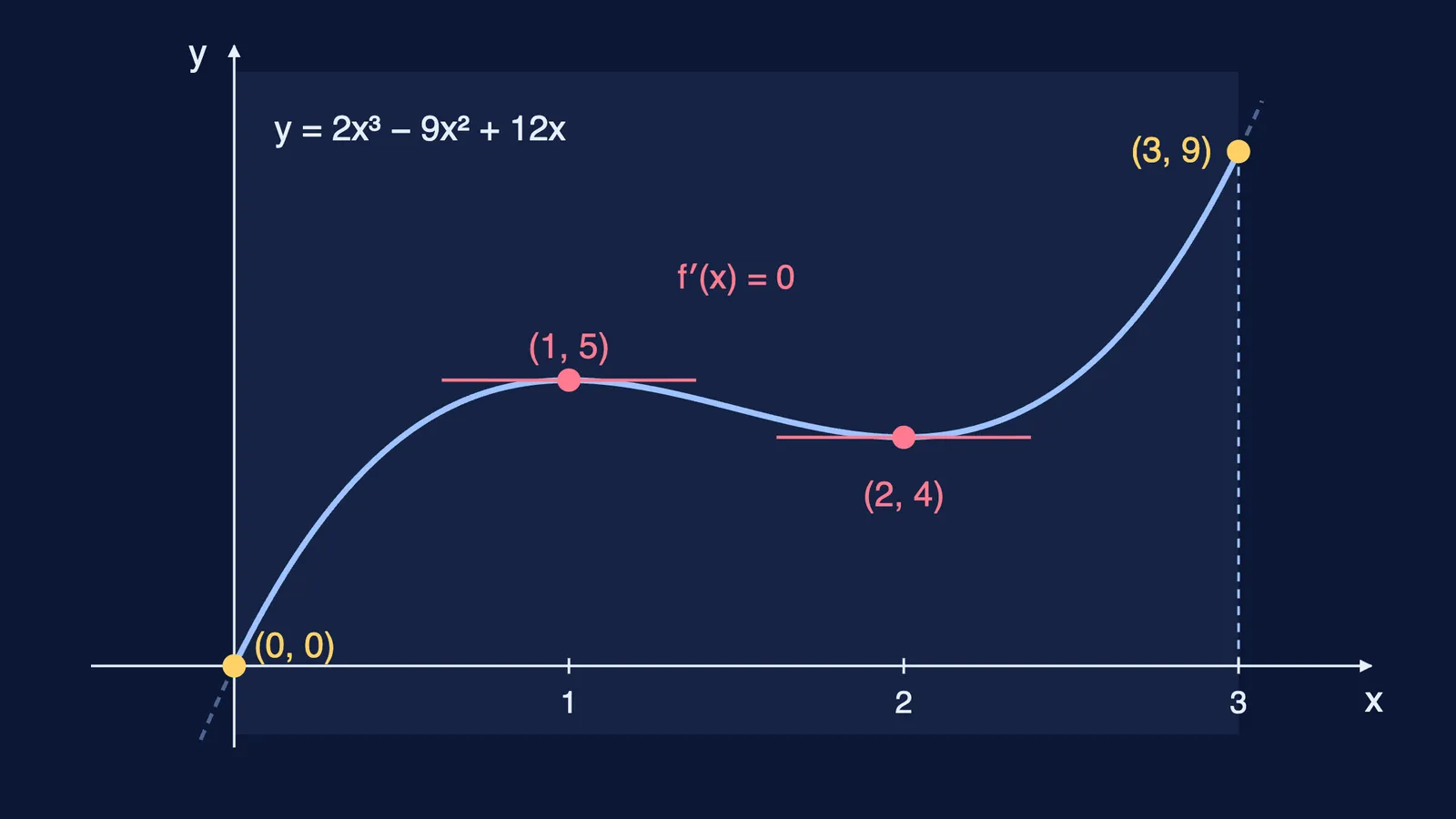
Worked example (the graph above): h(x) = 2x³ − 9x² + 12x on [0, 3]. h′(x) = 6(x − 1)(x − 2), so the critical points are 1 and 2. Then h(0) = 0, h(1) = 5, h(2) = 4, h(3) = 9: the absolute maximum is 9 at x = 3 and the absolute minimum 0 at x = 0, though x = 1 is a local maximum.
Watch for: skipping the end points, or keeping critical points outside [a, b].
How to revise this formula sheet
Derive the shape formulas by differentiating A, V or S with respect to t instead of memorising them.
Draw the sign line for f′ before writing any interval answer.
Run both extremum tests on the same function, so you know what to do when f″(c) = 0.
For closed intervals, always tabulate x and f(x) for critical points and end points.
If differentiating itself feels shaky, revise our continuity and differentiability Class 12 guide first. The Fermi Problem Library has worked problems with a step-by-step solver that explains the reasoning rather than printing an answer.