On this page
Most wrong answers in this chapter come from treating a true fact as the reason for another. These 10 original questions, easy to hard, target that slip.
What do these questions cover?
The CBSE Class 12 Mathematics sample paper for 2026-27 has two assertion-reason questions, Q19 and Q20, of 1 mark each. Every item stays inside the CBSE 2026-27 Mathematics syllabus (rate of change, increasing and decreasing functions, maxima and minima). Each was checked against the NCERT chapter, Reprint 2026-27. For the full chapter, see our guide to application of derivatives for Class 12 boards.
How do you answer assertion-reason questions?
Judge each statement alone first. If both are true, read "A, because R" and ask whether R is the actual reason. See our assertion-reason strategy guide.
Keys for Q1 to Q6:
(A) Both A and R are true and R is the correct explanation of A.
(B) Both A and R are true but R is NOT the correct explanation of A.
(C) A is true but R is false.
(D) A is false but R is true.
Keys for Q7 to Q10:
(A) Both statements are correct.
(B) Both statements are incorrect.
(C) Statement I is correct, Statement II is incorrect.
(D) Statement I is incorrect, Statement II is correct.
Assertion-reason questions with answers
Q1 (easy). Assertion (A): If a circle's radius grows at 0.5 cm/s, its area grows at 6π cm²/s when the radius is 6 cm. Reason (R): For a circle, dA/dt = 2πr · dr/dt.
Answer: (A). R is the chain rule on A = πr², giving 2π × 6 × 0.5 = 6π cm²/s, so R explains A.
Trap: stopping at dA/dr = 12π.
Q2 (easy). Assertion (A): f(x) = 3 − 5x is decreasing on R. Reason (R): f(x) is negative for every x > 3/5.
Answer: (B). Both true. A holds because f′(x) = −5 < 0; R is about the sign of f, not f′.
Trap: reading "f is negative" as "f is falling".
Q3 (medium). Assertion (A): f(x) = |x − 2| has a local minimum at x = 2. Reason (R): f′(2) = 0.
Answer: (C). A is true: f(2) = 0 and f ≥ 0. R is false: the one-sided derivatives at 2 are −1 and +1, so f′(2) does not exist. NCERT still calls x = 2 a critical point.
Trap: assuming every extremum has f′ = 0.
Q4 (medium). Assertion (A): If f′(c) = 0 and f″(c) = 0, then f has neither a local maximum nor a local minimum at c. Reason (R): The second derivative test fails when f′(c) = 0 and f″(c) = 0.
Answer: (D). R is NCERT's own rule. A is false: f(x) = x⁴ has f′(0) = f″(0) = 0, yet x = 0 is a local minimum. When the test fails, use the first derivative test.
Trap: reading "test fails" as "no extremum".
Q5 (medium). Assertion (A): On [0, 4], the absolute maximum value of f(x) = x³ − 12x is 16. Reason (R): A function continuous on a closed interval attains an absolute maximum there.
Answer: (B). A is true: x = 0, 2 and 4 give 0, −16 and 16. R is true (NCERT Theorem 5) but only promises that a maximum exists; comparing values at critical points and endpoints gives 16.
Trap: picking (A) because R mentions maxima.
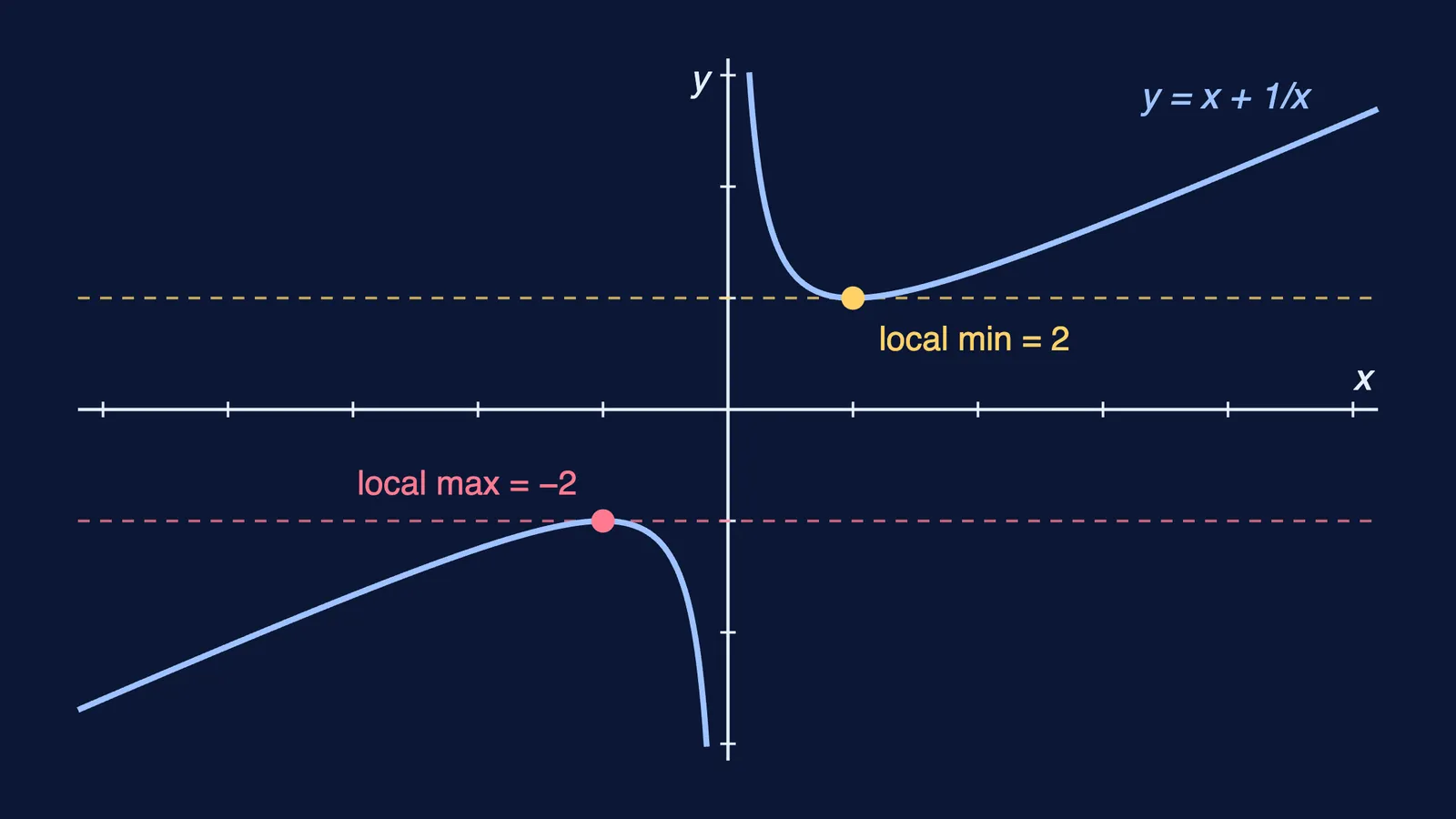
Q6 (hard). Assertion (A): f(x) = x + 1/x has a local maximum value that is less than its local minimum value. Reason (R): A local maximum value is the greatest value of the function on its whole domain.
Answer: (C). f′(x) = 1 − 1/x² is zero at x = ±1; f″(−1) = −2 gives a local maximum −2, and f″(1) = 2 a local minimum 2. So A is true. R is false: "local" means greatest only nearby, as the graph shows.
Trap: expecting a maximum above a minimum.
Statement I and II questions with answers
Q7 (easy). Statement I: cos 2x is decreasing on (0, π/2). Statement II: sin 2x is increasing on (0, π/2).
Answer: (C). The derivative of cos 2x, −2 sin 2x, is negative on (0, π/2), so I is correct. sin 2x rises until π/4 and then falls, so II is incorrect.
Trap: picturing half the sine curve.
Q8 (medium). Statement I: If a spherical balloon's volume grows at a constant rate, its radius also grows at a constant rate. Statement II: If a cube's edge grows at 0.2 cm/s, its volume grows at 9.6 cm³/s when the edge is 4 cm.
Answer: (D). From V = (4/3)πr³, dr/dt = (dV/dt)/(4πr²) shrinks as r grows, so I is incorrect. For the cube, dV/dt = 3a² · da/dt = 3 × 16 × 0.2 = 9.6 cm³/s.
Trap: assuming a constant rate carries over between quantities.
Q9 (hard). Statement I: f(x) = x³ + 3x² + 3x − 4 has no point of local maximum or minimum. Statement II: g(x) = 2x³ − 9x² + 12x has a local maximum at x = 1 and a local minimum at x = 2.
Answer: (A). f′(x) = 3(x + 1)² never changes sign, so x = −1 is a point of inflection. g′(x) = 6(x − 1)(x − 2) turns from + to − at 1 and − to + at 2.
Trap: calling every root of f′ an extremum.
Q10 (hard). Statement I: If f′(x) > 0 everywhere in its domain, f is increasing on its whole domain. Statement II: On [−1, 2], f(x) = x⁴ − 2x² attains its absolute minimum value at x = 0.
Answer: (B). For −1/x, f′(x) = 1/x² > 0, yet f(−1) = 1 > f(1) = −1: NCERT's test needs an interval, and this domain has a gap at 0. For II, f(−1) = −1, f(0) = 0, f(1) = −1, f(2) = 8, so the minimum is at x = ±1; x = 0 is a local maximum.
Trap: ignoring domain gaps and stopping at one critical point.
How should you use this set?
Attempt all ten in 15 minutes.
Label each miss: wrong fact or wrong link.
Redo the misses two days later.
If one method mistake keeps returning, the Fermi Problem Library has worked problems with a step-by-step solver that explains the reasoning rather than printing an answer. For timed MCQ practice, try our JEE Main application of derivatives questions with solutions.