On this page
This set has eight original amines questions in JEE Main style, ordered from easy to hard. Each comes with a worked solution and a trap line: the wrong option that looks most tempting, and the slip behind it. Q3 is a numerical-value question.
How should you use this amines practice set?
Amines sit in Unit 18, Organic Compounds Containing Nitrogen, of the NTA Syllabus for JEE (Main) - 2027, which lists preparation, basic character, identification of primary, secondary and tertiary amines, and diazonium salts in synthesis. Q6 also uses the pH ideas from the ionic equilibrium unit of the same syllabus.
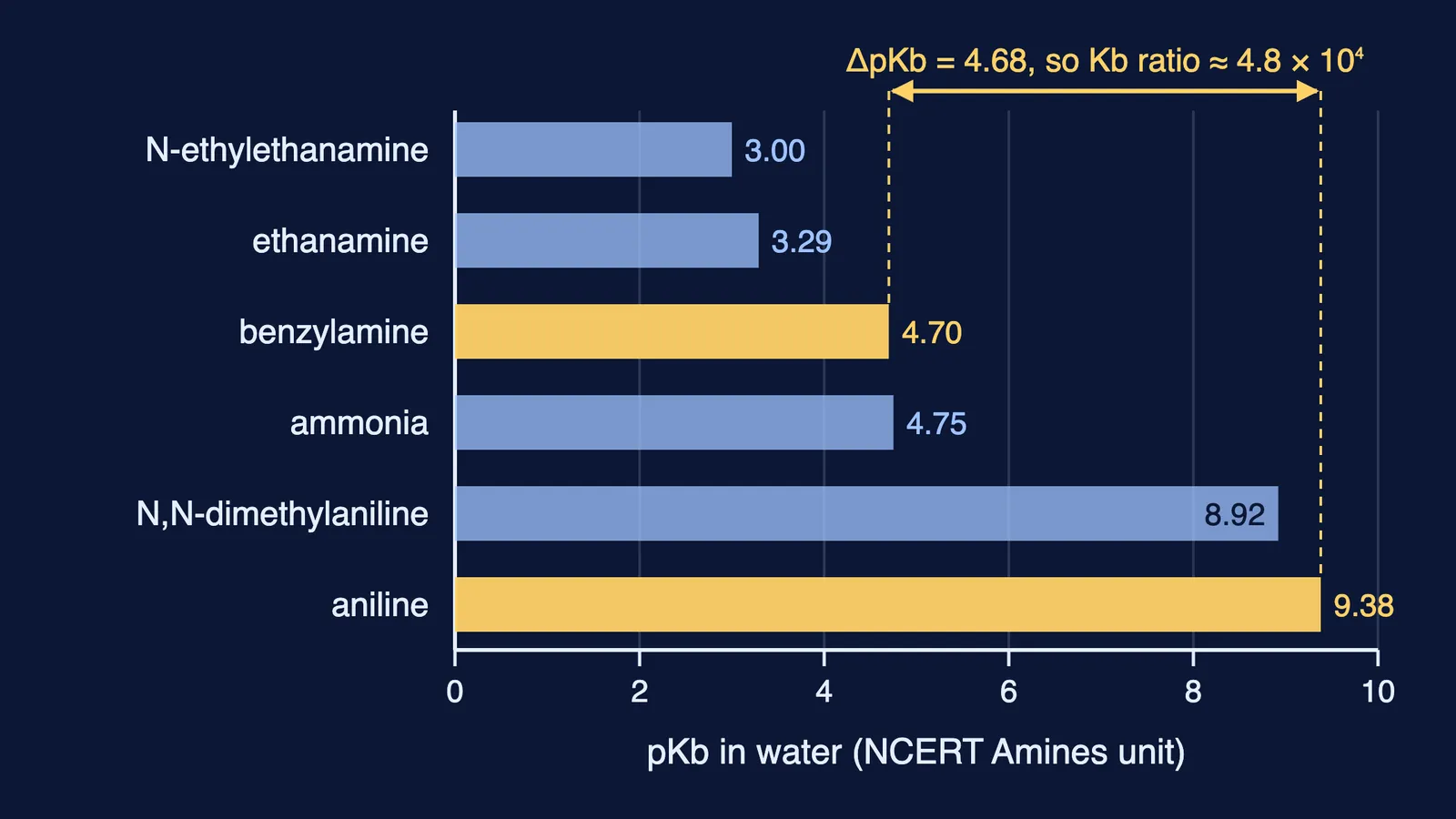
Every pKb value and reaction here follows Unit 9, Amines, of NCERT Class 12 Chemistry Part II (reprint 2026-27). In that chapter, aniline has a pKb of 9.38 and benzylamine 4.70.
Set a timer for 20 minutes and work on paper.
Before choosing an option, write whether each amine is primary, secondary or tertiary, and whether its nitrogen sits on the ring or on a carbon chain.
Read every trap line, even for questions you got right.
New to the chapter? Start with our guide on how to prepare amines for JEE Main.
Easy: can you classify an amine before you answer?
Q1 (easy). Which of these is the strongest base in water?
(A) Aniline
(B) N-Methylaniline
(C) N,N-Dimethylaniline
(D) Ethanamine
Answer: (D). In NCERT Table 9.3, ethanamine has pKb 3.29; the three aryl amines lie between 8.92 and 9.38, because their lone pair is spread into the ring. Smaller pKb means a stronger base. Trap: (C), from counting alkyl groups. The methyls help a little, but the nitrogen is still on the ring.
Q2 (easy). 2-Methylpropanamide, (CH₃)₂CHCONH₂, is warmed with Br₂ and aqueous NaOH. The amine formed is:
(A) 2-Methylpropan-1-amine
(B) Propan-1-amine
(C) Propan-2-amine
(D) 2-Methylpropan-2-amine
Answer: (C). In Hoffmann bromamide degradation the alkyl group moves from the carbonyl carbon to nitrogen and the C=O carbon is lost. The isopropyl group keeps its shape, so (CH₃)₂CH–NH₂ forms. Trap: (A), which keeps all four carbons. That is what LiAlH₄ reduction of the amide would give.
Q3 (easy, numerical). How many of these give a foul-smelling product when heated with chloroform and ethanolic KOH: aniline, N-methylaniline, benzylamine, p-toluidine, triethylamine, cyclohexylamine, acetanilide, propan-2-amine?
Answer: 5. The carbylamine test is positive only for primary amines, aliphatic or aromatic: aniline, benzylamine, p-toluidine, cyclohexylamine and propan-2-amine. N-methylaniline is secondary, triethylamine is tertiary and acetanilide is an amide. Trap: 3, from thinking only aliphatic primary amines respond.
Medium: where do tests and pKb numbers trip you up?
Q4 (medium). An amine C₄H₁₁N reacts with benzenesulphonyl chloride to give a solid that does not dissolve in aqueous KOH. The amine is:
(A) Butan-1-amine
(B) N-Ethylethanamine
(C) N,N-Dimethylethanamine
(D) 2-Methylpropan-2-amine
Answer: (B). A secondary amine gives a sulphonamide with no hydrogen on nitrogen, so it is not acidic and stays insoluble in alkali. Primary amines (A, D) give an acidic N–H that dissolves in KOH. Trap: (C). A tertiary amine does not react at all, so there is no solid to test. For the history of this reagent, read how the Hinsberg test sorts three amines.
Q5 (medium). Using pKb(benzylamine) = 4.70 and pKb(aniline) = 9.38 (NCERT Table 9.3), the ratio Kb(benzylamine)/Kb(aniline) is closest to:
(A) 2.0
(B) 4.7
(C) 2.1 × 10⁻⁵
(D) 4.8 × 10⁴
Answer: (D). Kb = 10^(−pKb), so the ratio is 10^(9.38 − 4.70) = 10^4.68 ≈ 4.8 × 10⁴. Trap: (A), from dividing 9.38 by 4.70. pKb is a logarithm, so a difference in pKb is a ratio in Kb.
Q6 (medium). The pH of 0.010 M aqueous aniline at 298 K (pKb = 9.38, Kw = 1.0 × 10⁻¹⁴) is closest to:
(A) 5.69
(B) 8.31
(C) 10.31
(D) 4.62
Answer: (B). Aniline ionises very little, so [OH⁻] = √(Kb·c) and pOH = ½(pKb − log c) = ½(9.38 + 2) = 5.69. Then pH = 14 − 5.69 = 8.31. Solving the full quadratic gives the same 8.31, since only about 0.02% ionises. Trap: (A), which stops at pOH and reports it as pH.
Hard: can you track the nitrogen through a sequence?
Q7 (hard). p-Toluidine is treated with NaNO₂ and HCl at 273-278 K, then with CuCN/KCN to give X. X is reduced with LiAlH₄ to Y, and Y is treated with NaNO₂ and dilute HCl in the cold to give Z with brisk effervescence. Z is:
(A) 4-Methylphenol
(B) (4-Methylphenyl)methanol
(C) 4-Methylbenzenediazonium chloride
(D) 4-Methylbenzoic acid
Answer: (B). Diazotisation and the Sandmeyer reaction give X, 4-methylbenzonitrile. LiAlH₄ turns –CN into –CH₂NH₂, so Y is 4-methylbenzylamine, a primary amine whose nitrogen is on a CH₂, not the ring. Like a primary aliphatic amine, it reacts with nitrous acid to release N₂ and form an alcohol. Trap: (C), from treating Y as an aromatic amine that forms a stable diazonium salt.
Q8 (hard). Aniline is treated in turn with (i) acetic anhydride, (ii) conc. HNO₃ and conc. H₂SO₄, (iii) aqueous acid with heating, (iv) NaNO₂ and HCl at 273-278 K, and (v) H₃PO₂. The final organic product is:
(A) Nitrobenzene
(B) 4-Nitrophenol
(C) Benzene
(D) 4-Nitroaniline
Answer: (A). Acetylation tames –NH₂ so nitration gives mainly the para product, p-nitroacetanilide. Hydrolysis gives 4-nitroaniline, diazotisation gives the diazonium salt, and H₃PO₂ replaces –N₂⁺ with H. Only the nitro group is left: nitrobenzene. Trap: (B), which treats step (v) as warming the diazonium salt in water, the route to a phenol.
What should you do after checking your answers?
Sort each miss into one bin: classification (Q1, Q3, Q4, Q7), carbon bookkeeping (Q2, Q7, Q8) or logarithms (Q5, Q6). The fullest bin is what you practise this week. If basicity was the weak spot, read why secondary amines are the strongest bases in water.
When a whole conversion falls apart rather than one step, the Fermi Problem Library has worked problems with a step-by-step solver that explains the reasoning rather than printing an answer.
Redo your misses in two days, without the solutions.