On this page
Here are eight original JEE Main-style questions on alcohols, phenols and ethers, arranged from easy to hard. Each has a worked solution and a trap line naming the most tempting wrong option. Q3 and Q5 are numerical-value questions; the rest are single-correct.
How should you use this alcohols, phenols and ethers set?
The JEE (Main) 2027 syllabus puts this chapter in Unit 17, Organic Compounds Containing Oxygen: identifying primary, secondary and tertiary alcohols, the mechanism of dehydration, the acidic nature of phenols, their electrophilic substitution, the Reimer-Tiemann reaction and the structure of ethers. Every question stays inside that unit (Q7 also uses carbocation rearrangement from Unit 14), and the reactions follow Unit 7 of the NCERT Class 12 Chemistry Part II textbook (Reprint 2026-27), which supplies the pKa values in Q2 and Q5.
Allow 16 minutes, about two per question.
Before choosing an option, write one line naming the intermediate: alkoxide, phenoxide, carbocation or oxonium ion.
Read every trap line, even where you were right.
New to the chapter? Start with our guide on how to prepare alcohols, phenols and ethers for JEE Main and come back.
Easy: can you classify, rank and count?
Q1 (easy). Which alcohol turns Lucas reagent (conc. HCl + anhydrous ZnCl₂) turbid immediately at room temperature?
(A) 2,2-dimethylpropan-1-ol
(B) pentan-2-ol
(C) 2-methylbutan-2-ol
(D) 3-methylbutan-1-ol
Answer: (C). The –OH carbon in 2-methylbutan-2-ol carries three carbons, so it is tertiary; its chloride forms at once and, being insoluble, clouds the solution. (B) is secondary; (A) and (D) are primary, which NCERT says give no turbidity at room temperature. Trap: (A), because it looks the most branched. Its –OH carbon is a CH₂.
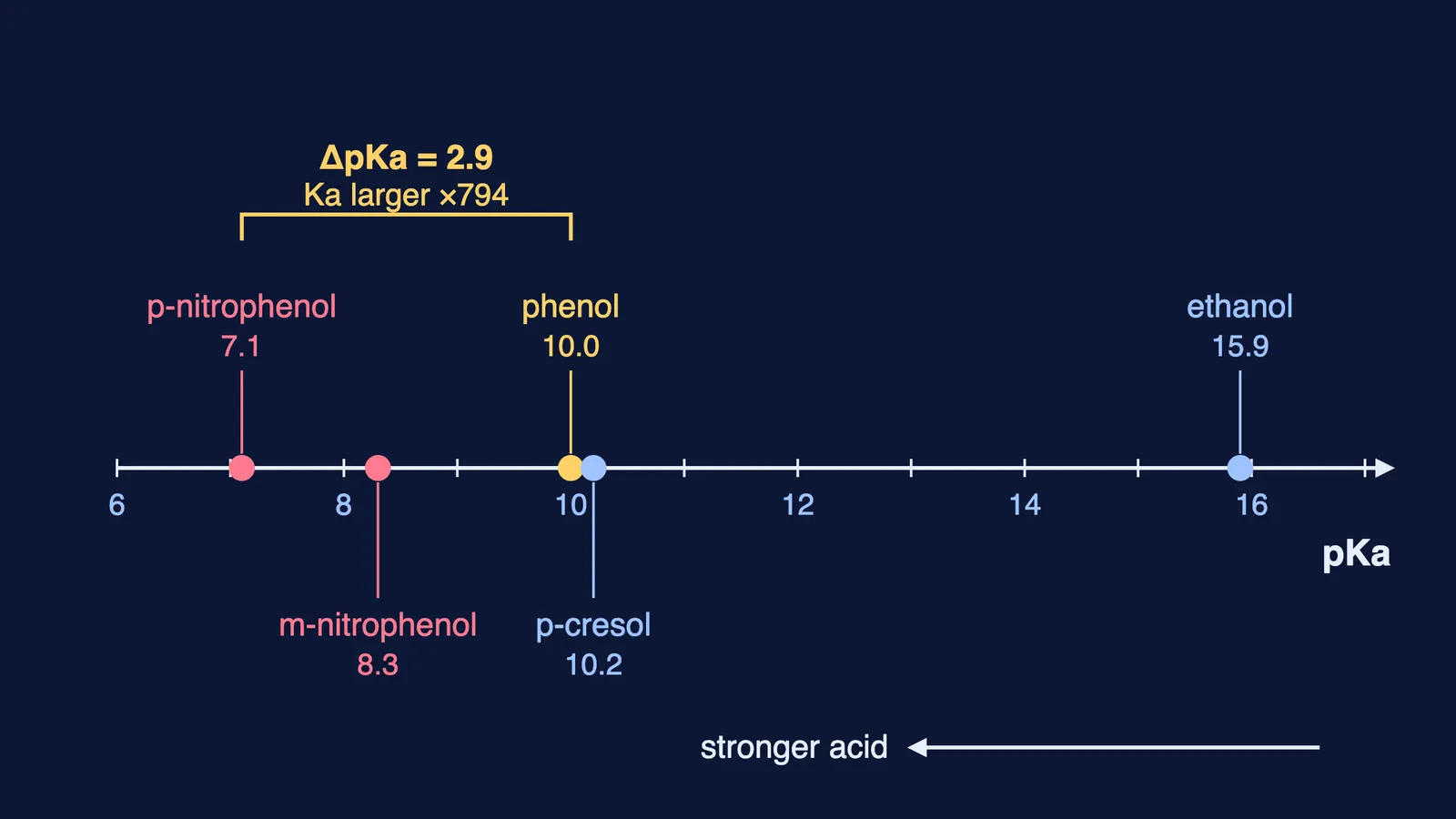
Q2 (easy). Using the NCERT pKa values, arrange in increasing acid strength: ethanol, phenol, p-cresol, m-nitrophenol, p-nitrophenol.
(A) ethanol < phenol < p-cresol < m-nitrophenol < p-nitrophenol
(B) ethanol < p-cresol < phenol < m-nitrophenol < p-nitrophenol
(C) ethanol < p-cresol < phenol < p-nitrophenol < m-nitrophenol
(D) p-cresol < ethanol < phenol < m-nitrophenol < p-nitrophenol
Answer: (B). NCERT Table 7.3 gives pKa 15.9 for ethanol, 10.2 for p-cresol, 10.0 for phenol, 8.3 for m-nitrophenol and 7.1 for p-nitrophenol; a lower pKa means a stronger acid. Methyl destabilises the phenoxide; a para –NO₂ takes the negative charge by resonance, which a meta –NO₂ cannot. Trap: (C), from thinking the –I effect alone decides, so the nearer meta group should win.
Q3 (easy, numerical). 4.70 g of phenol is shaken with excess bromine water, and the white precipitate forms in 90% yield. Find its mass in grams, to the nearest integer. (C = 12, H = 1, O = 16, Br = 80)
Answer: 15. Bromine water gives 2,4,6-tribromophenol, C₆H₂Br₃OH, with molar mass 331 g/mol. Phenol (94 g/mol): 4.70/94 = 0.0500 mol. Mass = 0.0500 × 331 × 0.90 = 14.9 g, which rounds to 15. Trap: 17, from forgetting the 90% yield; 8 comes from assuming monobromination, which needs bromine in CS₂ at low temperature.
Medium: can you predict the product?
Q4 (medium). p-Cresol is heated with chloroform and aqueous NaOH, and the mixture is then acidified. The main organic product is:
(A) 2-hydroxy-5-methylbenzaldehyde
(B) 4-hydroxy-3-methylbenzaldehyde
(C) 2-hydroxy-5-methylbenzoic acid
(D) 4-methylbenzaldehyde
Answer: (A). This is the Reimer-Tiemann reaction: the phenoxide directs the new –CHO group to a position ortho to –OH. Para is blocked by CH₃, and numbering from the –CHO carbon puts –OH at C2 and CH₃ at C5. Trap: (C), which is what CO₂ under pressure gives (Kolbe's reaction), not chloroform.
Q5 (medium, numerical). From pKa(phenol) = 10.0 and pKa(p-nitrophenol) = 7.1 (NCERT Table 7.3), how many times larger is Ka of p-nitrophenol than Ka of phenol? Give the nearest integer.
Answer: 794. Ka = 10^(−pKa), so the ratio is 10^(10.0 − 7.1) = 10^2.9 ≈ 794.3. Trap: 50, which is 10^1.7 and belongs to m-nitrophenol (pKa 8.3); read the right row of the table.
Q6 (medium). Which combination gives 2-methoxy-2-methylpentane in good yield?
(A) CH₃ONa + 2-bromo-2-methylpentane
(B) (CH₃)₂C(ONa)CH₂CH₂CH₃ + CH₃Br
(C) 2-methylpentan-2-ol + methanol, conc. H₂SO₄ at 413 K
(D) 2-methylpent-1-ene + CH₃ONa
Answer: (B). Williamson synthesis is an SN2 attack of an alkoxide on an alkyl halide, so the halide must be the unhindered one. Put the bulky tertiary part on the alkoxide and let it attack CH₃Br. Trap: (A). With a tertiary halide the alkoxide acts as a base, and NCERT notes the only product is an alkene. For why (C) also fails, see why tertiary alcohols give alkenes, not ethers, with acid.
Hard: can you follow the carbocation?
Q7 (hard). 2,2-Dimethylpentan-3-ol, (CH₃)₃C–CH(OH)–CH₂CH₃, is heated with conc. H₂SO₄. The major alkene is:
(A) 4,4-dimethylpent-2-ene
(B) 2,3-dimethylpent-1-ene
(C) 2,3-dimethylpent-2-ene
(D) 3,4-dimethylpent-2-ene
Answer: (C). Loss of water gives a secondary carbocation at C3. A methyl from the neighbouring quaternary carbon shifts across, giving the more stable tertiary cation (CH₃)₂C⁺–CH(CH₃)–CH₂CH₃. Losing the lone hydrogen on the next carbon gives the tetrasubstituted alkene (CH₃)₂C=C(CH₃)CH₂CH₃. Trap: (A), the alkene you get if you skip the shift; (B) has the shift but the less substituted double bond.
Q8 (hard). Ether P is anisole (C₆H₅–O–CH₃) and ether Q is 2-methoxy-2-methylbutane. Each is heated with one equivalent of concentrated HI. Which is correct?
(A) P: iodobenzene + methanol; Q: CH₃I + 2-methylbutan-2-ol
(B) P: phenol + CH₃I; Q: methanol + 2-iodo-2-methylbutane
(C) P: phenol + CH₃I; Q: CH₃I + 2-methylbutan-2-ol
(D) P: iodobenzene + methanol; Q: methanol + 2-iodo-2-methylbutane
Answer: (B). In anisole the O–aryl bond is stronger, so iodide attacks the methyl carbon: phenol and CH₃I. For Q, the protonated ether loses methanol to leave a tertiary carbocation (SN1), so iodide ends up on the tertiary carbon. Trap: (C), applying the "iodide goes to the smaller group" rule to Q, where it only holds for primary and secondary groups.
What should you do with your mistakes?
Sort each wrong answer into one bucket: misclassified the alcohol (Q1), misread a table (Q2, Q5), arithmetic (Q3), or mechanism (Q4, Q6 to Q8). Mechanism slips cost the most, because the same intermediates return in haloalkanes and carbonyl chemistry. If the phenol order is still shaky, work through the acidity order of substituted phenols.
For more practice, the Fermi Problem Library has worked problems with a step-by-step solver that explains the reasoning rather than printing an answer.