On this page
Write di-tert-butyl ether as the product of heating tert-butyl alcohol with concentrated sulphuric acid and you will lose the mark. Making ethers with acid works only for simple primary alcohols. Give the acid a secondary or tertiary alcohol and you get an alkene.
Why don't tertiary alcohols form ethers with acid?
The NCERT Class 12 chemistry textbook says acid dehydration "is suitable for the preparation of ethers having primary alkyl groups only" (NCERT Chemistry Part II, Unit 7). The same page says that for secondary and tertiary alcohols "elimination competes over substitution and as a consequence, alkenes are easily formed".
The reason lies in the intermediate. NCERT describes ether formation as an SN2 step: a second alcohol molecule attacks a protonated alcohol directly. That needs an unhindered carbon. A tertiary carbon is crowded by three alkyl groups, which blocks that direct attack. NCERT notes that the reaction follows an SN1 pathway for secondary and tertiary alcohols: the protonated alcohol loses water and becomes a carbocation.
NCERT's margin note says tertiary carbocations are more stable and form more easily than secondary and primary ones, so tertiary alcohols are the easiest to dehydrate. Once the carbocation forms, it has two options. It can wait for the oxygen of another bulky alcohol to reach it, or it can lose a proton from a neighbouring carbon. Losing the proton is easier, so the alkene wins.
What happens to tert-butyl alcohol in acid, step by step?
This worked example follows NCERT's dehydration mechanism (protonation, then a carbocation, then loss of a proton) using 2-methylpropan-2-ol, (CH3)3C-OH (NCERT Unit 7).
Protonation (fast): (CH3)3C-OH + H+ gives (CH3)3C-OH2+. The leaving group is now water, which leaves easily.
Loss of water (slow, rate-determining): (CH3)3C-OH2+ gives (CH3)3C+ and H2O. The three methyl groups stabilise the positive carbon.
The fork. Path A: one of the nine hydrogens on the neighbouring methyl groups leaves as H+, giving CH2=C(CH3)2, 2-methylpropene. Path B: the oxygen of a second (CH3)3C-OH has to reach a carbon already shielded by three methyl groups to make (CH3)3C-O-C(CH3)3.
Path A wins. The H+ is returned, ready to protonate the next molecule. NCERT notes that ethene "is removed as it is formed" to drive the equilibrium to the right; removing any alkene as it forms works the same way.
Chemistry LibreTexts agrees: "Secondary and tertiary alcohols dehydrate through the E1 mechanism" (Chemistry LibreTexts, Reactions of Alcohols/17%3A_Alcohols_and_Phenols/17.06%3A_Reactions_of_Alcohols)).
How much milder are the conditions for tertiary alcohols?
NCERT gives these conditions (NCERT Unit 7):
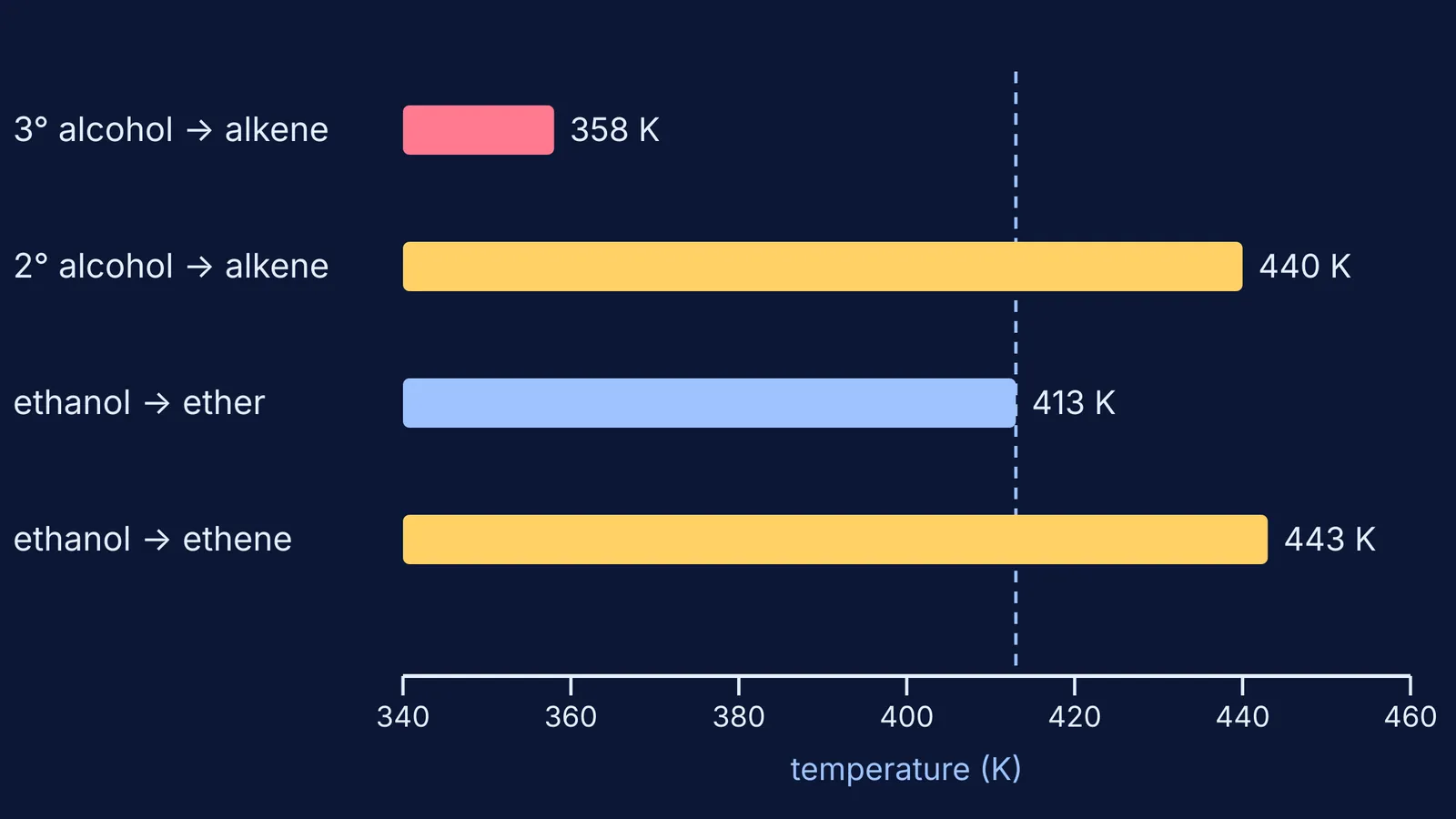
Ethanol with concentrated H2SO4 gives ethoxyethane (diethyl ether) at 413 K.
Ethanol with concentrated H2SO4 gives ethene at 443 K.
Propan-2-ol (secondary) gives propene with 85% H3PO4 at 440 K.
2-Methylpropan-2-ol (tertiary) gives 2-methylpropene with 20% H3PO4 at 358 K.
A tertiary alcohol becomes an alkene at 358 K in 20% H3PO4, 55 K below the temperature at which ethanol gives an ether. NCERT puts the ease of dehydration as tertiary > secondary > primary. LibreTexts gives typical ranges of 25-80 °C for tertiary alcohols and 100-140 °C for secondary ones (Chemistry LibreTexts/17%3A_Alcohols_and_Phenols/17.06%3A_Reactions_of_Alcohols)).
That is why NCERT calls making ethers from secondary and tertiary alcohols this way "unsuccessful". For the primary case, see our explainer on why ethanol gives ether at 413 K but ethene at 443 K.
How do you make an ether with a tertiary group, then?
Use the Williamson synthesis, and put the tertiary group on the alkoxide, not the halide. In NCERT's Example 7.6, sodium ethoxide and tert-butyl chloride give mainly 2-methylprop-1-ene, "because sodium ethoxide is a strong nucleophile as well as a strong base". The correct route is sodium tert-butoxide with ethyl chloride (NCERT Unit 7). Our guide to choosing the halide and alkoxide in Williamson synthesis works through more pairs.
If you keep mixing up which partner goes where, the Fermi Problem Library has worked problems with a step-by-step solver that explains the reasoning rather than printing an answer.
What should you write for alcohol + conc. H2SO4 in an exam?
Run through this checklist, built on NCERT Unit 7:
Is the alcohol primary and unhindered? If not, write an alkene.
If it is primary, check the temperature. For ethanol, the lower one (413 K) gives an ether and the higher one (443 K) gives an alkene.
For a secondary or tertiary alcohol, draw the carbocation; by Zaitsev's rule the most stable, usually the more substituted, alkene is the major product (Chemistry LibreTexts/17%3A_Alcohols_and_Phenols/17.06%3A_Reactions_of_Alcohols)). Our post on the carbocation route to the major alkene explains how to pick it.
Asked for a mixed or tertiary ether? Switch to Williamson: tertiary alkoxide plus primary halide.
Asked why acid dehydration fails? Answer in one line: for secondary and tertiary alcohols, elimination competes over substitution, so alkenes form.
NCERT also asks why bimolecular dehydration is not suitable for making ethyl methyl ether. Think about what happens when two different primary alcohols are protonated in the same flask.
If carbocation stability still feels shaky, the Fermi Concept Library covers every concept in chemistry, each with its own lesson.