

On this page
Same flask, same two chemicals, two different products. That makes this an easy question to set: change only the temperature and see whether you know why the product changes. Here are the textbook facts, both mechanisms, the reason temperature decides, and a model answer.
What does ethanol give with conc. H2SO4 at 413 K and 443 K?
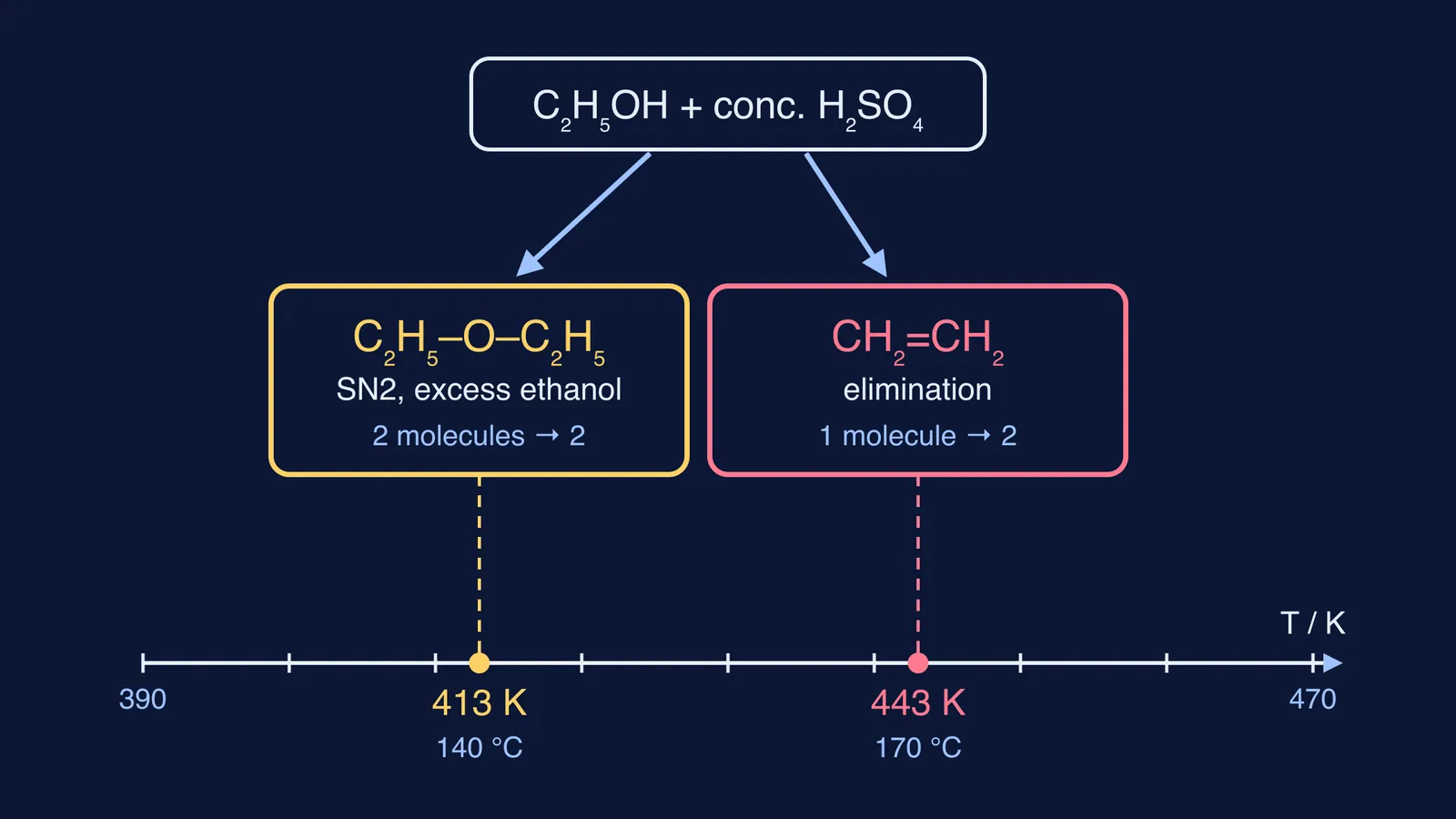
The NCERT Class 12 Chemistry chapter on alcohols, phenols and ethers states that ethanol is dehydrated to ethene by sulphuric acid at 443 K, and that at 413 K ethoxyethane is the main product. In degrees Celsius, 413 K is 140 °C and 443 K is 170 °C.
At 413 K: 2 CH3CH2OH → CH3CH2–O–CH2CH3 + H2O (ethoxyethane, also called diethyl ether)
At 443 K: CH3CH2OH → CH2=CH2 + H2O (ethene)
Temperature is not the only condition. A LibreTexts module on making ethers by dehydration/Ethers/Synthesis_of_Ethers/Dehydration_of_Alcohols_to_Make_Ethers) says the alcohol has to be in excess and the temperature kept around 413 K; if it is not in excess, or the temperature is higher, the alcohol goes on to the alkene instead.
How does diethyl ether form by SN2 at 413 K?
NCERT calls ether formation a nucleophilic bimolecular reaction (SN2), in which an alcohol molecule attacks a protonated alcohol. In three steps:
Ethanol takes a proton from the acid and becomes CH3CH2–OH2+, the protonated alcohol. Water is now a good leaving group.
The oxygen of a second ethanol molecule attacks the CH2 carbon from the back and pushes out water in one step. This is the SN2 step.
The protonated ether loses H+, giving CH3CH2–O–CH2CH3 and returning the acid.
Excess ethanol matters because step 2 needs a second ethanol molecule close by. The same textbook page notes that this method works only for ethers with primary alkyl groups that are unhindered, and that the temperature must be kept low, otherwise the reaction favours the alkene. If the SN2 step itself is shaky, our explainer on SN1 and SN2 stereochemistry walks through backside attack.
Why does a higher temperature give ethene instead?
In the NCERT mechanism for making ethene, ethanol is first protonated, then loses water to form a carbocation (the slow, rate-determining step), and then loses a proton to give ethene; the acid used in step 1 comes back in step 3, as shown in the same NCERT chapter. Some university texts describe primary alcohols as dehydrating by the E2 route instead; LibreTexts' version of Wade's Organic Chemistry_Complete_and_Semesters_I_and_II/Map:_Organic_Chemistry_(Wade)/14:_Reactions_of_Alcohols/14.04:_Dehydration_Reactions_of_Alcohols) says this, and also that alcohols which are not heated enough react with one another to form ethers. For a CBSE board answer, write the NCERT steps. Both routes give the same product.
The reason temperature decides comes from free energy, ΔG = ΔH − TΔS. A LibreTexts chapter on elimination reactions/08:_NUCLEOPHILIC_SUBSTITUTIONS_AND_ELIMINATIONS/8.05:_Elimination_reactions) explains that elimination increases the number of molecules and so increases entropy, that high temperatures favour such reactions, and that SN2 is best run at the lowest temperature that still gives a reasonable rate.
In our flask, making ether turns two molecules into two, while making ethene turns one into two. Raise T and the −TΔS term helps the ethene route more and more, so by 443 K elimination takes over.
How do you write the answer in an exam?
Here is a model answer to the usual question, built from the NCERT chapter: "What happens when ethanol is heated with concentrated H2SO4 at (a) 413 K and (b) 443 K? Give the mechanism for (a)."
(a) At 413 K, with ethanol in excess, the main product is ethoxyethane: 2 C2H5OH → C2H5OC2H5 + H2O.
Mechanism: protonation of ethanol; SN2 attack by a second ethanol molecule on the protonated ethanol, with water leaving; loss of H+ from the protonated ether.
(b) At 443 K the product is ethene: C2H5OH → CH2=CH2 + H2O, an elimination.
One line of reasoning: elimination produces more molecules, so it is favoured at the higher temperature.
Use this checklist for variations on the question:
Primary alcohol, about 413 K, alcohol in excess: symmetrical ether by SN2.
Primary alcohol, about 443 K: alkene by elimination.
Secondary or tertiary alcohol: expect the alkene. NCERT says getting ethers this way is unsuccessful because elimination competes with substitution and alkenes form easily.
Unsymmetrical ether such as ethyl methyl ether: not by this route. The LibreTexts module/Ethers/Synthesis_of_Ethers/Dehydration_of_Alcohols_to_Make_Ethers) says it cannot make unsymmetrical ethers because a mixture of products is likely; with methanol and ethanol, that means dimethyl, diethyl and ethyl methyl ethers together. Use Williamson ether synthesis instead.
Alkene from a branched alcohol: work out the more substituted product with the carbocation route in our post on alcohol dehydration and the major alkene.
If you keep losing marks on mechanism steps, try worked problems in the Fermi Problem Library, where the step-by-step solver explains the reasoning rather than printing an answer. If protonated alcohols as leaving groups still feel shaky, the Fermi Concept Library gives each chemistry concept its own lesson.


