On this page
Chapter 8 of Kaushal Vikas, NCERT's new Class 9 skill education book (0916, First Edition, April 2026), is titled Additional Vocations. Chapters 4 and 12 share the title; this one sits in Unit II, Work with Machines and Materials.
What is Additional Vocations (Chapter 8) in Class 9 Kaushal Vikas?
The book's opening pages say each unit offers seven vocations and schools are encouraged to pick one. Chapter 5 (Shaping Materials) is compulsory. Chapters 6 and 7 cover construction and apparel in detail. Chapter 8 gives shorter guidelines for five more: sheet metal work, plumbing, food processing, furniture making and pottery. Each unit gets about 36 hours (44 periods).
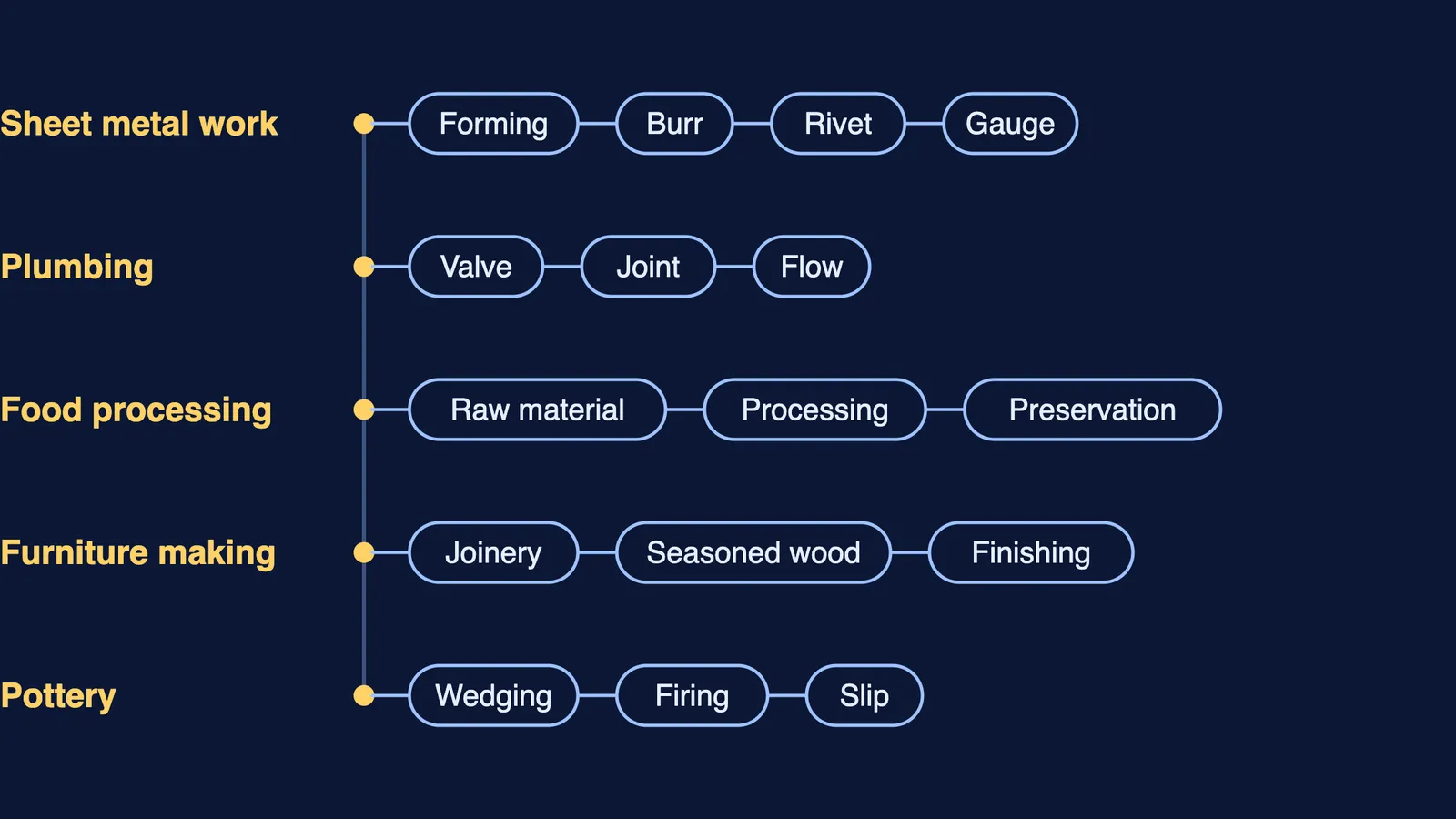
For every vocation, the chapter lists keywords (mapped in the diagram above), tools and materials, quality and safety parameters, and key steps.
How is Kaushal Vikas assessed in 2026-27?
Your school assesses it. CBSE's Kaushal Vikas assessment guidelines for Class IX, 2026-27 list five modes: paper-pencil test 40%, demonstration with oral presentation or viva 20%, site visit report or observation notes 10%, portfolio 20% and teachers' observations 10%.
The 40-mark test has objective questions (8 marks), short answers (12), scenario or case questions (16) and one reflective question (4). Plan and Prepare, which includes the bill of materials, carries 14 of those 40 marks. These figures cover the whole subject; there is no chapter-wise mark.
The 2026-27 curriculum lists the Grade 9 Work with Machines and Materials vocation-specific themes: site visit, process chart, tool safety, prototypes, estimating materials, cost records and waste disposal. It names no chapters, so this guide follows the book and maps it to that unit.
What does the chapter say about each vocation?
From the NCERT chapter, in our words:
Sheet metal work: cutting, bending, joining and finishing thin steel, aluminium or copper sheets. A burr is the sharp leftover edge after a cut; a rivet joins sheets; gauge means sheet thickness. A cardboard prototype tests folds and joints first.
Plumbing: fitting, maintaining and repairing pipe systems for water, other fluids, gases or waste. Tasks stay small, like a leaking tap or blocked drain; water is shut off first and checked for leaks after.
Food processing: making raw grains, fruit, vegetables or milk safe and longer-lasting by drying, cooking, fermenting or preserving. Hand washing and keeping raw and processed food apart are among its safety points.
Furniture making: stools, small tables, shelves or boxes from wood, bamboo or engineered boards. Joinery is how parts are joined; seasoned wood has been dried to cut its moisture.
Pottery: wedging (kneading clay to push out air bubbles), shaping by pinch, coil, slab or mould, joining with slip, slow shaded drying, then hardening by kiln firing, open firing or long sun drying.
Spelling note: the furniture quality list prints "Recyling"; write recycling in answers. The pottery list repeats its firing and finishing steps; learn them once.
How do you plan materials for a sheet metal chalk box?
The curriculum asks you to estimate materials from a sketch and keep cost records. Our own numbers and made-up prices, for study only:
An open chalk box has a base of 10 cm × 8 cm and sides 6 cm high. Its net is the base plus four sides:
Base: 10 × 8 = 80 cm²
Two long sides: 2 × 10 × 6 = 120 cm²
Two short sides: 2 × 8 × 6 = 96 cm²
Net area: 80 + 120 + 96 = 296 cm²
It fits on a rectangle (10 + 12) × (8 + 12) = 22 cm × 20 cm = 440 cm². The four corner squares, 4 × 6 × 6 = 144 cm², become scrap, about 33% of the piece. Reusing it meets the book's minimum-waste quality point.
Bill of materials for 4 boxes: sheet, 4 pieces at ₹30 = ₹120; rivets, 16 at ₹1 = ₹16; prototype cardboard = ₹10; paint = ₹40. Total = ₹186, or ₹46.50 per box.
Practice questions for Additional Vocations (Unit II)
Our own questions; marks are our suggestion.
What is a burr, and how is it removed? (1 mark)
Arrange in order: restore water supply, shut off water supply, join and seal the pipe. (1 mark)
Why is a cardboard prototype made before cutting sheet metal or wood? (2 marks)
A clay planter cracks while drying. Name three things from the chapter that help prevent cracking. (3 marks)
Find the net area of an open box with base 12 cm × 9 cm and height 5 cm. (3 marks)
Choose one of the five vocations for your school, with a local reason and one safety point. (4 marks)
Related reading: work, energy and simple machines in Class 9, food processing and technology in Class 12 Home Science, and surface area of cuboids in Class 9 maths.
Which vocation should you revise first? Fermi's AI tutor works out what you already know and builds a plan for the session.