On this page
Chapter 4 of NCERT's Human Ecology and Family Sciences Part I (reprint 2026-27) explains why food spoils, how processing slows it, and where the careers lie.
What does the 2026-27 syllabus include?
The CBSE Home Science (064) curriculum for 2026-27 places this chapter in Unit II, Nutrition, Food Science and Technology. Unit II carries 23 of the 70 theory marks across its four chapters; CBSE prints no per-chapter split.
Every main section of the chapter stays on the list, so nothing is dropped.
Practical 4, making and evaluating your own processed food product, is listed but has no line of its own in the 30-mark practical scheme. The project carries 5 marks; one option is a market survey of five processed foods, checking their packaging and labels.
What are food science, processing, technology and manufacturing?
Food science applies chemistry, physics, microbiology and related subjects to food, from harvest or slaughter right through to cooking and eating.
Food processing is the set of methods that turn raw ingredients into finished or semi-finished products.
Food technology uses food science and engineering to produce safe, nutritious, affordable food, from storage and preservation to packing, while cutting waste.
Food manufacturing is the mass production of food using these principles.
NCERT's history has two dates to learn: Nicolas Appert developed canning in 1810, and Louis Pasteur researched wine spoilage in 1864 and developed pasteurisation, treating milk to destroy disease-causing organisms.
On significance, NCERT notes that India once grew too little and now has surplus produce to store and process, and gives fortification examples such as iodised salt.
Why does food spoil, and how does processing stop it?
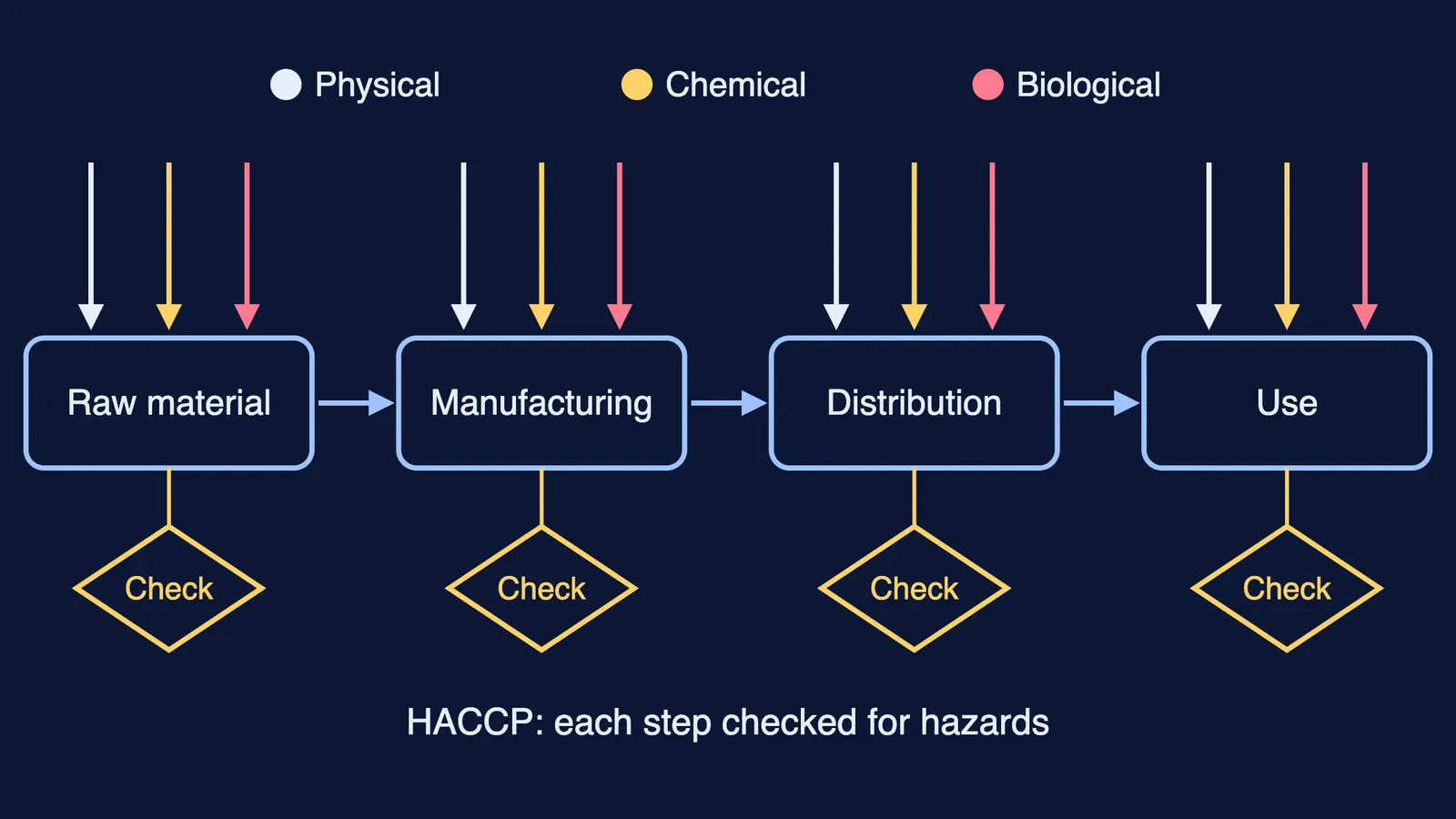
Food deteriorates physically, chemically and biologically, through pests, wrong temperatures, light, oxygen, moisture, microbes, pesticides and the food's own enzymes.
NCERT lists the oldest methods as sun drying, controlled fermentation, salting or pickling, candying, roasting, smoking, baking and spices. Modern methods rest on five basic concepts:
Apply heat.
Remove water.
Store at a lower temperature.
Lower the pH.
Control how much oxygen is available.
Two quick facts from NCERT: protein-rich foods such as meat, fish, poultry, eggs and dairy are called high-risk foods, and bacteria can grow anywhere from 5 to 60 °C, the danger zone.
How are foods classified?
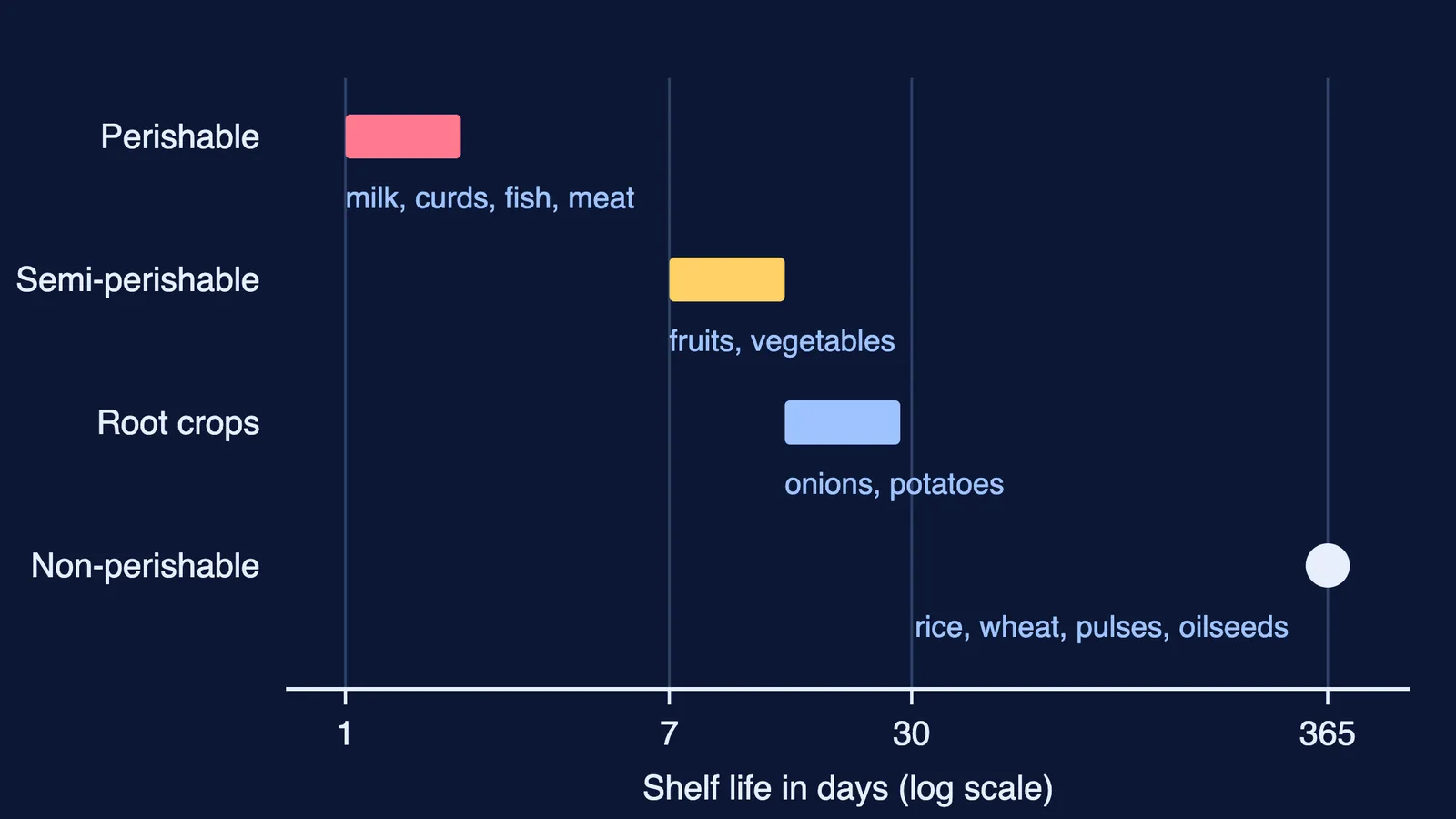
By perishability, as NCERT sets out (see the chart above):
Perishable: spoil within one or two days, such as milk, curds, fish and meat.
Semi-perishable: last one to two weeks, such as fruits and vegetables; onions and potatoes last two to four weeks.
Non-perishable: generally last a year, such as rice, wheat, pulses and oilseeds.
By extent and type of processing, NCERT gives seven classes: minimally processed (cleaned, cut and chilled), preserved (frozen or canned vegetables), manufactured (pickles, jams, papads), formulated (bread, biscuits, kulfi), food derivatives (sugar from cane, oil turned into vanaspati by hydrogenation), functional (probiotics) and medical (low-sodium salt, lactose-free milk).
Worked example: costing a practical product
NCERT's practical asks you to cost your product by ingredients, energy, labour, and storage and packing. These prices are our own illustrative numbers, not NCERT's. Say your group makes 500 g of lemon-rind pickle:
Ingredients ₹62, energy ₹8, labour ₹40, jars and labels ₹30.
Total: 62 + 8 + 40 + 30 = ₹140.
Cost per 100 g: 140 ÷ 500 × 100 = ₹28.
Filled into two 250 g jars: ₹70 per jar.
Labour share: 40 ÷ 140 × 100 = 28.6 per cent.
The label needs the product and maker's names, ingredients from largest to smallest share, net weight, storage instructions and a "Use By" or "Best Before" date.
What careers does food technology lead to?
NCERT lists certificate and diploma courses after Class 12, including at CFTRI in Mysore, and degrees up to research level; NIFTEM at Sonepat offers specialised postgraduate courses. Roles include production, quality assurance, sensory evaluation, product development, research, teaching, consultancy and entrepreneurship. See also our guide to BSc Home Science career options, and the next chapter, Food Quality and Food Safety.
The 2026-27 sample paper tests this chapter in Q10 (1-mark MCQ on processing classes), Q15 (2-mark spoilage case) and Q25 (3 marks: significance, or the industry's knowledge and skills). Our own practice questions in its formats:
(1 mark) Turning vegetable oil into vanaspati is called: (a) fermentation (b) pasteurisation (c) hydrogenation (d) fortification
(1 mark) Assertion: Fish and eggs are treated as high-risk foods. Reason: Bacteria favour foods rich in protein.
(2 marks) A farmer has more ripe tomatoes than the market can take this week. Name two processing concepts that could extend their shelf life.
(3 marks) Place papad, kulfi and lactose-free milk in NCERT's processing classes, with a reason for each.
(4 marks) Explain how Appert and Pasteur each moved food preservation forward.
(5 marks, 2 + 3) I. Distinguish between food processing and food manufacturing. II. Describe three skills a product development technologist needs.
Answers: 1 (c). 2 Both true; the reason explains the assertion. 4 Manufactured, formulated, medical.
Which part of this chapter should you revise first? Fermi's AI tutor works out what you already know and builds a plan for the session.