On this page
Chapter 4 of Kaushal Vikas, the new NCERT Class 9 skill education book (0916, First Edition, April 2026), is titled Additional Vocations. Chapters 8 and 12 carry the same title, so look for the one in Unit I, Work with Life Forms.
What is Additional Vocations in Class 9 Kaushal Vikas?
The book's front matter (About the Book) says each unit offers seven vocations and your school picks one. Chapter 1 (Agricultural Practices) is compulsory. Chapters 2 and 3 work through rooftop gardening and precision farming in detail. Chapter 4 gives shorter guidelines for five more: mushroom cultivation, aquaponics, pisciculture, backyard poultry and non-timber forest produce (NTFP). Schools may also choose a vocation outside the book.
Its time allocation note gives each unit about 36 hours (44 periods), with about 32 periods for vocation-specific work.
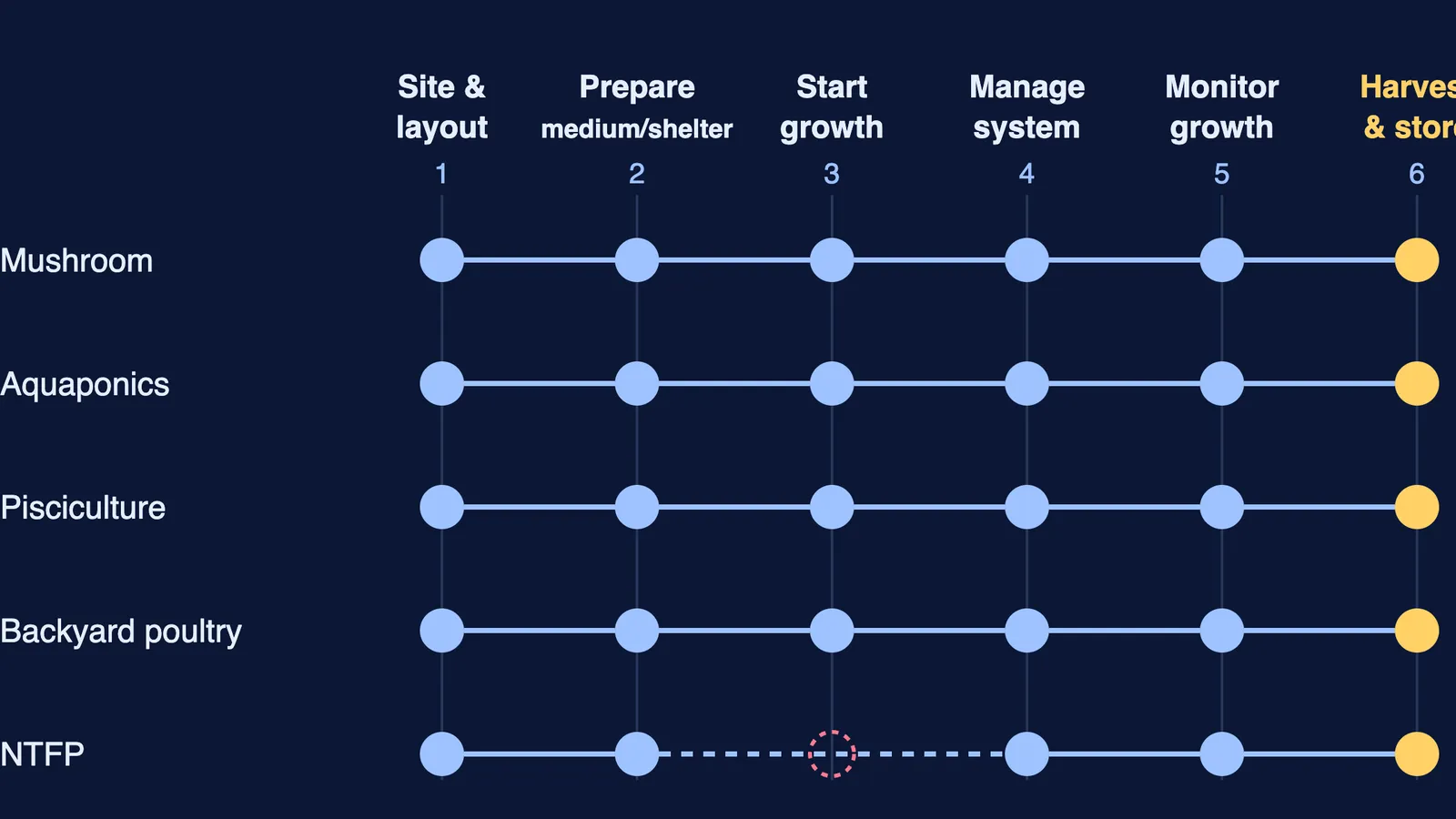
Each vocation gets keywords, a tools and materials list, quality and safety parameters, and key steps, lined up in the diagram above. Four vocations run six steps; NTFP has five, with no separate step for starting growth.
How is Kaushal Vikas assessed in 2026-27?
Your school assesses it. CBSE's Kaushal Vikas assessment guidelines for 2026-27 set five modes: paper-pencil test 40%, demonstration and viva 20%, site visit report 10%, portfolio 20% and teacher observations 10%.
The 40-mark test has Section A objective questions (8 marks), Section B short answers (12), Section C scenario or case questions (16) and Section D one reflective question (4). Within that test, the Plan and Prepare area, which includes the bill of materials, carries 14 marks. These figures cover the subject, not this chapter; there is no chapter-wise mark.
The 2026-27 curriculum lists Work with Life Forms themes including a site visit, process chart, safety protocols for tools, cost records and waste disposal.
What are the key conditions for each vocation?
From the NCERT chapter, in our words:
Mushroom cultivation: mushrooms come from spores, and the mycelium spreads through the substrate like roots. Spawn is substrate already carrying mycelium. You sterilise the substrate, inoculate it with spawn, then incubate. Targets: 25–30°C, 80–90 per cent humidity, substrate damp but not soggy, storage at 4–8°C. A squeeze test guides watering.
Aquaponics: fish farming joined to soil-free plant growing. Bacteria in the biofilter turn fish waste into plant nutrients (the nitrogen cycle). Start that cycle before the full fish load, and keep the water slightly acidic to neutral.
Pisciculture: lime and manure improve the pond. Cow dung slurry before stocking grows plankton as starter food. Feed twice a day without overfeeding, since excess feed leads to ammonia. Net a sample every 2 weeks and adjust feed to average weight.
Backyard poultry: a coop, a brooder (a warm house for very young chicks), rice husk or sawdust bedding, and water tested for E. coli. Remove wet bedding and collect eggs gently.
NTFP: honey, gums, resins, seeds, leaves, bamboo and more, gathered without felling trees. Lac is a resin left on trees such as ber and kusum by a tiny insect. Harvest partially, never uproot, and keep drying areas away from flames.
A spelling note: the book prints "coup" once for coop, "Tempeture" for temperature and "carboard" for cardboard. Use the correct spellings in answers.
How do you prepare a bill of materials?
The curriculum asks you to keep cost records. Here is a worked example with made-up prices; your teacher will give local ones.
A mushroom batch of 10 poly bags needs:
Straw, 10 kg at ₹8 per kg = ₹80
Spawn, 1 kg at ₹120 per kg = ₹120
Poly bags, 10 at ₹4 each = ₹40
Mild disinfectant, 1 bottle = ₹60
Total = 80 + 120 + 40 + 60 = ₹300, or ₹300 ÷ 10 = ₹30 per bag.
For pisciculture monitoring, suppose five sampled fish weigh 118, 126, 131, 109 and 136 g. Average = 620 ÷ 5 = 124 g. Compare it with the next sample.
Practice questions for Additional Vocations (Unit I)
Our own questions; mark labels are our suggestion.
In mushroom cultivation, what is spawn? (1 mark)
Put these aquaponics steps in order: transplant seedlings, fill grow beds with media, start the nitrogen cycle. (1 mark)
Why is cow dung slurry added to a pond before fish are introduced? (2 marks)
A coop smells strongly of ammonia and the bedding is damp. Give two likely causes and two fixes from the chapter. (4 marks)
Make a bill of materials for 6 poly bags using the prices in our example (1 kg straw and 0.1 kg spawn per bag, one bottle of disinfectant). (3 marks)
Which of the five vocations suits your school best? Justify with one local condition and one safety point. (4 marks)
Related reading: how hydroponics grows plants without soil, why fish die in hot ponds, and useful fungi, including mushrooms.
Not sure which vocation to revise first? Fermi's AI tutor works out what you already know and builds a plan for the session.