

On this page
You can grow a lettuce in a juice bottle with no soil, its roots hanging in water with a little fertiliser dissolved in it. That is hydroponics.
How does hydroponics work?
Roots take up water and the mineral ions dissolved in it. The soil mostly stores those ions and holds the plant up. Hydroponics gives the roots the solution directly.
Julius Sachs made this work in 1860, and Wilhelm Knop did so at about the same time, according to the University of California guide by Hoagland and Arnon (Circular 347, revised 1950). Sachs wrote that his experiments showed land plants can absorb their nutrients "out of watery solutions, without the aid of soil".
Without soil, you do its other jobs:
Nutrients: every essential mineral element, dissolved and in balance.
Oxygen: roots respire, so "an adequate supply of air to the roots must be provided", Hoagland and Arnon write.
Darkness: they describe roots in solution "with light excluded". A dark container also discourages algae.
Support: a lid or net pot holds the stem while the roots hang below.
Oxygen is the need that is easiest to forget. It is the same reason too much water kills potted plants: waterlogged roots run out of air.
What mineral nutrients do plants need?
An element counts as essential only if it passes three tests set by Arnon and Stout in 1939. Soil scientist Phillip Barak of the University of Wisconsin summarises them: the plant cannot complete its life cycle without the element, no other element can replace it, and it plays a direct part in the plant's metabolism.
Plants need 14 essential mineral elements, and they take carbon, hydrogen and oxygen in as gas or water, according to Barak's list of essential elements. He sorts the 14 "somewhat arbitrarily" into macronutrients and micronutrients:
Macronutrients (needed in larger amounts): nitrogen, phosphorus, potassium, calcium, magnesium, sulfur.
Micronutrients (needed in traces): iron, manganese, zinc, copper, boron, molybdenum, chlorine, nickel.
The list has grown over time. The 1950 Hoagland and Arnon circular named 11 indispensable elements and said new evidence suggested adding molybdenum. Nickel came later, after Brown, Welch and Cary (1987) showed that barley grown without it fails to produce viable grain. Our post on mineral deficiency symptoms in plants shows what a missing element does to a leaf.
What did Sachs show in 1860?
Sachs's water culture gave biology a method. Once a plant grows well in a solution of known salts, you can leave out one element and watch what goes wrong. Hoagland and Arnon describe this test, with "each essential element omitted from experimental solutions" and the leaf symptoms compared. Our post on the hydroponics experiment that finds essential plant elements walks through it.
How can you set up hydroponics at school?
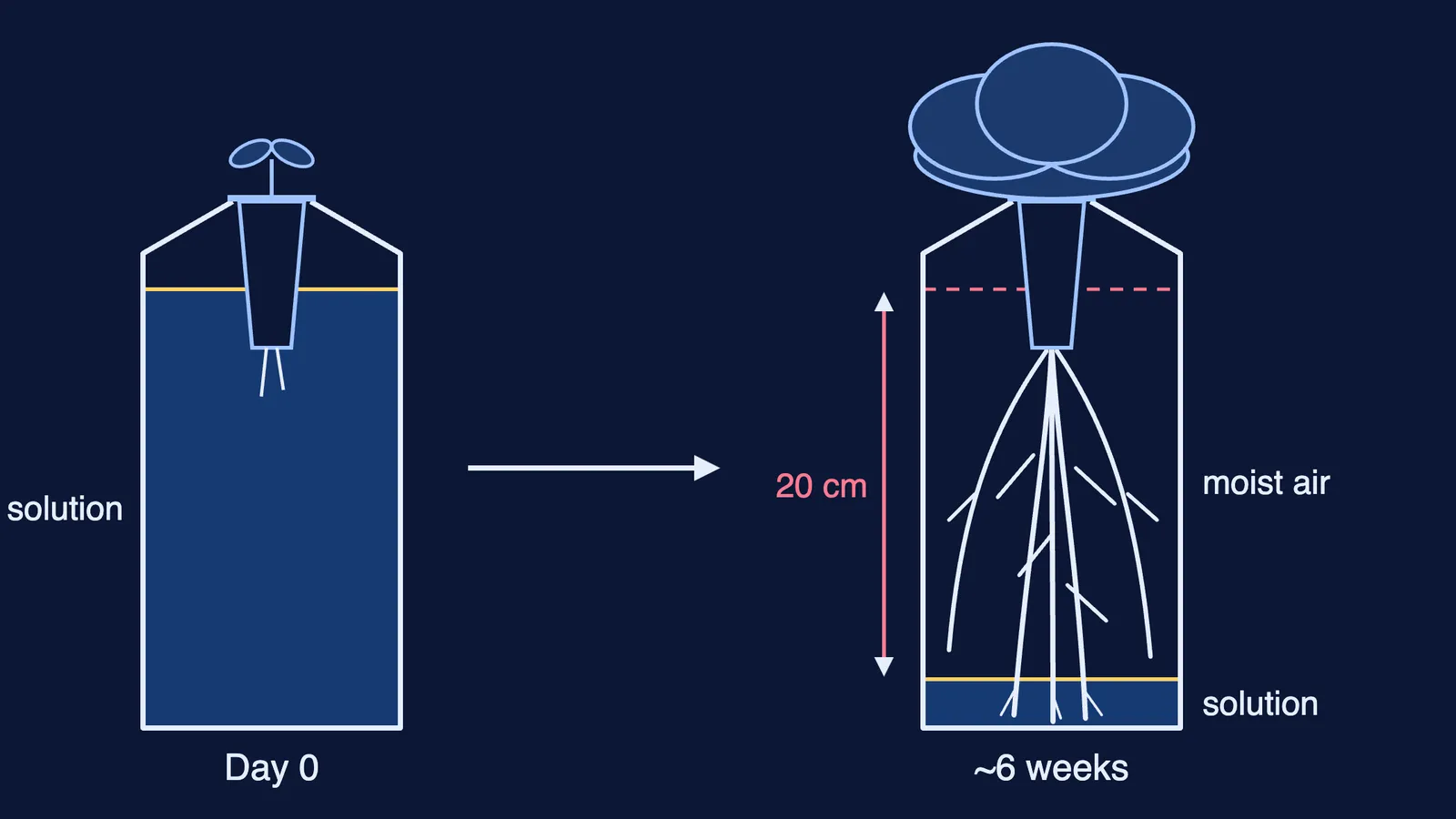
Horticulturist B. A. Kratky of the University of Hawaii (2004) describes a bottle version with no pump and no electricity. Lettuce usually matures about 6 weeks from seeding with nothing added, and he writes that the bottles "can be prepared in one class period".
Darken or cover a 4-litre plastic bottle to discourage algae.
Dissolve 5 g of hydroponic fertiliser in water and fill the bottle. Choose one that lists micronutrients.
Sow lettuce in a 7.5 cm net pot of growing medium and set it in the neck with its bottom 3 cm in the solution.
Mark the starting level on the outside.
Never top up. Kratky warns that the level "may not be raised or else the roots will 'drown'".
As the level falls, the upper roots sit in moist air while the lower roots keep drinking. Wear gloves when handling fertiliser.
How much water does a hydroponic lettuce use?
Set up three bottles: darkened with fertiliser, darkened with plain tap water, and clear with fertiliser. Each week, record leaf number, leaf colour and the drop in level. Bottle two tests nutrients and bottle three tests light.
In Kratky's bottles the level typically fell 15 to 25 cm, and a 200 g lettuce used about 3 to 4 litres. For a bottle 13 cm by 13 cm inside:
Cross-section = 13 × 13 = 169 cm²
Drop by harvest = 20 cm
Water used = 169 × 20 = 3,380 cm³, about 3.4 litres
If your own bottle gives an answer far from 3 to 4 litres, check its shape: a tapered bottle needs its cross-section measured at each height.
If getting volume from a cross-section trips you up, the Fermi Concept Library has a lesson on every concept in biology, chemistry and mathematics.
Is hydroponics better than soil?
Not automatically. Hoagland and Arnon wrote that "there is no magic in nutriculture methods" and that nutriculture "is rarely superior to soil culture". They also advised against accepting claims of unusual nutritional value unless research institutes of high standing back them up.
If mineral nutrition is on your syllabus and you are not sure where to begin, Fermi's AI tutor can work out what you already know and build a plan for the session.


