

On this page
Why do plant roots need air in the first place?
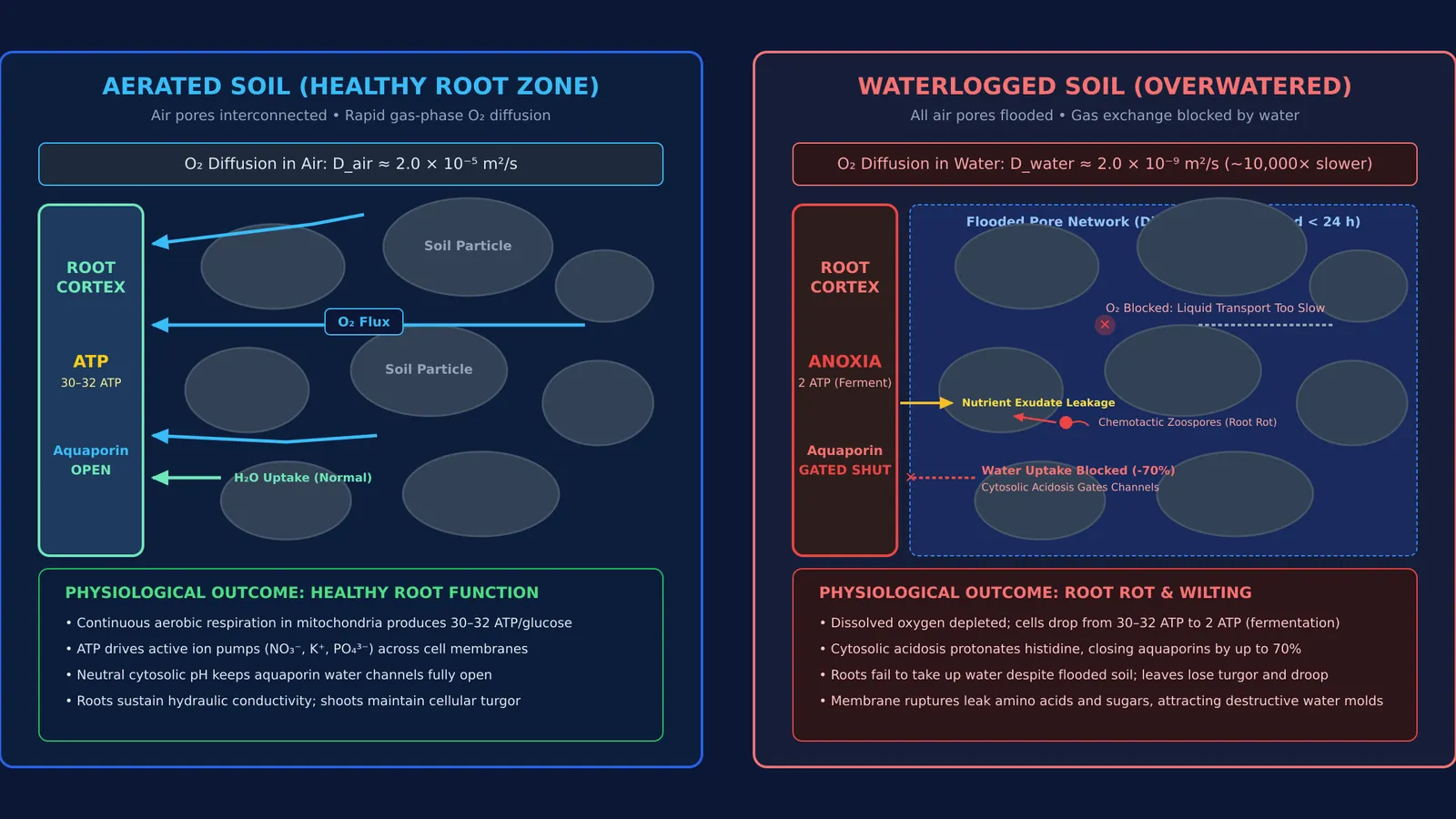
Roots operate underground without sunlight and cannot photosynthesise. In his review of root oxygen deficiency in the *Annual Review of Plant Physiology and Plant Molecular Biology*, Malcolm C. Drew explained that root tissues rely on aerobic respiration to generate adenosine triphosphate (ATP). In root mitochondria, respiration uses oxygen as the terminal electron acceptor to produce roughly 30 to 32 ATP molecules per glucose molecule, as detailed in our guide on where each step of respiration occurs in a cell.
Root cells consume this ATP to power active transport pumps that absorb nitrate, potassium, and phosphate against steep concentration gradients. Drew showed that without continuous oxygen, root cells suffer an immediate energy crisis: active nutrient transport halts, membrane potentials collapse, and root cells begin to die within hours.
How does excess water displace oxygen in potted soil?
Healthy potting soil is roughly 50% solid particles and 50% pore space, according to soil physical transport data reviewed in *Advances in Botanical Research60089-0)*. In well-aerated soil, half of these pores hold capillary water (about 25% of soil volume) and the other half hold air (25%). When you overwater, liquid fills every pore, driving out the soil air.
Once pores fill with water, gas exchange stops. William Armstrong showed in his root aeration study60089-0) that oxygen diffuses approximately 10,000 times slower through water than through air. Oxygen moves through air pores at about 2.0 × 10⁻⁵ m²/s, but slows to 2.0 × 10⁻⁹ m²/s in water. Living roots and microbes rapidly consume the remaining dissolved oxygen in under 24 hours. While wetland species rely on pneumatophores in mangrove roots to breathe, ordinary potted plants lack air channels and quickly suffocate.
Why do overwatered plants wilt if they have so much water?
The most deceptive symptom of overwatering is wilting. When stems sag, growers often add more water, worsening the damage. In reality, the plant suffers from physiological drought: its roots can no longer take up water.
In *Nature*, Colette Tournaire-Roux and colleagues revealed why this happens. Starved of oxygen, root cells switch to anaerobic fermentation, yielding only 2 ATP per glucose molecule. This pathway produces organic acids that trigger cytosolic acidosis—a sharp drop in cellular pH.
Tournaire-Roux showed that this internal acidification protonates a conserved histidine residue on plasma membrane aquaporins, the protein channels that admit water. This protonation snaps the channels shut, cutting root hydraulic conductivity by up to 70% within hours. The plant cannot draw water into its vascular system, and deprived of water, leaves lose turgor and droop.
What actually causes root rot after flooding?
Oxygen starvation injures roots, but opportunistic pathogens deliver the fatal blow. In *Phytopathology*, researchers T. L. Kuan and D. C. Erwin demonstrated that water saturation for 24 hours ruptures root cell membranes. As cells break down, they leak amino acids, sugars, and electrolytes into the surrounding water film.
This leakage attracts soil-borne oomycetes such as *Phytophthora* and *Pythium*, commonly known as water molds. These pathogens release flagellated zoospores that swim through waterlogged pores toward leaking nutrients via chemotaxis. The zoospores encyst on the cracked root epidermis, penetrate the tissue, and digest the cortex. Healthy white roots decay into brown, mushy, foul-smelling cords.
Students often wonder how a money plant grows in water if flooding rots roots. In a clean glass jar, oxygen dissolves continuously across the open water surface, and the absence of soil organic debris prevents pathogen blooms.
How can you tell if a potted plant is overwatered?
Because underwatering and overwatering both cause drooping, check the soil and roots to find the cause:
The depth check: Push a wooden skewer deep into the root ball. If it emerges damp with dark soil clinging to it, moisture is plentiful; if clean and dry, water is needed.
The heft test: Lift the container. Because water is dense, a saturated pot feels heavy and waterlogged, whereas a parched pot feels noticeably light.
Leaf feel: Underwatered leaves feel dry and papery. Overwatered leaves feel limp and soft, yellowing with dark, water-soaked blotches.
Root inspection: Slide the plant out. Healthy roots are firm and white; rotted roots are brown, slimy, and sour-smelling.
To save an overwatered plant, trim away rotted root sections with shears cleaned in rubbing alcohol. Repot into fresh mix amended with perlite or coarse pumice for aeration, and ensure the pot has open drainage holes.
For concepts that are easier to see than to read, the Fermi Simulation Lab provides interactive simulations of diffusion and membrane transport to explore how channels respond under stress. To trace related topics across cell biology, the Concept Library covers key physiological mechanisms, each with its own structured lesson and place in the conceptual map.


