On this page
Acids, Bases and Salts is Chapter 2 of the NCERT Class 10 Science textbook (reprint 2026-27). The CBSE Class X Science syllabus for 2026-27 covers H+ and OH- ions, indicators, reactions, neutralisation, pH, and how sodium hydroxide, bleaching powder, baking soda, washing soda and Plaster of Paris are made and used. The logarithm definition of pH is "not required". For the whole chapter, read our Acids, bases and salts Class 10 chapter guide.
What are acids, bases and alkalis?
Acid: a substance that gives hydrogen ions, H+(aq), in water. Example: hydrochloric acid (HCl), acetic acid (CH3COOH).
Base: a substance that gives hydroxide ions, OH-(aq), in water. Example: sodium hydroxide (NaOH).
Alkali: a base that dissolves in water. Example: NaOH. Don't confuse with: base; every alkali is a base, but not every base dissolves.
Hydronium ion (H3O+): a hydrogen ion joined to a water molecule. HCl can only give H+ ions when water is present, so dry HCl gas does not change the colour of dry litmus.
Strong and weak acids: at equal concentration, a strong acid gives more H+ ions. Example: HCl (strong), acetic acid (weak). Don't confuse with: concentrated vs dilute, which is about how much acid is in the water.
Dilution: adding water to an acid or base, so each unit of volume holds fewer H3O+ or OH- ions. Add acid to water slowly, never water to acid: mixing gives out a lot of heat and can splash.
How do indicators tell acids from bases?
Acid-base indicator: a substance, often a dye, that changes colour to tell you whether a solution is acidic or basic.
Litmus: a purple natural dye from lichen. Acids turn blue litmus red; bases turn red litmus blue.
Synthetic indicators: man-made ones such as methyl orange and phenolphthalein, which is pink in NaOH solution and loses its colour when acid neutralises it.
Olfactory indicator: a substance whose smell changes in acid or base. Example: onion, vanilla, clove oil.
Universal indicator: a blend of several indicators. Its colour changes step by step along the pH scale.
How do acids and bases react?
Acid with a metal: gives a salt and hydrogen gas. Example: zinc with dilute sulphuric acid.
Base with a metal: zinc with NaOH gives sodium zincate (Na2ZnO2) and hydrogen; not all metals do this.
Acid with a metal carbonate or hydrogencarbonate: gives a salt, carbon dioxide and water. The CO2 turns lime water milky; excess CO2 makes it clear again.
Neutralisation: an acid and a base cancel each other to give a salt and water; H+ and OH- join as water. Example: NaOH + HCl gives NaCl + H2O.
Basic oxide: a metal oxide that reacts with an acid to give a salt and water. Example: copper oxide with dilute HCl.
Acidic oxide: a non-metal oxide that reacts with a base to give a salt and water. Example: carbon dioxide with lime water.
What does the pH scale measure?
Numbers here come from section 2.3 of the NCERT chapter.
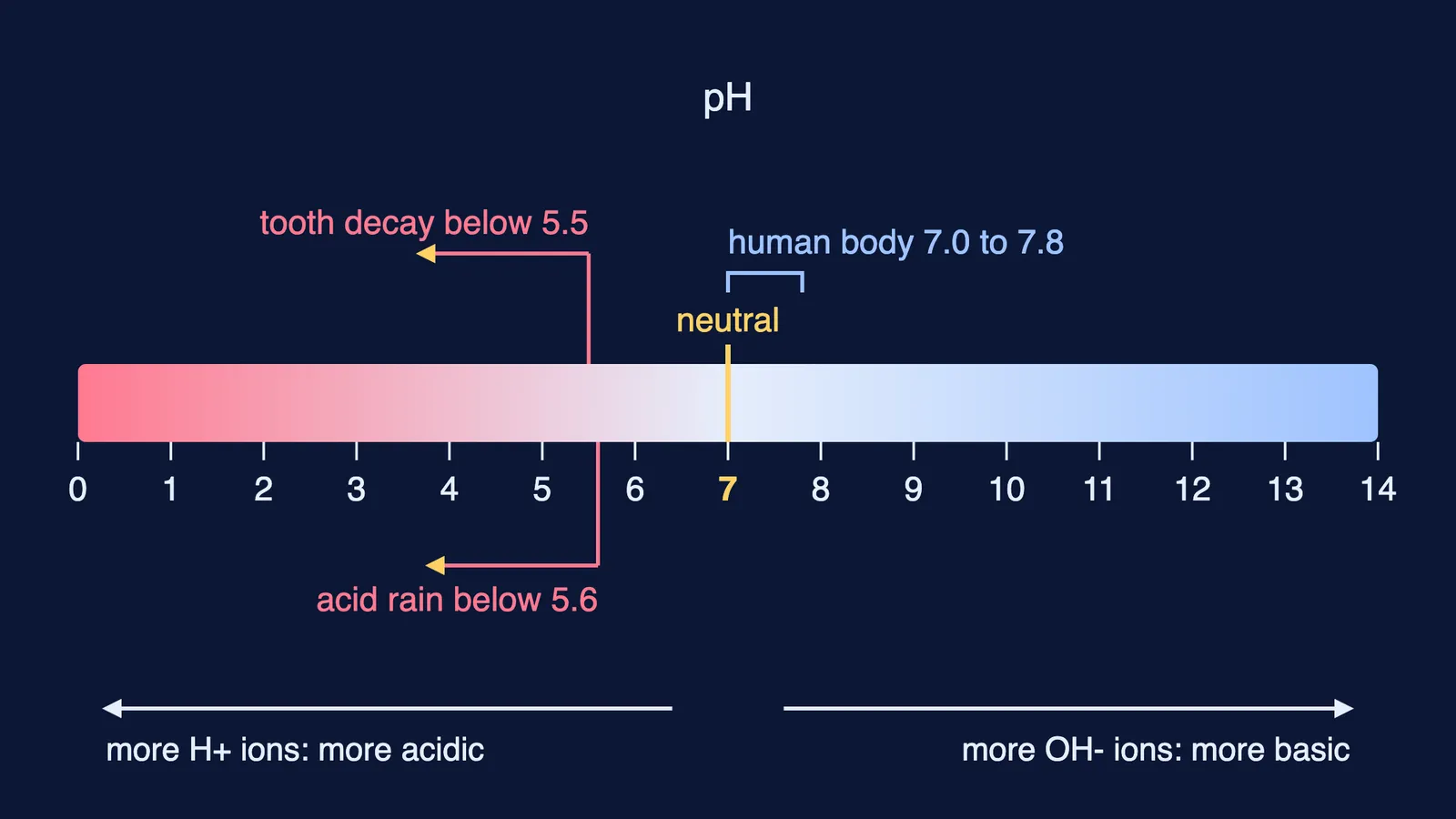
pH scale: a scale, usually 0 to 14, showing how acidic or basic a solution is ("p" is from German "potenz", power). Neutral is 7, below 7 is acidic, above 7 is basic. More hydrogen ions mean a lower pH.
Body pH: our body works at pH 7.0 to 7.8.
Acid rain: rain water with a pH below 5.6. When it flows into rivers, it lowers their pH and makes life hard for fish and other water animals.
Tooth decay: starts when the pH in the mouth falls below 5.5, when bacteria make acid from sugar and the acid corrodes enamel.
Antacid: a mild base that neutralises excess stomach acid. Example: milk of magnesia (magnesium hydroxide).
Natural acids: tamarind (tartaric), curd (lactic), vinegar (acetic), tomato (oxalic), ant and nettle stings (methanoic).
What should you know about salts?
Formulas follow section 2.4 of the NCERT chapter.
Family of salts: salts that share the same positive part (such as sodium) or the same negative part (such as chloride). Example: NaCl and Na2SO4 are sodium salts; NaCl and KCl are chloride salts.
pH of salts: a strong acid with a strong base gives a neutral salt (pH 7), such as NaCl; a strong acid with a weak base gives an acidic salt; a strong base with a weak acid gives a basic salt, such as sodium carbonate. More in our post on acidic, basic and neutral salts.
Chlor-alkali process: passing electricity through brine (salt solution in water) to make chlorine at the anode, hydrogen at the cathode and sodium hydroxide near the cathode.
Bleaching powder (Ca(ClO)2): made by passing chlorine over dry slaked lime. Used to bleach cloth and paper pulp and to make drinking water free from germs.
Baking soda (NaHCO3): a mild, non-corrosive basic salt; heating gives sodium carbonate, water and CO2. Used in antacids and soda-acid fire extinguishers.
Baking powder: baking soda mixed with tartaric acid; with heat or water it releases CO2 that makes cakes spongy. Don't confuse with: baking soda alone.
Washing soda (Na2CO3.10H2O): made by recrystallising sodium carbonate. Used in glass, soap and paper making and to remove permanent hardness of water.
Water of crystallisation: water that is locked inside a salt's crystals, always the same number of molecules for each formula unit. Example: blue copper sulphate (CuSO4.5H2O) turns white when heated and blue again with water.
Gypsum (CaSO4.2H2O): calcium sulphate with two water molecules of crystallisation.
Plaster of Paris (CaSO4.1/2H2O): made by heating gypsum at 373 K; with water it sets back into hard gypsum, so keep it dry. Used for plasters on fractured bones, toys and decorations.
How to learn these terms
Learn mix-ups as pairs: base vs alkali, strong vs concentrated, baking soda vs baking powder.
Put each salt's formula, how it is made and one use on a card.
Draw the pH scale and mark the numbers above.
Write each reaction family's products from memory; start with our post on the acid and metal carbonate reaction.
If a term still feels abstract, the Fermi Concept Library covers every concept in chemistry, each with its own lesson and its place in the map.