

On this page
In 2024, 22,38,827 students appeared for the CBSE Class 10 board exams, tackling topics from optics to carbon chemistry. One concept that consistently tests a student's grasp of reactions is predicting whether a salt will dissolve to form an acidic, basic, or neutral solution.
When an acid neutralises a base, the result is salt and water. However, "neutralise" does not always mean the final solution has a pH of exactly 7. The final pH depends entirely on the chemical strength of the parent acid and parent base that formed the salt, a fundamental principle outlined in the NCERT Class 10 Science syllabus.
Which salts are acidic, basic or neutral in Class 10?
Salts take their chemical nature from the stronger parent in the neutralisation reaction. The rule is straightforward: the strong parent wins.
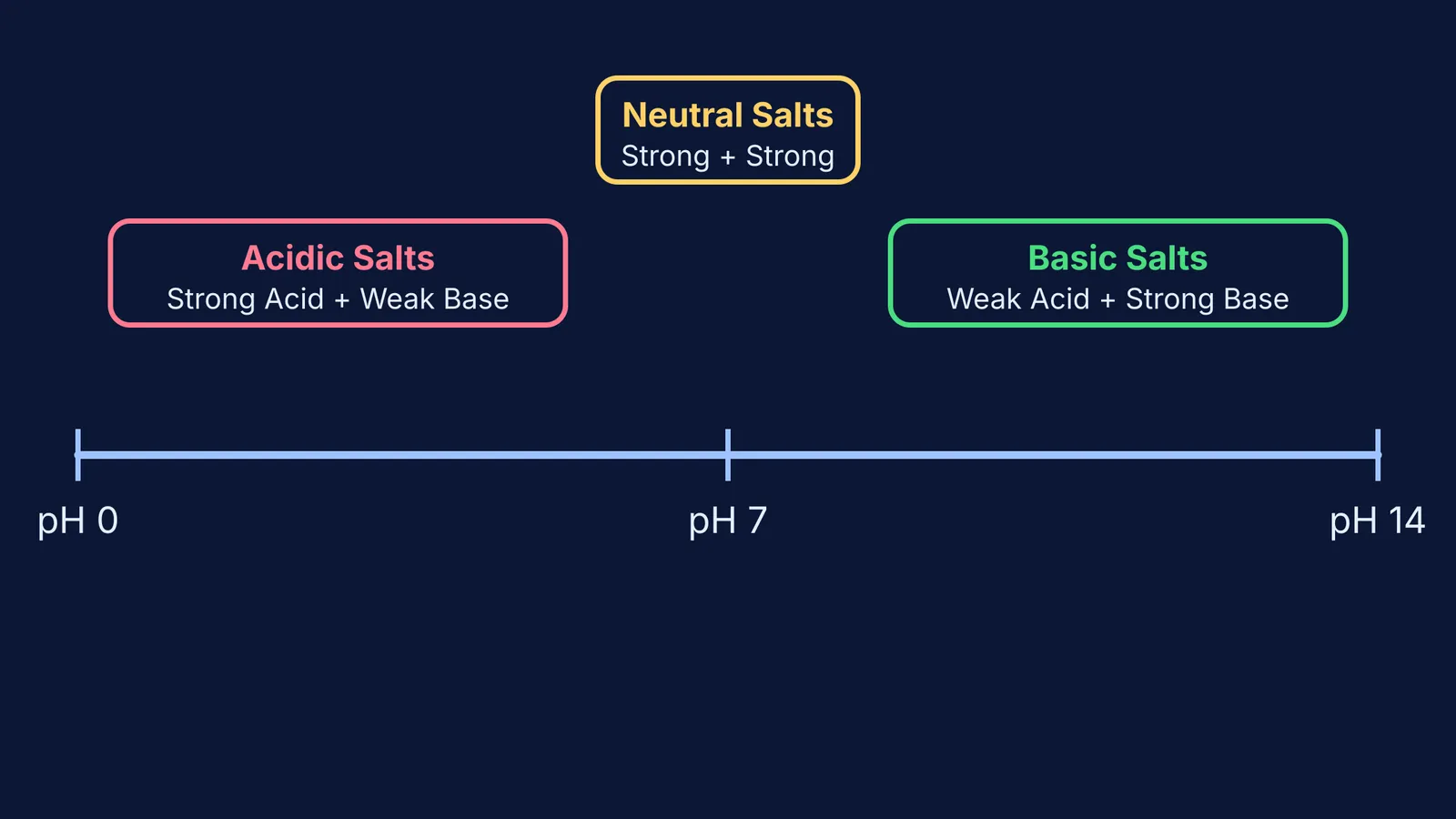
Neutral salts: Formed by the reaction of a strong acid and a strong base. Because both parents fully dissociate in water, they balance each other perfectly.
Acidic salts: Formed by the reaction of a strong acid and a weak base. The strong acid leaves behind an excess of hydrogen ions (H⁺) in the solution.
Basic salts: Formed by the reaction of a weak acid and a strong base. The strong base releases more hydroxide ions (OH⁻) into the water, overpowering the weak acid.
If you are struggling to remember which reaction produces which ions, the Fermi Concept Library has a full breakdown of acids, bases and salts to help you master the fundamentals.
What is the pH value of different salts?
The pH scale measures how acidic or basic a water-based solution is, running from 0 to 14.
The pH of a neutral salt solution, such as sodium chloride (NaCl) or potassium sulphate (K₂SO₄), is exactly 7. These are the salts you get when a strong acid like hydrochloric acid (HCl) meets a strong base like sodium hydroxide (NaOH).
An acidic salt solution has a pH less than 7. Ammonium chloride (NH₄Cl) is a classic example. It forms when strong hydrochloric acid reacts with weak ammonium hydroxide (NH₄OH).
A basic salt solution has a pH greater than 7. Sodium carbonate (Na₂CO₃) and sodium hydrogen carbonate (NaHCO₃) fall into this group because they originate from a strong base (sodium hydroxide) and a weak acid (carbonic acid).
How do you find the parent acid and base?
When you encounter a salt in an exam, use the "Split Method" to trace it back to its parents.
Let us take sodium acetate (CH₃COONa) as a worked example.
Identify the positive ion (cation): The sodium ion (Na⁺) comes from the base sodium hydroxide (NaOH).
Identify the negative ion (anion): The acetate ion (CH₃COO⁻) comes from the acid acetic acid (CH₃COOH).
Evaluate their strengths: Sodium hydroxide is a strong base, while acetic acid is a weak acid.
Conclude: A strong base and a weak acid create a basic salt. Therefore, sodium acetate has a pH greater than 7.
This method works for almost every salt in your syllabus. Once you understand the parentage, predicting the pH becomes a logical step rather than a memory test. If you want to practise tracing these reactions, Fermi's AI tutor can work out what you already know and build a plan for the session, so you sit down to a clear next step instead of a blank page.
Which acids and bases are strong or weak?
To use the Split Method, you must know which common laboratory chemicals are strong and which are weak. Memorise these short lists to save time in the exam hall.
Strong Acids:
Hydrochloric acid (HCl)
Sulphuric acid (H₂SO₄)
Nitric acid (HNO₃)
Weak Acids:
Carbonic acid (H₂CO₃)
Acetic acid / Ethanoic acid (CH₃COOH)
Strong Bases:
Sodium hydroxide (NaOH)
Potassium hydroxide (KOH)
Weak Bases:
Ammonium hydroxide (NH₄OH)
Calcium hydroxide (Ca(OH)₂)
Magnesium hydroxide (Mg(OH)₂)
Mastering these parent compounds will also give you a head start when studying Naming carbon compounds in Class 10: prefixes, suffixes, examples and learning about everyday chemical reactions like Corrosion and rancidity: everyday oxidation in Class 10 science. The same ionic principles govern much of what you will learn next.


