On this page
Add a few drops of a salt solution to methyl orange, then add a whole flask of it. You would expect the second to change the colour more. In 1910 Henry Thomas Tizard, working at the Davy-Faraday Laboratory of the Royal Institution, found that with aniline acetate it did not: "The addition of a few drops of the aniline acetate solution to a neutral solution of methyl-orange causes the same rise in colour as the addition of a large quantity." His paper is "The Hydrolysis of Aniline Salts Measured Colorimetrically", J. Chem. Soc. Trans. 97, 2490–2495. We read it in the scanned 1910 volume and checked the numbers below against the page images. The paper prints only his name and laboratory; we have not checked other details of his life.
How did Tizard measure [H⁺] with methyl orange?
He matched the colour of each solution in a tintometer, giving a number C, the "molecular colour". In the paper just before this one he had worked out two equations, which he quotes here:
C = 18.8y + (1 − y)
4.25 × 10⁻⁴ y = (1 − y) × [H⁺]
Here y is the fraction of methyl orange present as the undissociated indicator acid. The second equation is just Ka = [H⁺][In⁻]/[HIn] for the indicator, with Ka = 4.25 × 10⁻⁴, so the indicator's pKa is about 3.37. We have not read that earlier paper; we use the equations only as Tizard quotes them.
Example from his table: an aniline hydrochloride solution at V = 200 (N/200) gave C = 8.63. Then y = (8.63 − 1) ÷ 17.8 = 0.429, and [H⁺] = 4.25 × 10⁻⁴ × 0.429 ÷ 0.571 = 3.19 × 10⁻⁴ mol/L, the values he printed. For how the colour change itself works, see how acid-base indicators work.
What did he find for aniline hydrochloride?
The anilinium ion is a weak acid:
C₆H₅NH₃⁺ + H₂O ⇌ C₆H₅NH₂ + H₃O⁺
(Check: C 6 and 6, N 1 and 1, H 10 and 10, O 1 and 1, charge +1 and +1.)
So in pure solution, free aniline equals free H⁺. But the indicator soaks up some H⁺ to become HIn, so Tizard added that back. With the indicator at dilution V₂ = 20,000:
free aniline = 3.19 × 10⁻⁴ + 0.429 ÷ 20,000 = 3.40 × 10⁻⁴ mol/L
fraction hydrolysed x = 3.40 × 10⁻⁴ × 200 = 0.068, or 6.80%
Kh = Kw/Kb = x ÷ (1 − x) × [H⁺] = 0.068 ÷ 0.932 × 3.19 × 10⁻⁴ = 2.33 × 10⁻⁵ (he printed 0.230 × 10⁻⁴)
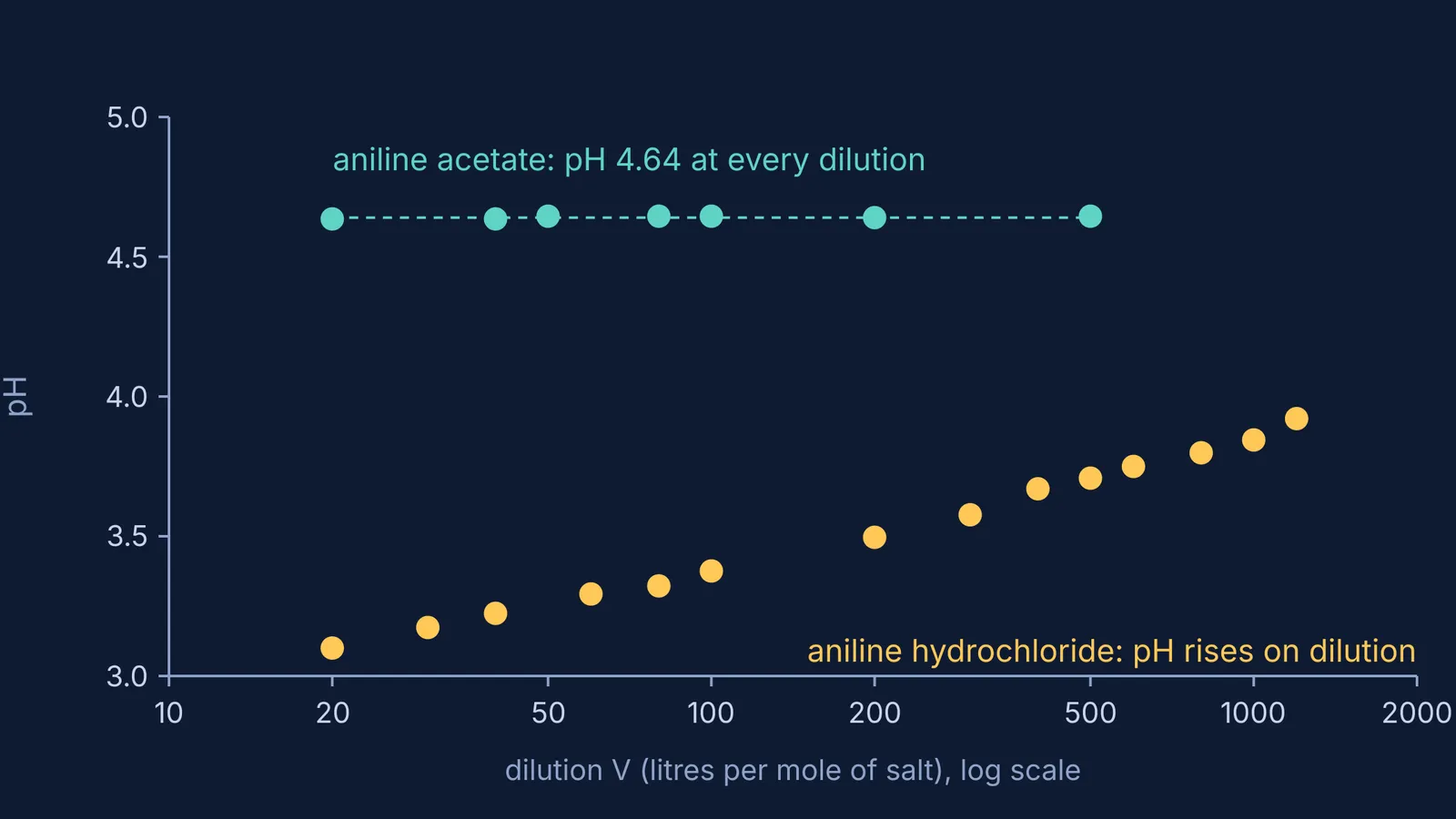
"The difference between the two concentrations is thus 7 per cent. It was not taken into account by Veley in researches of a similar nature". The mean over his eight most dilute solutions (N/200 to N/1200) was Kw/Kb = 0.242 × 10⁻⁴. Bredig had found 0.24 × 10⁻⁴ by conductivity. At N/20 to N/100 his constant came out much smaller, 0.133 to 0.204 × 10⁻⁴, which he blamed on a compound forming with methyl orange.
Why does aniline acetate give the same colour at every dilution?
Aniline acetate "has apparently not been prepared in the solid state". A kept equimolar mixture of aniline and acetic acid forms acetanilide, so Tizard mixed N/5 aniline and N/5 acetic acid. His colours from N/20 to N/500 were 1.92, 1.92, 1.90, 1.90, 1.90, 1.91 and 1.90, mean 1.91, giving [H⁺] = 0.229 × 10⁻⁴.
The algebra is the same one you meet for ammonium acetate, derived step by step in the pH of a salt of a weak acid and weak base. In short, the concentration c cancels, so [H⁺] = √(Kw·Ka/Kb). Tizard's extra point was that it cancels even if the salt is not fully dissociated. He wrote that "it has not, however, yet been pointed out, so far as I know, that the concentration of the hydrogen (and hydroxyl) ions in a solution of a weak salt must always be constant, whatever be the dilution". Note his "so far as I know": the hydrolysis equation itself was, in his words, "well-known".
Worked example: pH and degree of hydrolysis without the shortcut
Use Tizard's own constants: Kw = 1.1 × 10⁻¹⁴ at 25 °C (his value) and Ka(acetic acid) = 1.8 × 10⁻⁵.
pH. [H⁺] = 0.229 × 10⁻⁴, so pH = −log(2.29 × 10⁻⁵) = 4.64.
Degree of hydrolysis, exactly. From Ka = [H⁺][CH₃COO⁻]/[CH₃COOH], the ratio x ÷ (1 − x) = [H⁺] ÷ Ka = 2.29 × 10⁻⁵ ÷ 1.8 × 10⁻⁵ = 1.272. So x = 1.272 ÷ 2.272 = 56.0%, his figure. Arrhenius and Walker (1889), by another method, had 55.5%.
Kb of aniline. Rearranging [H⁺]² = Kw·Ka/Kb gives Kb = 1.1 × 10⁻¹⁴ × 1.8 × 10⁻⁵ ÷ (2.29 × 10⁻⁵)² = 3.8 × 10⁻¹⁰. From the chloride, Kb = Kw ÷ 0.24 × 10⁻⁴ = 4.6 × 10⁻¹⁰. He took the mean, 4.2 × 10⁻¹⁰.
The formula check. pKw = 13.96, pKa = 4.74, pKb = 9.42. pH = ½(pKw + pKa − pKb) = ½(13.96 + 4.74 − 9.42) = 4.64.
The shortcut fails. Kh = Kw ÷ (Ka·Kb) = 1.1 × 10⁻¹⁴ ÷ (1.8 × 10⁻⁵ × 3.78 × 10⁻¹⁰) = 1.62, and √Kh = 1.27. The shortcut h ≈ √Kh says 127% hydrolysed, which is impossible.
Why? The exact relation is h² ÷ (1 − h)² = Kh, so h ÷ (1 − h) = √Kh. The shortcut drops the (1 − h), which is safe only when h is small, that is when Kh is much less than 1. Here Kh is above 1, so you must use h = √Kh ÷ (1 + √Kh) = 1.27 ÷ 2.27 = 56%. The same mistake with Na₃PO₄ appears in John Shields' 1893 hydrolysis measurements.
How would a JEE question set this up today?
With Kw = 1.0 × 10⁻¹⁴, Ka(acetic acid) = 1.74 × 10⁻⁵ (pKa 4.76) and pKb(aniline) = 9.38, both common textbook values:
pH = 7 + ½(4.76 − 9.38) = 7 − 2.31 = 4.69, close to Tizard's 4.64.
Kb = 4.17 × 10⁻¹⁰, so Kh = 1.0 × 10⁻¹⁴ ÷ (1.74 × 10⁻⁵ × 4.17 × 10⁻¹⁰) = 1.38 and √Kh = 1.17.
Shortcut: 117%, impossible. Exact: h = 1.17 ÷ 2.17 = 54.0%.
In 0.1 M salt, that means 0.054 M each of free aniline and acetic acid, and 0.046 M each of C₆H₅NH₃⁺ and CH₃COO⁻. At 0.001 M the percentages, and the pH, are the same.
The gap from Tizard's 56% comes from the constants. He used Kw = 1.1 × 10⁻¹⁴, and a 10% change in Kw shifts every constant derived from it.
If a step like this goes wrong in practice, the Fermi Problem Library has a step-by-step solver that explains the reasoning. For timed JEE Main and Advanced practice on ionic equilibrium, Fermi Test Prep offers preparation with an AI tutor.
Quick checklist
Methyl orange is itself a weak acid (Ka 4.25 × 10⁻⁴ in Tizard's work), so it takes up some H⁺.
Aniline hydrochloride: Kw/Kb ≈ 0.24 × 10⁻⁴, about 6.8% hydrolysed at N/200.
Aniline acetate: same colour from N/20 to N/500, pH 4.64, 56% hydrolysed.
pH = ½(pKw + pKa − pKb) has no concentration term.
When √Kh is not small, use h = √Kh ÷ (1 + √Kh).