

On this page
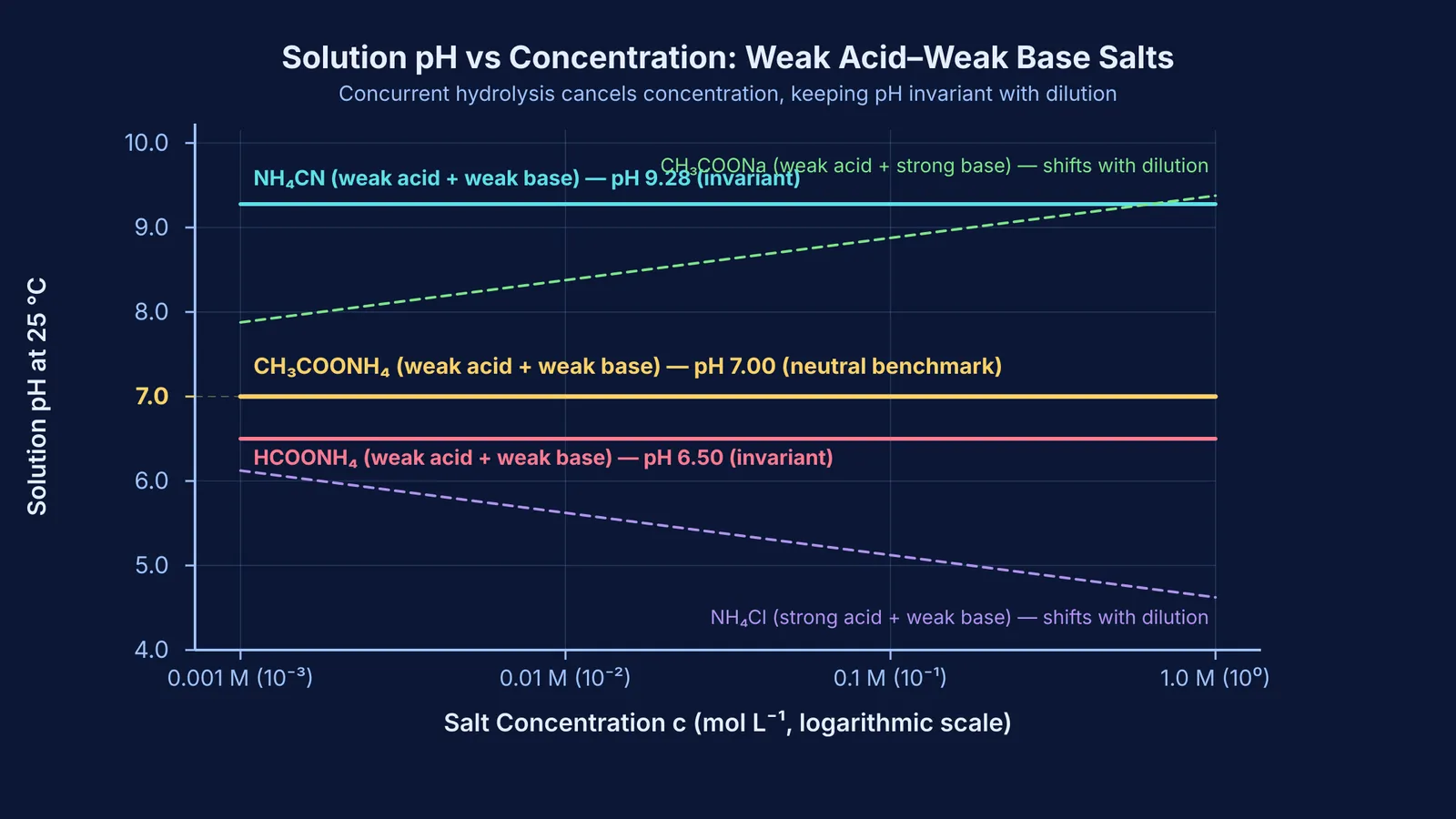
When you dissolve a salt in water, you normally expect dilution to shift the solution's pH. If you dilute a sample of sodium acetate, its basicity decreases because fewer hydroxide ions form per unit volume. Yet when you dilute ammonium acetate, the pH stays anchored at 7.00. Understanding this behaviour is essential for ionic equilibrium problems in CBSE Class 11, JEE Main, and NEET-UG.
What is the formula for the pH of a salt of a weak acid and a weak base?
For a salt derived from a weak monoprotic acid HA and a weak monoprotic base BOH, the hydrogen ion concentration in water depends on the equilibrium dissociation constants of the two components. In a foundational treatment of weak acid-weak base hydrolysis, Mario Emilio Cardinali, Claudio Giomini, and Giancarlo Marrosu (1990) in the *Journal of Chemical Education* show that for standard laboratory concentrations, the solution pH at 25 °C simplifies to:
pH = 7 + ½(pKa − pKb)
Here, pKa is the negative logarithm of the acid dissociation constant Ka of the parent acid, and pKb is the negative logarithm of the base dissociation constant Kb of the parent base. The number 7 represents ½pKw, where pKw equals 14.00 for pure water at 25 °C (298 K). If the temperature changes, the baseline shifts as well, as explained in our guide on neutral pH and how Kw changes with temperature.
You can also express this relation through the conjugate acid of the base, BH⁺. Because pKa(BH⁺) + pKb = pKw, substituting for pKb gives:
pH = ½[pKa(HA) + pKa(BH⁺)]
Expressed this way, the solution pH is simply the arithmetic average of the two pKa values.
Why does the pH not depend on concentration?
The absence of a concentration term in the formula often surprises students. To see why concentration cancels, trace the equilibria established when a salt BA dissolves at initial concentration c mol L⁻¹, as analyzed by Mario Emilio Cardinali, Claudio Giomini, and Giancarlo Marrosu (1990) in the *Journal of Chemical Education*:
The salt dissociates completely into B⁺ and A⁻ ions.
Both ions react with water in coupled hydrolysis steps: B⁺ + A⁻ + H₂O ⇌ BOH + HA.
The overall hydrolysis constant is Kh = [BOH][HA] / ([B⁺][A⁻]) = Kw / (Ka × Kb).
Let h represent the degree of hydrolysis of both ions. At equilibrium, the concentrations become [BOH] = ch, [HA] = ch, [B⁺] = c(1 − h), and [A⁻] = c(1 − h). Substituting these values into the hydrolysis constant yields:
Kh = (ch × ch) / [c(1 − h) × c(1 − h)] = h² / (1 − h)²
The initial concentration c cancels out from both the numerator and the denominator. Taking the square root gives h / (1 − h) = √Kh = √(Kw / [Ka × Kb]).
Next, evaluate the hydrogen ion concentration using the parent acid's equilibrium, Ka = [H⁺][A⁻] / [HA]:
[H⁺] = Ka × [HA] / [A⁻] = Ka × (ch) / [c(1 − h)] = Ka × [h / (1 − h)]
Substituting the expression for h / (1 − h) gives:
[H⁺] = Ka × √(Kw / [Ka × Kb]) = √(Kw × Ka / Kb)
Taking the negative logarithm of both sides yields pH = ½(pKw + pKa − pKb), or 7 + ½(pKa − pKb) at 25 °C. The evaluation by Cardinali and colleagues confirmed that this concentration independence remains almost exact for standard laboratory concentrations above 10⁻⁵ mol L⁻¹, where water's self-ionisation does not alter the coupled ionic balance.
Why is ammonium acetate neutral in water?
Ammonium acetate (CH₃COONH₄) serves as the classic neutral benchmark for weak acid-weak base hydrolysis. As investigated by S. James O'Brien and Christopher L. Kenny (1939) in the *Journal of Chemical Education*, it forms from the neutralisation of acetic acid (CH₃COOH) and aqueous ammonia (NH₃). At 25 °C, acetic acid has an acid dissociation constant Ka of 1.75 × 10⁻⁵ (pKa = 4.76), while aqueous ammonia has a base dissociation constant Kb of 1.77 × 10⁻⁵ (pKb = 4.75).
Substituting these constants into the formula gives:
pH = 7 + ½(4.76 − 4.75) = 7 + ½(0.01) = 7.005 ≈ 7.00
Because the conjugate acid NH₄⁺ and the conjugate base CH₃COO⁻ possess virtually equal strengths, their hydrolysis releases equal amounts of hydronium and hydroxide ions. This mutual neutralisation produces a neutral solution at pH 7.00 across typical laboratory dilutions, whether you dissolve 0.1 mol or 0.001 mol of salt per litre. For more on how acid and base dissociation constants relate, review our article on conjugate acid-base pairs.
How do you predict whether the salt solution is acidic or basic?
Not all weak acid-weak base salts are neutral. According to OpenStax Chemistry 2e (Section 14.4), you can predict whether a salt containing acidic and basic ions is acidic, basic, or neutral by comparing the relative ionization constants of the parent species. The sign of the difference (pKa − pKb) determines the outcome:
When pKa = pKb (Ka = Kb): the solution is neutral (pH = 7.00), as with ammonium acetate.
When pKa < pKb (Ka > Kb): the parent acid is stronger than the parent base, making the solution acidic (pH < 7.00). For ammonium formate (HCOONH₄), formic acid has Ka = 1.8 × 10⁻⁴ (pKa = 3.75) and ammonia has Kb = 1.8 × 10⁻⁵ (pKb = 4.75). The formula gives pH = 7 + ½(3.75 − 4.75) = 6.50.
When pKa > pKb (Ka < Kb): the parent base is stronger than the parent acid, making the solution basic (pH > 7.00). For ammonium cyanide (NH₄CN), hydrocyanic acid has Ka = 4.9 × 10⁻¹⁰ (pKa = 9.31) and ammonia has Kb = 1.8 × 10⁻⁵ (pKb = 4.75). The formula gives pH = 7 + ½(9.31 − 4.75) = 9.28.
When preparing for competitive exams, identifying these relationships early prevents unnecessary calculations. The Fermi Problem Library offers worked problems with a step-by-step solver that explains the reasoning rather than printing an answer. To explore broader trends in salt hydrolysis and buffer calculations, the Fermi Concept Library covers every concept in physics, chemistry, biology, mathematics and computing, each with its own lesson and its place in the map.


